 LunarWeave
Bombs, Tariffs, And A Robot That Left Bolt In The Dust
World & Security
The weekend in Ukraine followed the now familiar spiral. The Guardian reports Russian drones hit a busy shopping centre in Kryvyi Rih, Volodymyr Zelenskyy's hometown, killing 16 people; EU foreign policy chief Kaja Kallas called it “terror by design” and promised the most far-reaching Russia sanctions since the war began. France 24 reports it will send interceptor missiles to Ukraine's stretched air defences. The civilian toll ran in both directions: community-shared AFP copy said a Ukrainian drone attack on a house in southern Russia killed two children, while Russian ballistic missiles outside Kyiv killed two more.
In Syria, the US ambassador to Turkey offered a diplomatic damage-control masterclass. Israel attacked an abandoned airbase in Idlib; Dawn reports Washington checked the intelligence claim that Turkey was moving military assets there, concluded “this claim was not true,” and was not told in advance that the strike was coming. Around the Gulf, Iran keeps signalling in two directions at once: one official threatened that not a drop of oil would leave the Persian Gulf and Strait of Hormuz if neighbours join US sanctions, while Al Jazeera reports Iran allowed some Iraqi tankers through. Consistency, it seems, is not part of the ceasefire package.
Elsewhere, shipping routes are being redrawn: South Korea's PanStar Acro was set to become the country's first container ship to test the Arctic route to Europe, cutting thousands of kilometres from the usual voyage as Middle East conflict rattles global trade, France 24 reports. Myanmar offers a grimmer kind of news: an air strike on a monastery hosting a Buddhist Lent retreat killed 14 people, according to two rebel fighters who witnessed the aftermath, per the South China Morning Post. And DR Congo's Ebola outbreak has now claimed more than 2,500 lives, with the UN warning that spread is exponential while emergency funds run out within weeks, France 24 reports.
Markets & Economy
Trade talks between Washington and Ottawa collapsed into an expensive game of chicken. Dawn reports the US imposed 50% tariffs on $20bn worth of Canadian exports after Friday negotiations failed, and Prime Minister Mark Carney promised dollar-for-dollar retaliation, targeting US steel and dairy from September 8. The tariff menu is admirably democratic: hockey sticks and cement on the US list, a relationship in the blender on the side.
Germany, already having a rough decade, halved its 2026 growth forecast to 0.5%, blaming the Middle East war's energy shock, according to European feeds circulating the AFP report. And if you thought the Nvidia story was only about getting rich, think again: SCMP reports the company has told big customers that AI servers carrying Vera Rubin and Grace Blackwell chips will get more than 15% more expensive when they ship early next year, pushed up by memory-chip costs. The AI boom may not have popped, but it is now invoicing.
Finally, in the markets-as-theatre file, President Trump floated using the military to intervene in bond markets: “If we have to use that, we will,” he said, according to Yahoo News and Mediaite reports shared on community boards. Somewhere, a Treasury official is presumably drafting a memo titled: “Please do not point the infantry at the yield curve.”
Research In Context
Germany’s government was reported this week to have halved its 2026 growth forecast to 0.5%, blaming a Middle East energy shock. In the IMF’s books that is not a new crash. German real GDP already fell 0.9% in 2023 and 0.5% in 2024 — the first consecutive contractions since 2002–03 — and the Fund only estimates 0.2% for 2025. Its own 2026 projection is 0.8%. A 0.5% year would still be stronger than those two down years, and weaker than Germany’s 2.0% average in the 2010s. Among large peers, only Austria shares the two-year contraction; Spain and the United States remain near 2% in the same vintage.
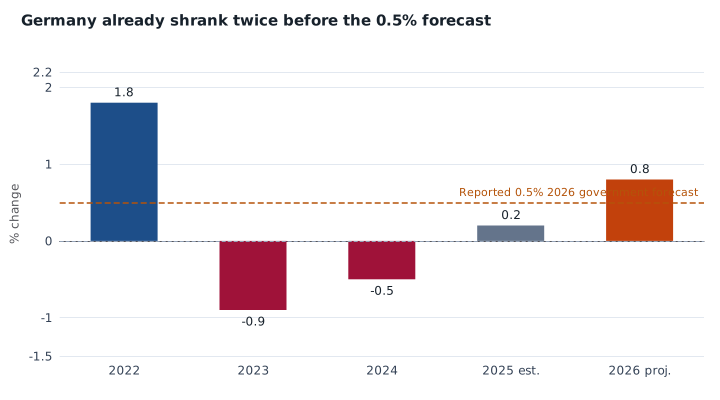
IMF WEO real GDP growth for Germany, percent change. 2025 is an IMF estimate; 2026 is a projection. The dashed line is the reported 0.5% German government forecast, not an IMF value. A 0.5% year would still be stronger than 2023–24. Source: IMF WEO. Retrospective research on 10 September 2026, using a snapshot ingested 10 August 2026 — later than the 22 August news.
Germany’s 0.5% forecast is a stalled recovery, not a new crash
Technology & Industry
Robots have now made the 100 metres embarrassing for humans. Deutsche Welle reports Chinese humanoid Lightning ran faster than Usain Bolt's world record at the World Humanoid Robot Games. A year ago, humanoid robots struggled to finish a race; now the struggle is updating the human highlight reels.
Governments are also redrawing the operating-system map. A ZDNet story circulating on community boards says China has ordered some government agencies off Windows 10 China Government Edition and onto domestic Linux distributions such as Kylin OS and UnionTech OS, sending shares in Chinese Linux makers upward, per the post. Windows Home China 11 remains available, but the writing is on the terminal.
AI's appetite for data is now eating the library. A 404 Media investigation circulated via Techmeme put a tracking device in a rare book and followed it to an Amazon warehouse in Las Vegas, where workers described cutting bindings off large shipments to scan books faster — destroying the physical books in the process. Amazon's statement: it buys books commercially “to help develop and improve the products and services our customers use.” Meanwhile, The Guardian reports Dutch regulators fined Uber $966m for automating driver suspensions. Presumably the appeal will also be handled by a bot.
Politics & Policy
US immigration policy now runs on a rule that would be funny if it weren't so disruptive: you may have to leave the country you're already in to apply for permission to stay. Dawn reports a federal judge in Manhattan called the State Department's suspension of immigrant visas for 75 countries “patently unlawful” and ruled that Secretary Marco Rubio overstepped his authority. The policy had blocked applicants from Pakistan, Bangladesh, Brazil, Colombia and many other nations. Separately, the administration reportedly plans to force foreigners already in the US to travel abroad and apply for green cards from there, per NPR coverage shared on community boards.
Washington is also fighting with everyone, including children's privacy regulators. France 24 reports TikTok and ByteDance will pay $400 million to settle US allegations that they violated children's privacy law by collecting data without parental consent. And the Times of India reports 29 states are pressing a lawsuit against Meta, alleging Facebook and Instagram were designed to exploit young users and that internal research on harm was concealed; the states want financial penalties and court-ordered redesigns.
Press lawyers, meanwhile, are getting their reps in: Disney-owned ABC sued the FCC, accusing the Trump administration of a “retaliatory campaign” against its speech, per Deadline coverage shared on social media. A tracker flagged by Guardian readers says nearly 400 US datasets have been deleted or altered, with health data among the hardest hit, per the community post. And Tulsi Gabbard resigned as director of national intelligence, PBS reported. It is a lot of churn, and not the kind that generates electricity.
Human Stories / Social Trends
Here is a good-news item with actual lungs attached: researchers report that London children's lung growth recovered after the Ultra Low Emission Zone reduced toxic air. Data from a five-year study showed children whose growth had been stunted caught up with peers outside the capital, leaving scientists “stunned,” as widely shared on community boards. Clean-air rules, it turns out, sometimes work exactly as advertised.
Workers are organising against the machinery too. Community threads report the formation of the largest tech worker union in the US, with a stated plan to challenge AI-driven layoffs, per the announcement posts. The timing is poetic: Meta laid off 10% of its workforce while Mark Zuckerberg warned that “success isn't a given” in the AI era. That memo probably writes itself now.
Finally, a study making the rounds on academic social media offers a parable for the AI age: adoption raises homework scores by 18% and cuts completion time by 30%, but monthly exam scores drop by 20% within six months, and high-stakes entrance-exam scores fall by 18–24% after about two years, per the posted findings. Translation: the model does the homework until exam day, at which point it is mysteriously unavailable.
Dates and sources
This digest covers the news day 2026-08-22. It is presented retrospectively from a saved draft; its date in the URL identifies the news day, not an assertion of publication on that day. News references link to their original outlets. Supporting research was completed 2026-09-10. Its data vintage and material limitations are recorded in the article methods and chart captions.