LunarWeave
Half Of America’s Budget Hole Is Now Interest. The Rest Never Closed.
When Dawn reported that US gross national debt had passed $40 trillion, the round number did the usual work of a headline. It sounded like a new event. It is better read as a stock that has been in view for years. The more useful question is what still pushes that stock higher: a government that spends more than it collects even before interest, or an interest bill that has taken over.
Those are different problems. A primary deficit means today’s programmes and tax take do not add up. An interest-dominated deficit means past borrowing has become the main flow. The IMF World Economic Outlook lets those pieces be separated for general government — the federal government plus state and local, on the Fund’s accounts — without treating the Treasury’s daily $40 trillion print as the same statistic.
A round number is not a ratio
Dawn, citing US Treasury data, said total public debt outstanding was $40.05 trillion at the close of business on a Tuesday in August 2026. That Treasury series is federal gross national debt, including money the government owes its own trust funds. It is not independently checked here.
The IMF’s general government gross debt is a different object. In the WEO snapshot retrieved on 10 August 2026, that stock was $38.12 trillion in 2025, or 123.9 percent of GDP. The Fund’s 2026 projection is $40.73 trillion, or 125.8 percent of GDP. The two $40 trillion figures sit near each other by coincidence of timing and scale, not because they measure the same liabilities.
The ratio, not the dollar stock, is what tells you whether debt is outrunning the economy. It peaked at 132.6 percent of GDP in 2020, when the pandemic blew a 14.1 percent-of-GDP hole in the overall budget balance. It then fell to 119.2 percent in 2022 as the deficit shrank and nominal GDP recovered. By 2025 it was climbing again, to 123.9 percent. The dollar total never paused: $23.43 trillion in 2019, $28.33 trillion in 2020, $38.12 trillion in 2025. From 2019 to 2025, general government debt rose 63 percent while current-dollar GDP rose 43 percent.
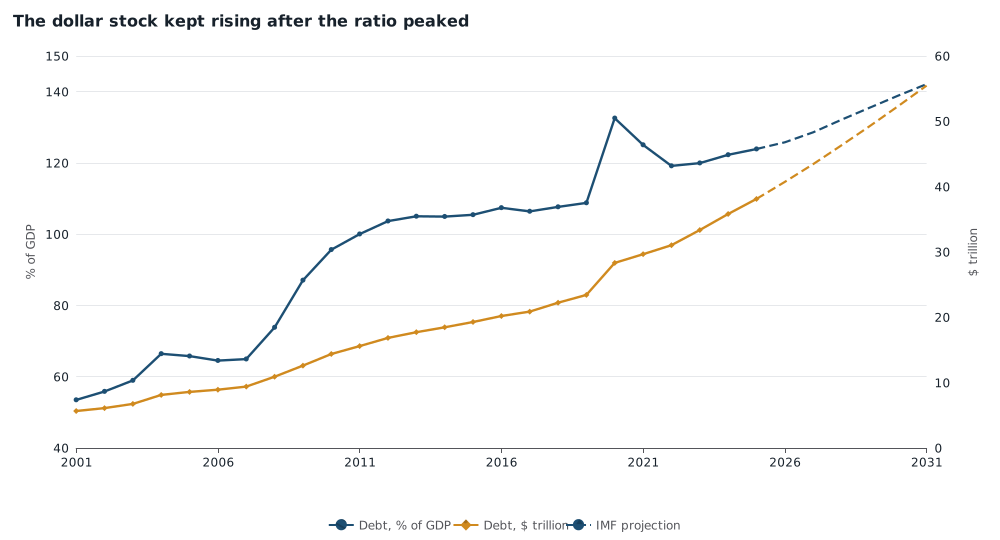
United States general government gross debt in trillions of dollars and as a percent of GDP, 2001–2031. Solid lines end in 2025; dashed lines are IMF projections. The ratio peaked in 2020; the dollar stock did not. Source: IMF World Economic Outlook, GGXWDG and GGXWDG_NGDP. This is not Treasury gross national debt.
Interest caught up. The primary deficit reopened.
The overall deficit is revenue minus spending, including interest. The primary balance strips interest out. Subtracting one from the other gives implied interest as a share of GDP. That identity follows the IMF definition of the primary balance; it is not a separate official interest table, and it is not the Treasury’s net-interest line.
In 2025 the overall general government deficit was 6.8 percent of GDP. Of that, 3.2 percentage points was a primary deficit and 3.7 percentage points was implied interest — just over half the hole (53.5 percent). In 2019 the split was a 3.5 percent primary deficit and 2.3 percent interest. The primary gap actually narrowed a little over those six years. Interest did the opposite, rising from a 2010–2019 average of 2.1 percent of GDP to 3.7 percent.
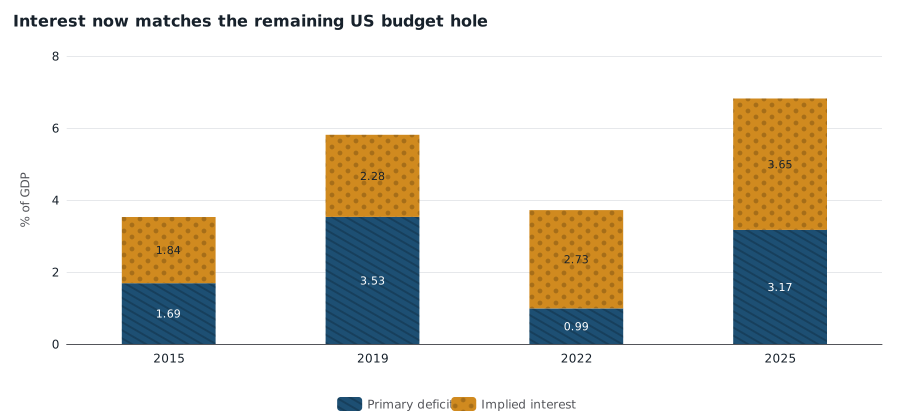
United States general government deficit split into the primary deficit and implied interest, percent of GDP. Implied interest is the primary balance minus the overall balance. Years 2015–2025 in the August 2026 IMF WEO snapshot. These are annual general-government figures, not daily Treasury debt.
The 2022 print looked, briefly, like a return to normal. The overall deficit shrank to 3.7 percent of GDP, and the primary deficit almost disappeared (1.0 percent). That squeeze did not last. The overall deficit was 7.9 percent of GDP in 2024 and 6.8 percent in 2025. What changed was not only interest. The primary deficit reopened to 3.2 percent of GDP — almost back to its 2019 width — while interest stayed high.
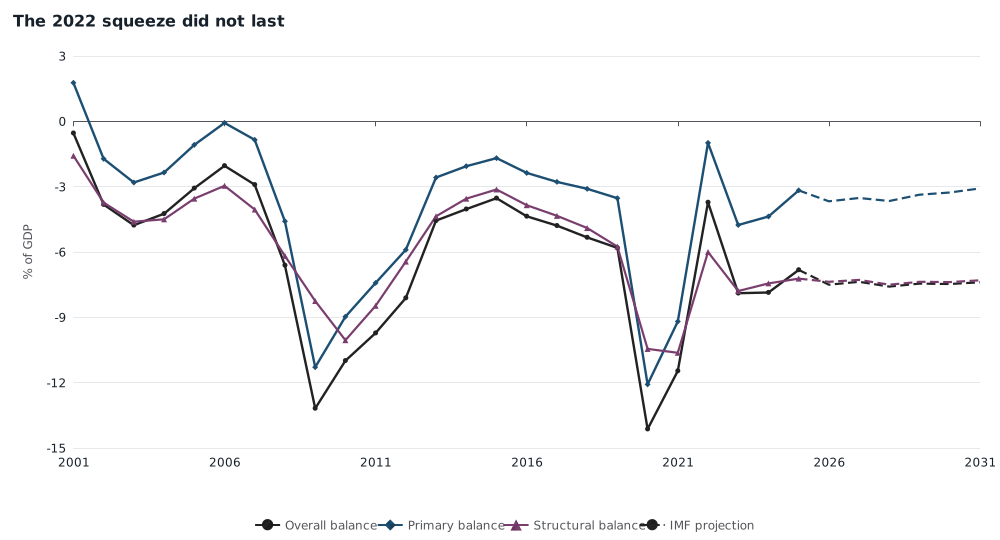
Overall and primary balances are percent of GDP; the structural balance is percent of potential GDP. Solid lines are 2001–2025; dashed lines are IMF projections for 2026–2031. In this snapshot the local English names for the primary (GGXONLB_NGDP) and structural (GGSB_NPGDP) series are swapped; the IMF codes are used.
That reopened gap is not a leftover from a weak economy. The IMF structural balance, which tries to remove the economic cycle, was −7.2 percent of potential GDP in 2025 — if anything a little worse than the headline deficit. Revenue was 30.9 percent of GDP, against 30.0 percent in 2019. Expenditure was 37.7 percent, against 35.8 percent. The United States did not lose a huge slice of tax take. It is still spending more, and it is paying more to roll over what it already owes.
| Year | Overall deficit, % of GDP | Primary deficit, % of GDP | Implied interest, % of GDP | Structural balance, % of potential GDP | Debt, % of GDP | Debt, $ trillion | GDP, $ trillion |
|---|---|---|---|---|---|---|---|
| 2019 | 5.8 | 3.5 | 2.3 | −5.7 | 108.8 | 23.43 | 21.54 |
| 2020 | 14.1 | 12.1 | 2.0 | −10.5 | 132.6 | 28.33 | 21.38 |
| 2022 | 3.7 | 1.0 | 2.7 | −6.0 | 119.2 | 31.04 | 26.05 |
| 2025 | 6.8 | 3.2 | 3.7 | −7.2 | 123.9 | 38.12 | 30.77 |
| 2026* | 7.5 | 3.7 | 3.8 | −7.4 | 125.8 | 40.73 | 32.38 |
*2026 figures are IMF projections in this snapshot, not realised outcomes. Deficits are the negative of net lending/borrowing.
The Fund’s own 2026–2031 path does not show a closing. It holds the overall deficit near 7.4–7.6 percent of GDP, with implied interest still around 3.8–4.3 percent and the primary deficit still above 3 percent.
What the $40 trillion does not decide
None of this verifies Dawn’s accompanying claims about invalidated tariffs, a Congressional Budget Office $39.4 trillion forecast, long-term Treasury yields, or the cost of a Middle East war. Those remain reported, not measured here.
It also does not say the Treasury figure is wrong. Federal gross national debt and IMF general government debt can both be large while remaining different books. State and local governments sit inside the IMF total; intragovernmental federal holdings sit inside the Treasury total. Crossing $40 trillion is a stock event. The flow that still matters is a 3 percent-of-GDP primary deficit that looks structural, with an interest bill that is now as large as that remaining gap.
If interest were the whole story, a primary balance near zero would show it. It does not. If the 2022 squeeze had been a new fiscal regime, 2024 and 2025 would not have gone back to deficits of 7 to 8 percent of GDP. They did. The round number arrived on top of that arithmetic, not instead of it.
Sources and methods
This is retrospective research completed on 10 September 2026, using a pinned IMF World Economic Outlook snapshot (SDMX dataflow WEO 9.0.0, retrieved 10 August 2026). The news item is from 21 August 2026. Later WEO vintages can revise history; these figures were not what a reader would necessarily have had on the Tuesday the Treasury print crossed $40 trillion.
Annual series: GGXCNL_NGDP (overall balance, percent of GDP), GGXONLB_NGDP (primary balance, percent of GDP), GGSB_NPGDP (structural balance, percent of potential GDP), GGXWDG_NGDP and GGXWDG (gross debt), GGR_NGDP and GGX_NGDP (revenue and expenditure), and NGDPD (current-dollar GDP). Geography is the United States. Years 2026–2031 are treated as IMF projections. 2025 had already ended by the retrieval date but can still be an estimate in the WEO. Charts were rendered to SVG; they have not been through a separate browser or mobile layout check.
Research Date
The displayed date matches the related news edition. Research was completed 2026-09-10.
Related news: Daily · 2026-08-21
More Research
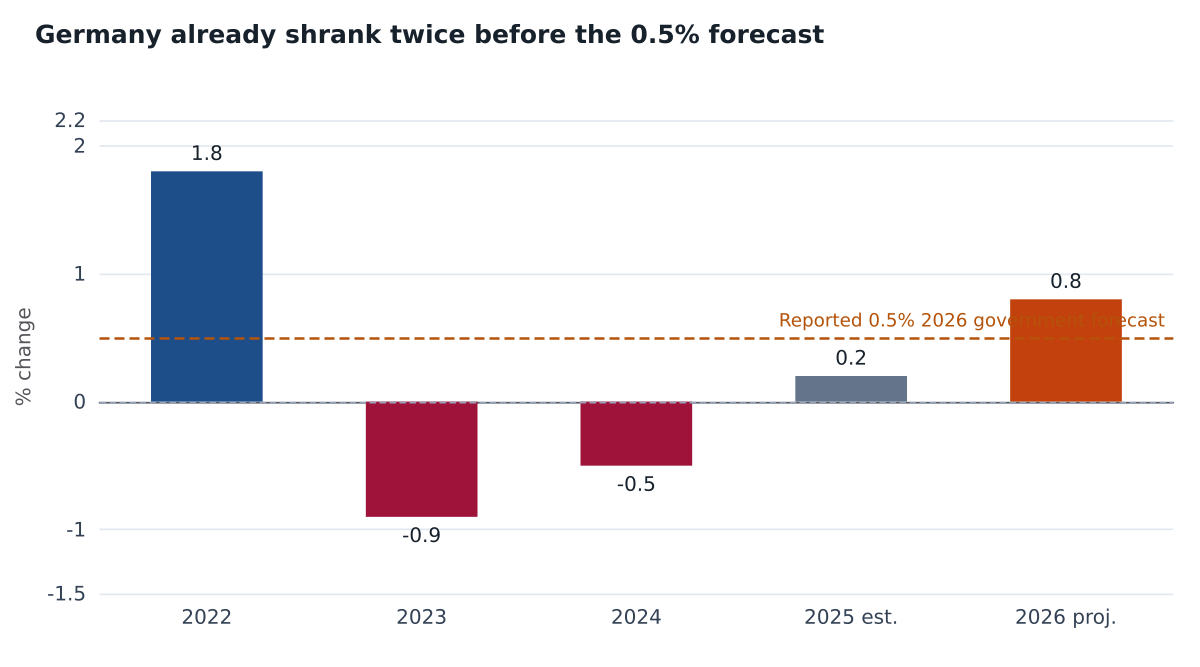
Germany’s 0.5% Forecast Is A Stalled Recovery, Not A New Crash
Germany’s reported 0.5% 2026 growth forecast follows two IMF contraction years, not a new crash.
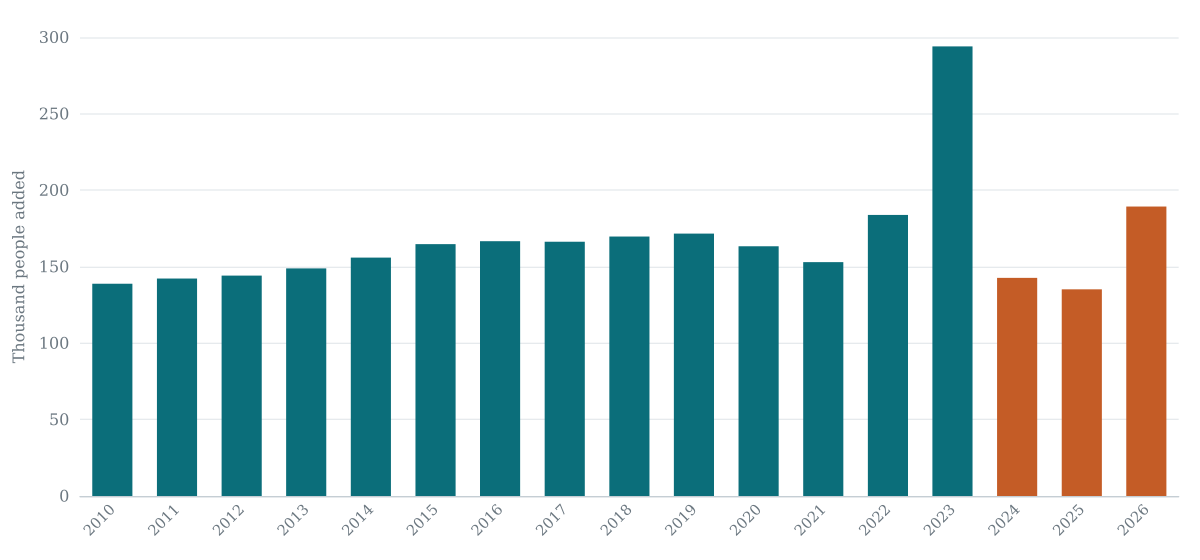
Israel Is Still Growing. The War’s Scar Is In The Economy.
IMF population data show Israel still adding people in 2024. The war years show up in stalled output and an 8 percent-of-GDP deficit, not in a shrinking country.
The United States Is Paying Italy’s Interest Bill — Without Italy’s Surplus
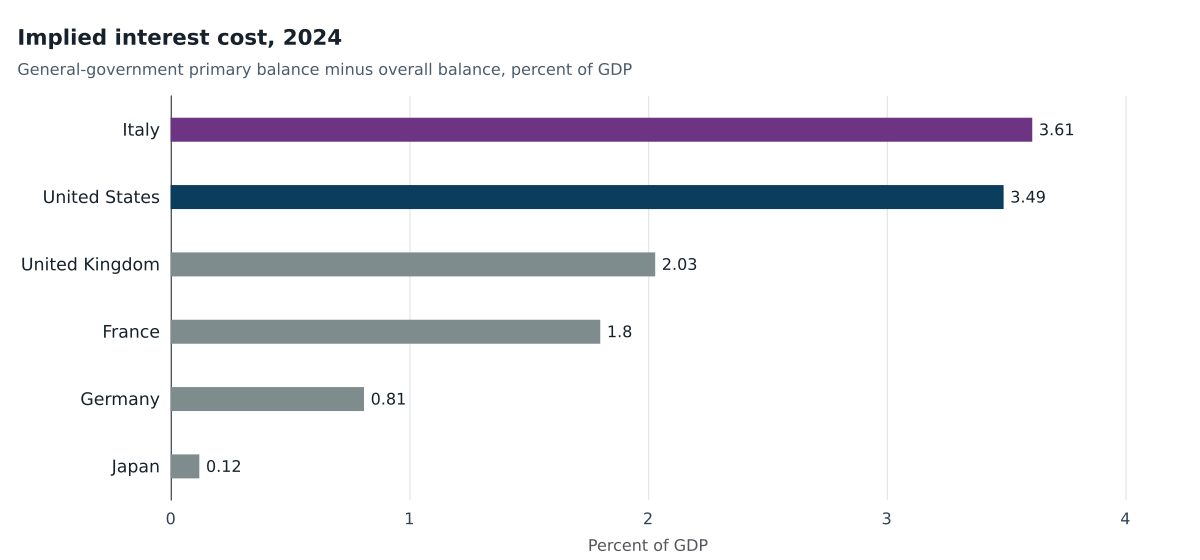
IMF 2024 accounts show a 3.5 percent of GDP US interest residual, matching Italy rather than Japan, on top of a still-wide primary deficit.