LunarWeave
Israel Is Still Growing. The War’s Scar Is In The Economy.
In August 2026, Al Jazeera reported that nearly 270,000 Israelis had left over three years, citing political uncertainty and security concerns. Experts quoted in that coverage called the outflow a “tsunami” reshaping the country’s future.
If Israel were emptying out, the International Monetary Fund’s population path would turn down. It has not. The Fund’s population series still has Israel adding people every year, including in 2024, the first full calendar year after the October 2023 attacks and the war in Gaza. What did break is the economy: real output slowed to a crawl, and the budget swung from a small surplus into an 8 percent-of-GDP deficit. The war is visible in production and public finances. It is not visible as a shrinking country.
A stock that is still rising
The IMF records Israel’s population as 9.85 million in 2023 and 9.99 million in 2024. That is a gain of 142,675 people, or 1.45 percent. Every annual increment in the series from 2001 through 2024 is positive. So are the Fund’s 2025 estimate and 2026–2031 projections.
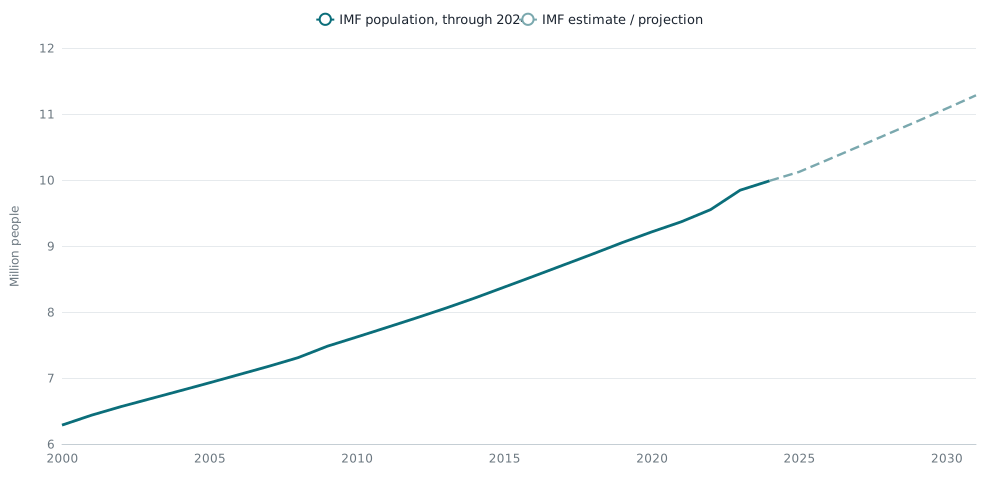
IMF World Economic Outlook population for Israel, millions of people. Solid line: 2000–2024. Dashed line: 2025 estimate and 2026–2031 projections from the April 2026 WEO vintage. Population is a resident stock, not an emigration count. Choose Israel in the chart selector. Source: IMF WEO indicator LP.
That 1.45 percent increase is a little slower than the 2011–2019 average of 1.93 percent a year, when Israel typically added about 159,000 people. It is not a reversal. The IMF still puts the country at 10.31 million in 2026 and 11.28 million in 2031.
The 2023 increment is the awkward observation in the series: population jumped by 294,083 people, or 3.1 percent, the largest annual gain since 2000. Most of 2023 came before October. That spike should not be read as a war-year migration total, and it may include a statistical revision. Even if 2023 is set aside, 2024 still adds people.
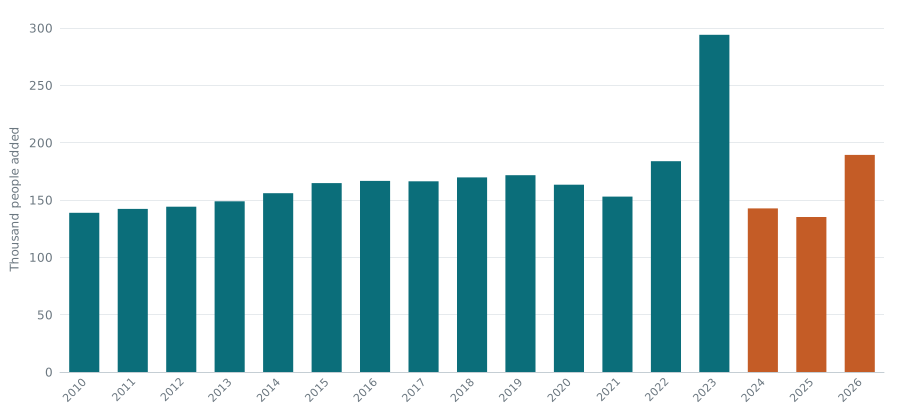
Annual change in Israel’s IMF population, thousands of people. Teal: 2010–2023. Amber: 2024 and the 2025–2026 estimate/projection. Source: IMF WEO indicator LP.
None of this verifies or refutes the reported 270,000 departures. Population is a stock. It moves with births, deaths, immigration and returning residents as well as people who leave. A gross outflow of 270,000 over three years would be 2.7 percent of the 2023 population — large enough to matter, and still compatible with a rising headcount if natural increase and inflows are larger. The IMF series cannot identify who left.
Faster than the United States. Not the fastest.
Among ten large rich economies, Israel’s 2023–2024 population increase ranked third. Canada grew 3.0 percent and Australia 1.6 percent, both riding well-documented immigration. Israel’s 1.45 percent still outpaced the United Kingdom (1.10 percent), the United States (0.90 percent), France (0.34 percent) and Germany (0.28 percent). Italy and Japan already shrank.
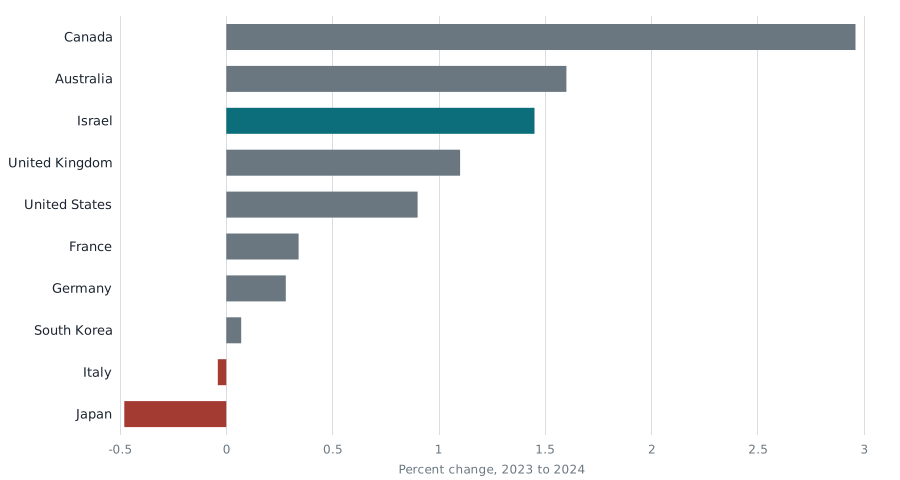
Percent change in IMF WEO population, 2023 to 2024. Israel is highlighted. These are resident-population changes, not net-migration rates. Choose each country in the population series. Source: IMF WEO indicator LP.
| Economy | 2023–2024 population change | Percent |
|---|---|---|
| Canada | +1,181,462 | 2.96% |
| Australia | +431,346 | 1.60% |
| Israel | +142,675 | 1.45% |
| United Kingdom | +755,000 | 1.10% |
| United States | +3,027,666 | 0.90% |
| France | +233,534 | 0.34% |
| Germany | +230,000 | 0.28% |
| South Korea | +38,446 | 0.07% |
| Italy | −25,971 | −0.04% |
| Japan | −591,939 | −0.48% |
The IMF’s 2023–2026 path, which mixes 2025 estimates with 2026 projections, has Israel accumulating a 4.7 percent gain over those three years — more than Canada or Australia in this vintage. That ranking depends on the Fund’s outlook, not on a completed count. The harder historical fact is the 2024 print: Israel was still growing, and growing faster than most of its rich-country peers.
The war shows up in output and the budget
Real GDP growth tells a different story. After 6.4 percent in 2022, growth slowed to 2.1 percent in 2023 and 0.95 percent in 2024. That is the weakest year since the 2020 pandemic contraction, and among the weakest in the 2000–2024 series. The Fund then estimates 2.9 percent in 2025 and projects 3.5 percent in 2026 — a rebound on paper, not a measured recovery.
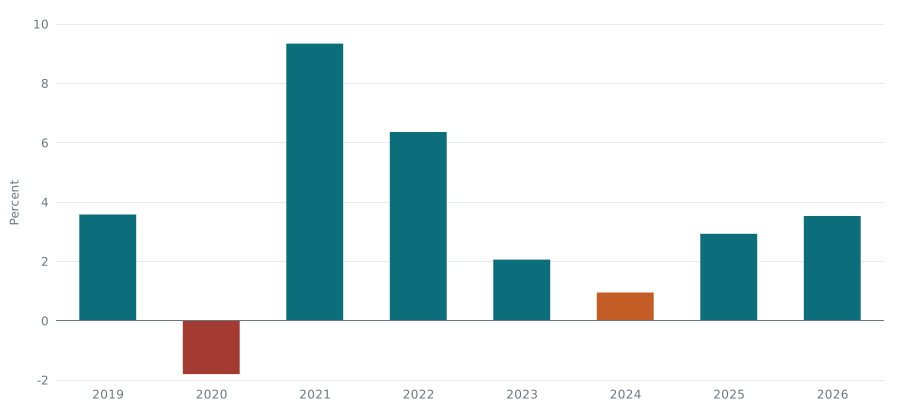
IMF WEO real GDP growth for Israel, percent change in constant-price GDP. 2025 is an estimate and 2026 a projection. Choose Israel in the growth series. Source: IMF WEO indicator NGDP_RPCH.
Public finances moved with the war. General government net lending was a 0.3 percent-of-GDP surplus in 2022, then a 5.4 percent deficit in 2023 and an 8.1 percent deficit in 2024. Only 2020 (−10.6 percent) and 2002 (−8.2 percent) were deeper in this dataset. That is a fiscal scar, not a demographic collapse.
The labor-market print cuts against a simple “everyone left” reading. The IMF unemployment rate fell to 3.0 percent in 2024, the lowest year in the 2000–2024 series. A tight labor market can coexist with emigration of particular groups. It does not look like a country that has lost its workforce.
What the numbers cannot settle
Al Jazeera’s 270,000 figure is reported, not independently counted here. Official population cannot confirm a gross emigration total, and it cannot show whether those who left were dual citizens, high-earning professionals, or families with children. Composition is the part of the “reshaping” claim that this evidence cannot touch.
The IMF series is also a model-consistent annual path, not Israel’s Central Bureau of Statistics monthly file. Observation dates in this extract are stored as 1 January of each year; that is an annual label, not a January 1 census. Years from 2025 onward in this vintage are estimates or projections. Later WEO rounds can revise 2024.
The practical conclusion is narrower, and more useful, than a slogan about national destiny. If the question is whether Israel has started shrinking, the IMF’s answer through 2024 is no. If the question is whether the war years were economically cheap, the answer is also no. Output stalled and the budget opened a hole. Headcount did not.
Sources and methods
This article is retrospective. It was researched on 10 September 2026, after the 20 August 2026 news report, using the pinned IMF World Economic Outlook snapshot (SDMX WEO 9.0.0, retrieved 10 August 2026; normalized run of 24 August 2026). Figures for 2025 are treated as estimates and 2026–2031 as projections; the extract does not flag years individually. Portal pages above are the same IMF measures; readers must select Israel. They are not a substitute for the IMF WEO source.
Research Date
The displayed date matches the related news edition. Research was completed 2026-09-10.
Related news: Daily · 2026-08-20
More Research
Half Of America’s Budget Hole Is Now Interest. The Rest Never Closed.
IMF books show the 2025 US general-government deficit split almost evenly between a still-open primary gap and a larger interest bill — a different story from the $40 trillion headline.
The $40 Trillion Debt Milestone Is A Bigger Dollar Economy, Not A Second 2020
The Treasury $40 trillion print is a dollar stock. IMF general-government accounts show the US debt ratio still below its 2020 peak, with interest now about half of a deficit that remains a
Germany’s 0.5% Forecast Is A Stalled Recovery, Not A New Crash
Germany’s reported 0.5% 2026 growth forecast follows two IMF contraction years, not a new crash.