LunarWeave
France Still Gets Most Of Its Electricity From Nuclear. The Plants Are Producing Less Of It.
When western European rivers ran unusually warm in June and early July 2026, French nuclear plants had to ease off. That is how many of the country’s reactors dump waste heat: they take water in, and they are not allowed to send it back too hot. The Guardian described a familiar summer constraint — high temperatures, thin rainfall, and a grid that still leans on those riverside units.
The operational reports will take time. What can be measured now is the system those limits hit. In the latest full year of IRENA electricity statistics, 2023, nuclear plants generated 338.2 terawatt-hours in France — 64.4 percent of the country’s electricity. That is not a niche technology bumping against environmental rules. It is most of the power supply.
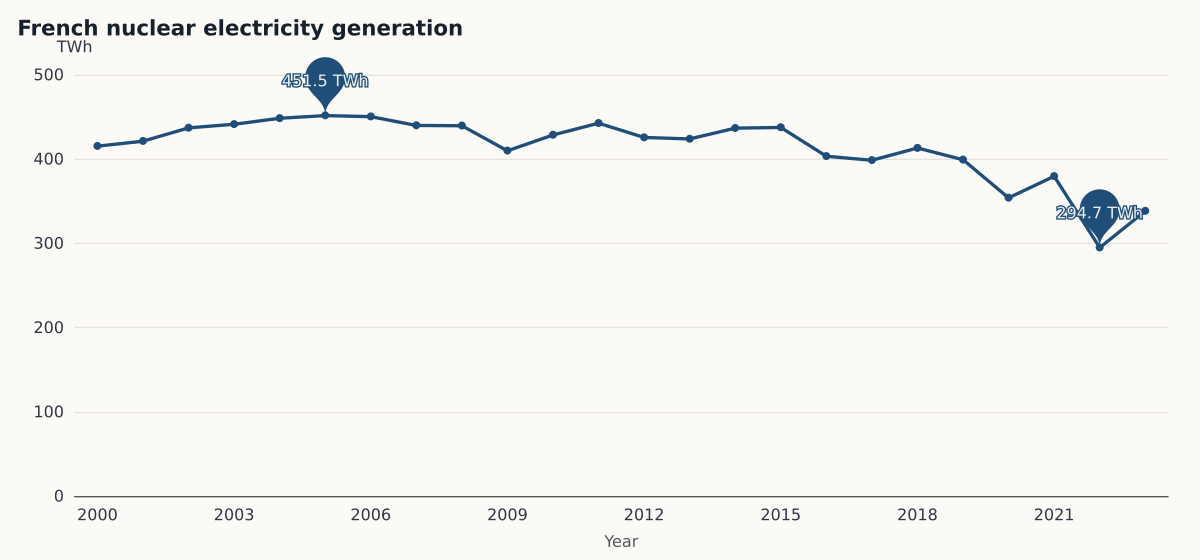
It is also a much thinner buffer than the fleet’s reputation suggests. French nuclear output in 2023 was 25.1 percent below its 2005 peak. Installed capacity barely moved. The hardware is still there. The terawatt-hours are not.
Two-thirds of a large grid
Nuclear’s 64.4 percent share of French generation in 2023 compares with 9.2 percent of electricity worldwide the same year. Among the systems compared here, only much smaller grids such as Finland (42.1 percent) and Belgium (39.4 percent) come close. South Korea, at 29.6 percent, is the next large producer with a high nuclear share. The United States generated far more nuclear electricity in absolute terms — 808.1 TWh against France’s 338.2 — but that was only 18.1 percent of a much bigger mix. Germany, which had produced 169.6 TWh from nuclear in 2000, was down to 7.2 TWh and a 1.4 percent share in 2023.
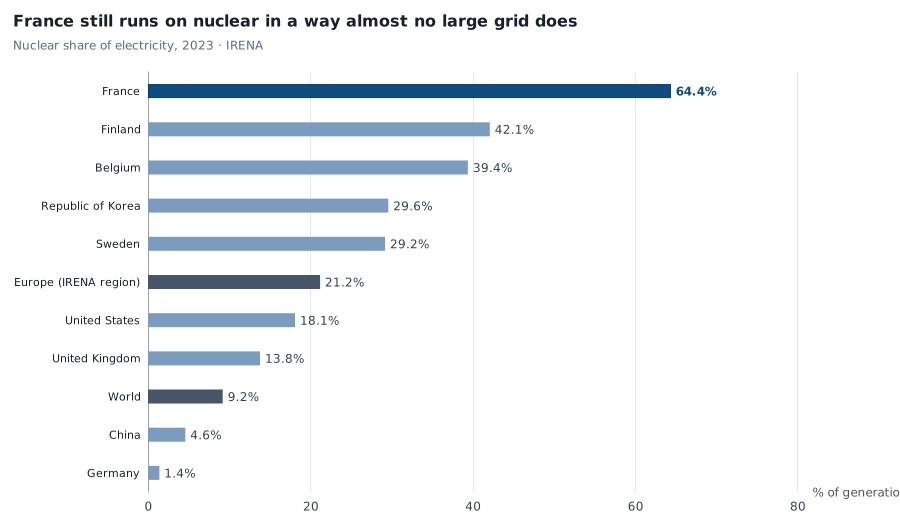
Nuclear electricity as a percent of total generation (IRENA renewable plus non-renewable) in 2023. Country series use all-grid generation; Europe and World use IRENA region totals. Finland and Belgium have high shares on much smaller systems. Source: IRENA Renewable Energy Statistics.
France is not just nuclear-heavy at home. In 2023 it produced 45.2 percent of all nuclear electricity in IRENA’s Europe region (338.2 of 748.3 TWh). That region is not the European Union, but the concentration still matters: when French reactors throttle, a large slice of Europe’s remaining nuclear supply throttles with them. European nuclear generation itself has been shrinking. It was 33.3 percent below its 2004 level by 2023.
Not every French reactor sits on a river. Several large plants use seawater. IRENA does not split capacity by cooling type, so these figures cannot say what share of the 61.4 gigawatts still installed in 2025 is exposed to the Loire, the Rhône or the Garonne. They can say what happens to a country — and to Europe’s nuclear totals — if a material part of that fleet has to back down.
The missing terawatt-hours are mostly unused capacity
French on-grid nuclear capacity peaked at 63.4 GW in 2003 and 2004. From 2020 through 2025 it has been reported at 61.4 GW every year, about 3 percent below that peak. Generation did not follow capacity.
| Year | Nuclear (TWh) | Nuclear share | Renewables share | Implied utilization | Total generation (TWh) |
|---|---|---|---|---|---|
| 2005 | 451.5 | 78.4% | 9.5% | 81.5% | 576.1 |
| 2019 | 399.0 | 69.9% | 19.8% | 72.2% | 570.8 |
| 2022 | 294.7 | 62.1% | 24.0% | 54.8% | 474.8 |
| 2023 | 338.2 | 64.4% | 26.6% | 62.9% | 525.0 |
Implied utilization is annual nuclear generation divided by year-end capacity times 8,760 hours. It is not an official capacity factor, and it cannot isolate heat-related derating from maintenance, inspections or demand. It is still the right shape of fact: the fleet of the mid-2000s ran much harder than the fleet of the 2020s.
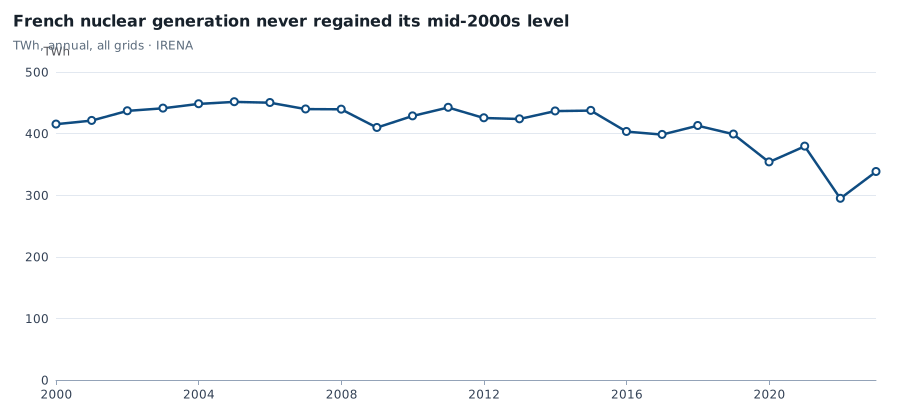
Nuclear electricity generation in France, terawatt-hours, 2000–2023. Annual totals for all grids. IRENA reports generation through 2023 only; these figures do not measure summer 2026 river-temperature derating. The 2022 drop coincided with widespread outages as well as a hot, dry year. Source: IRENA Renewable Energy Statistics.
The 2022 collapse is the extreme. Output fell 22.3 percent in a single year, to 294.7 TWh, the lowest in this 2000–2023 series. That drop is widely associated with corrosion inspections and other outages, not with river temperature alone, and these annual totals cannot assign the cause. What they do show is the compounding: renewable hydropower, which also needs water, fell 23.6 percent in 2022, to 45.5 TWh from 59.6 TWh in 2021. Total French generation shrank to 474.8 TWh from 555.2. Natural-gas plants filled part of the hole, rising to 45.7 TWh from 33.3. In 2023 nuclear recovered 14.7 percent, hydropower bounced to 56.7 TWh, and gas fell back to 29.8. The system can scramble. It is not indifferent to a bad nuclear year.
Renewables rose. They did not take nuclear’s place.
French renewable generation more than doubled from 55.0 TWh in 2005 to 139.7 TWh in 2023, lifting its share from 9.5 percent to 26.6 percent. Onshore wind plus solar photovoltaic supplied 72.6 TWh in 2023 — real growth, and still about a fifth of nuclear’s contribution. Other non-renewable generation (the non-nuclear remainder, mostly fossil fuels) was 9.0 percent of electricity in 2023. The mix shifted. It did not stop being a nuclear mix.
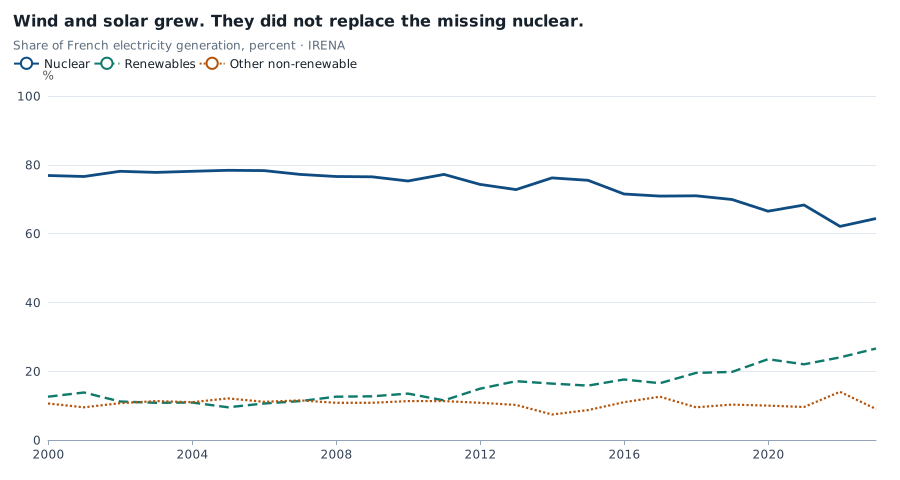
Share of French electricity generation, 2000–2023: nuclear; total renewables; other non-renewable (non-renewable minus nuclear). The three series sum to 100 percent of IRENA’s renewable plus non-renewable total. Source: IRENA Renewable Energy Statistics.
That is the stake in a heatwave. A river-temperature limit on French reactors is a limit on the source that still supplies about two-thirds of national electricity, on a fleet whose output is already a quarter below its mid-2000s peak, and on a country that accounts for approaching half of Europe’s remaining nuclear generation. Annual IRENA figures stop in 2023, so they cannot count the megawatts taken offline in July 2026. They can show why those megawatts are not a rounding error.
Sources and methods
This is retrospective research written on 10 September 2026. The news motive is the July 2026 river-temperature limits reported by the Guardian. The electricity figures are IRENA Renewable Energy Statistics, retrieved from a snapshot compiled 24 August 2026 (generation through 2023; French nuclear capacity through 2025). Later releases are not treated as if they had been available on 13 July 2026.
Electricity totals are IRENA “total renewable” plus “total non-renewable” generation, all grids for countries. Nuclear is inside the non-renewable total. Named fuels (gas, coal and peat, oil; hydro, solar PV, onshore wind) do not exhaust those totals; residuals remain. An empty French offshore-wind extract is treated as missing, not zero. IRENA’s Europe region is not the EU. Implied utilization uses 8,760 hours and year-end capacity; leap years and within-year capacity changes are ignored. The series do not identify which reactors are river-cooled, and they cannot attribute 2022’s nuclear drop to heat.
Research Date
The displayed date matches the related news edition. Research was completed 2026-09-10.
Related news: Daily · 2026-07-13
More Research
The Data-Center Boom Is Not A Jobs Boom
New York paused large data centers over power and community strain. National hosting still employs about 464,000 people, below its 2023 peak.
Heat Can Take France’s Reactors Offline. Nuclear Is Still Most Of The Power System.
IRENA data through 2023 show nuclear still supplying 64% of French electricity, even though output is a quarter below its mid-2000s peak — so heat-driven reactor cuts hit the core of the gri
China Is Still Built For 10% Growth. It Is No Longer Delivering It.
IMF annual accounts show China’s 4.3% quarter arriving after a decade-long growth downshift, with investment still near 39% of GDP and a widening current-account surplus.