 LunarWeave
One Strait, Two Self-Appointed Guardians, And A Heatwave Bill That Just Arrived
World & Security
The US-Iran truce is gasping, and the world's most important toll road is at the centre. Dawn reports oil prices jumped more than 4 percent after new strikes, with ship-tracking showing only six vessels transited the Strait of Hormuz on Sunday—the lowest in five weeks. Iran's Revolutionary Guards claimed attacks on American facilities in Bahrain, Kuwait, Jordan and Oman; Washington said it hit dozens of targets. President Trump answered by reinstating a blockade and, per Euronews, announcing a 20 percent fee on Hormuz cargo—the United States as self-appointed toll collector on the sea lane it says Iran doesn't control. Adding novelty to the horror, the New York Times reports US forces used naval drones in combat for the first time.
Yemen's long-dormant front also stirred. The internationally recognised government said it bombed the Houthi-controlled Sanaa airport to keep an Iranian plane out, and analysts warn the 2022 ceasefire framework may not survive the exchange. In London, the UK moved to ban support for Iran's Revolutionary Guards after a spate of antisemitic attacks, using new powers aimed at state proxies. In Paris, more than 25 allies met Volodymyr Zelensky, where Ukraine ordered 16 Rafale jets and joined nine European nations in launching a shared anti-ballistic missile programme.
Elsewhere: Sudan's RSF chief was sentenced to death in absentia over war crimes, and drone strikes on the Moscow region killed three people, with the regional governor saying air defences downed 81 of them. Diplomacy has a lot of catching up to do.
Markets & Economy
Monday's oil shock did what oil shocks do: it hit markets. The Guardian put Brent up 4.7 percent at $79.59, while South Korea's Kospi fell about 7 percent, dragged down by SK Hynix and Samsung as the year's best-performing major index remembered that geopolitics can ambush any rally. Chip stocks suffered, but the selloff looked more like a flinch than a rout.
India is treating the chaos as leverage. According to a detailed report on the stalled talks, New Delhi rejected a quick interim trade deal with Washington, betting on stronger exports, new pacts with the UK and EU, and legal challenges to US tariff policy to improve its terms—while accepting that steeper American levies may still land this month. The confidence has a number behind it: India's June retail inflation rose to 4.38 percent, above the central bank's 4 percent target but hardly a reason to panic.
Europe's industrial mood is gloomier. Volkswagen confirmed plans for 50,000 more job cuts on top of the 50,000 already agreed—a leaked internal memo, cited by the Times of India, warned the total could reach 100,000—even as its supervisory board rejected outright plant closures. Nearby, Deutsche Welle reports cities in Germany's Ruhr Valley are sliding toward financial collapse as tax revenues fall and social spending climbs. Somewhere, a management consultant is describing this as an opportunity.
Technology & Industry
Artificial intelligence news swung between breakthrough and bar fight. Chinese researchers unveiled an all-optical interconnect system that speeds up distributed AI inference more than 100-fold while using a fraction of the usual compute—the kind of efficiency that keeps export-control officials reaching for the aspirin. Apple countered with a lawsuit accusing OpenAI of stealing trade secrets for its AI hardware push and seeking an injunction.
Brussels is focusing on the product side of the attention economy. Ursula von der Leyen promised EU-wide age-appropriate restrictions after an expert panel recommended under-13s use platforms only under supervision, and the European Commission preliminarily found Meta's Instagram and Facebook 'addictive' designs breach the bloc's digital rules. Meta disputes the finding; apparently infinite scroll is now a matter of principle.
Battlefields and sidewalks are filling with machines. Ground robots in Ukraine have graduated from supply mules to evacuating the wounded, holding trenches and killing, according to the New York Times. Privacy anxieties run in both directions: the LAPD let its contract with license-plate reader firm Flock expire, citing civil-liberties concerns, while China's Xi Jinping will attend the country's World AI Conference for the first time as Beijing pushes AI to the centre of state strategy.
Politics & Policy
It was a lively day for heads of state and would-be heads of state. Andy Burnham effectively secured the Labour leadership and with it the British prime ministership, then backed a controversial asylum bill against a 14-member Labour rebellion. Hungary's parliament passed a constitutional amendment clearing the way to remove President Tamás Sulyok, an Orbán ally, as part of the post-Orbán reset. Seoul's courts added their own chapter: a two-year sentence for former president Yoon Suk-yeol over free opinion polling services he accepted from a political broker.
Germany offered two transparency dramas at once: the government wants to amend its Freedom of Information Act in ways critics say gut public disclosure, while a reported German proposal would criminalise public denial of Israel's right to exist. Across the Atlantic, a federal judge ruled that Trump's IRS lawsuit sought to 'manipulate the judicial process' and ordered sanctions on the lawyers behind it. The administration, meanwhile, launched a campaign to diplomatically isolate the International Criminal Court, Mexico said it would file criminal complaints over migrants killed in US enforcement operations, and Trump scheduled a prime-time address to the nation for Thursday. No topic announced—which, given the week, is its own kind of promise.
Human Stories / Social Trends
The bill for Europe's summer is arriving, and it is not itemised gently. More than 2,700 deaths in the UK were linked to the May and June heatwaves, and data cited across European reporting puts excess deaths from the late-June heatwave above 10,000, the vast majority among people over 65. Even French nuclear plants have had to reduce output because the rivers used for cooling are too warm. Summer, it turns out, now comes with a body count and a grid warning.
The human texture is harrowing. A Welsh artist is embroidering the names of 300 babies killed in Gaza onto a christening gown, an act of witness she hopes will reach New York. In India, Rajasthan's public hospitals are under scrutiny after nine maternal deaths in six days, part of 18 since May. And in Bangkok, a pub fire killed 27 people, with victims reportedly trapped in bathrooms as smoke filled the venue.
There are quieter accounts worth hearing, too. Indigenous witnesses told an Australian inquiry they felt dismissed and ignored by police after an alleged bomb was thrown into the crowd at the January 26 Invasion Day rally in Perth. Separately, Australia's eSafety regulator reports that young men file more 'sextortion' complaints than any other age group, a reminder that the online safety conversation keeps leaving out the people it claims to protect.
Research In Context
Unusually warm French rivers forced nuclear plants to cut output in early July. That constraint lands on a system that still ran on nuclear for 64.4 percent of its electricity in 2023 — seven times the world average of 9.2 percent — and produced 45.2 percent of nuclear generation in IRENA’s Europe region. The fleet’s capacity has barely shrunk; its output has. French nuclear generation in 2023 was 25.1 percent below the 2005 peak, after a 22.3 percent drop in 2022. Wind and solar have grown, but they have not replaced those missing terawatt-hours. Annual statistics stop in 2023, so they cannot count the 2026 derating, and they cannot split river-cooled reactors from coastal ones. They do show why a summer limit on French nuclear is not a rounding error.
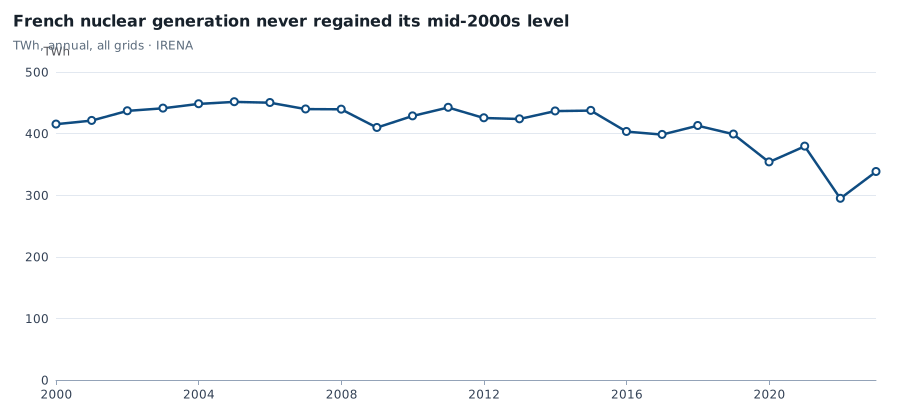
Nuclear electricity generation in France, TWh, 2000–2023 (all grids). IRENA generation ends in 2023 and does not measure July 2026 river-temperature cuts. The 2022 low coincided with widespread outages, not heat alone. Source: IRENA Renewable Energy Statistics.
Dates and sources
This digest covers the news day 2026-07-13. It is presented retrospectively from a saved draft; its date in the URL identifies the news day, not an assertion of publication on that day. News references link to their original outlets. Supporting research was completed 2026-09-10. Its data vintage and material limitations are recorded in the article methods and chart captions.