LunarWeave
Heat Can Take France’s Reactors Offline. Nuclear Is Still Most Of The Power System.
On 12 July 2026, France’s main energy provider temporarily shut three nuclear reactors and cut output at eight more. The reason was not a shortage of uranium or a grid fault. It was the weather. Rivers used to cool the plants were already warm, and environmental rules stop operators from dumping still-hotter water back into them.
In most large economies that would be a nuisance. In France it is the power system. IRENA data through 2023 — the latest generation year in the snapshot used here — show nuclear still supplying about two-thirds of French electricity, even after a brutal slump in output that capacity figures cannot explain. The same country generated nearly half of Europe’s nuclear electricity. When French rivers run hot, a very large share of a very large fleet is at stake.
Two-thirds of French electricity, not a sideline
In 2023 France generated 338.2 TWh of nuclear electricity, 64.4% of a 525.0 TWh total (renewable plus non-renewable generation, as IRENA reports them). The world figure for the same year was 9.2%. The United States, which produced more nuclear electricity than anyone else, still got only 18.1% of its power from the atom. South Korea, which issued its first emergency heatwave alert the same weekend, got 29.6%.
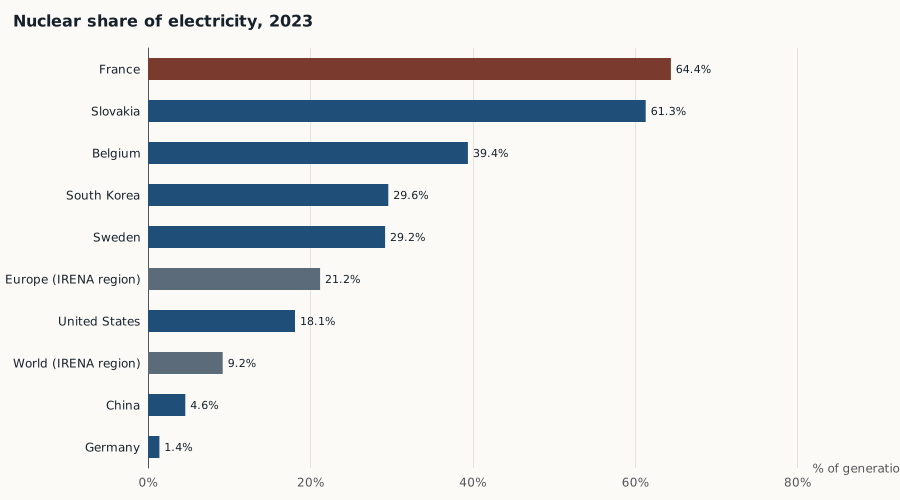
Nuclear electricity as a percentage of total generation (renewable plus non-renewable) in 2023. Country figures use IRENA country series; Europe and World use IRENA regional aggregates and may not match a sum of countries. France 64.4%; South Korea 29.6%; world 9.2%. Source: IRENA Renewable Energy Statistics.
Slovakia’s 61.3% nuclear share is the only close peer in that comparison, and it is not a peer in scale: 18.3 TWh of nuclear power on a 29.9 TWh grid, versus France’s 338.2 TWh. Belgium, at 39.4%, is the next large-enough European system. Germany, after years of closures, was down to 1.4% — 7.2 TWh.
That ranking is the point. A heat-driven derate in South Korea lands on a nuclear fleet that is important but not dominant. The same physics in France lands on the source that still produces most of the country’s electricity.
The plants are still there. The megawatt-hours are not.
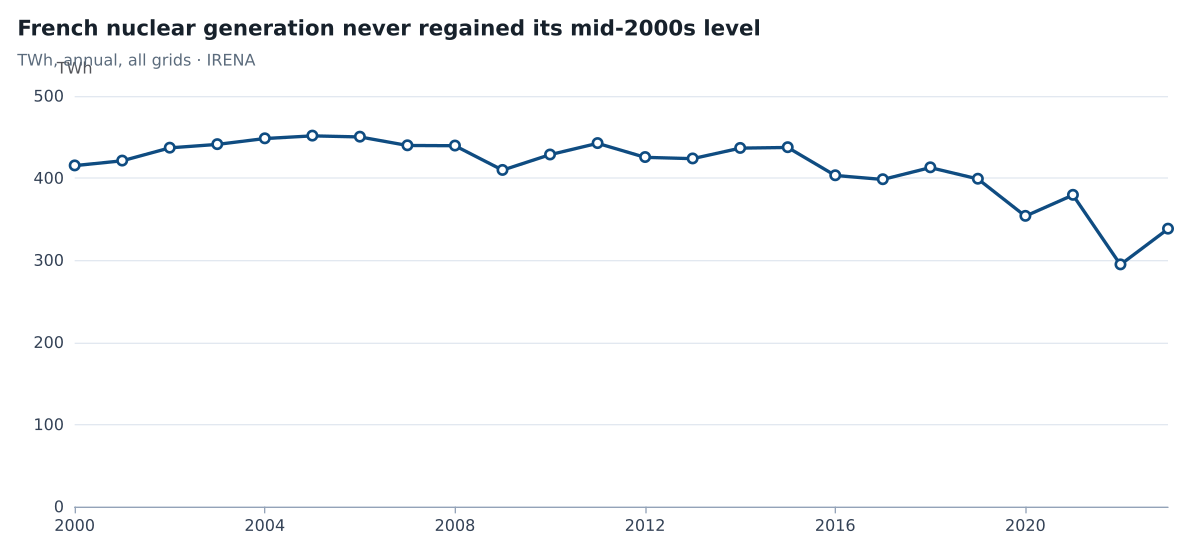
French on-grid nuclear capacity barely moved. IRENA records 63,130 MW in 2019 and 61,400 MW from 2020 through 2025 — a 2.7% cut, then a flat line. Generation did not stay flat.
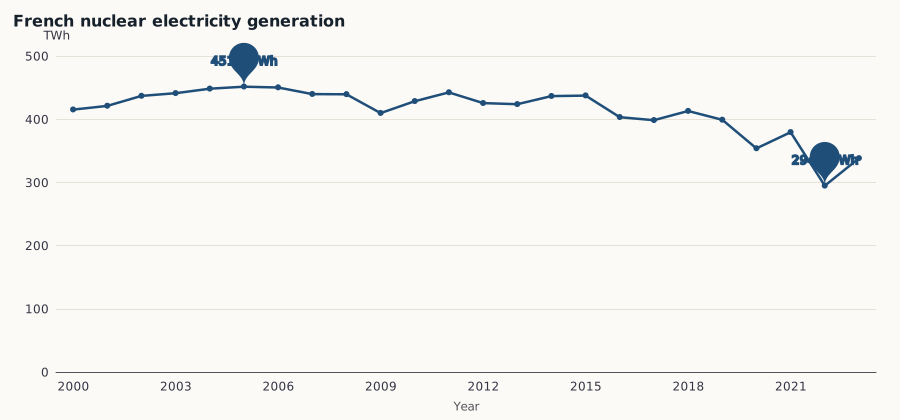
Annual nuclear electricity generation in France, terawatt-hours, 2000–2023. Values converted from IRENA GWh (all grids). Peak 451.5 TWh in 2005; trough 294.7 TWh in 2022; 338.2 TWh in 2023. Annual totals cannot measure July 2026 heat-related shutdowns. Source: IRENA Renewable Energy Statistics.
Output peaked at 451.5 TWh in 2005, when nuclear was 78.4% of French electricity and the implied capacity factor — annual generation divided by year-end capacity times hours in the year — was 81.5%. By 2022 generation had fallen to 294.7 TWh, 34.7% below that peak and 22.3% below 2021, with an implied capacity factor of 54.8%. 2023 recovered only to 338.2 TWh, still 25.1% below the 2005 high, at a 62.9% implied factor.
Those annual totals cannot isolate a summer heatwave, and they do not diagnose 2022. They do show that the reactors were not missing. A fleet whose installed capacity had hardly changed produced far fewer megawatt-hours. That is less spare output to give up when rivers run hot.
Renewables grew. They did not replace the missing nuclear.
French renewable generation rose from 55.0 TWh in 2005 to 139.7 TWh in 2023. Other non-renewable generation — IRENA’s non-renewable total minus nuclear, mostly fossil plants — fell from 69.5 TWh to 47.0 TWh. Add it up and France generated 8.9% less electricity in 2023 than in 2005. Nuclear remained the largest block in every year.
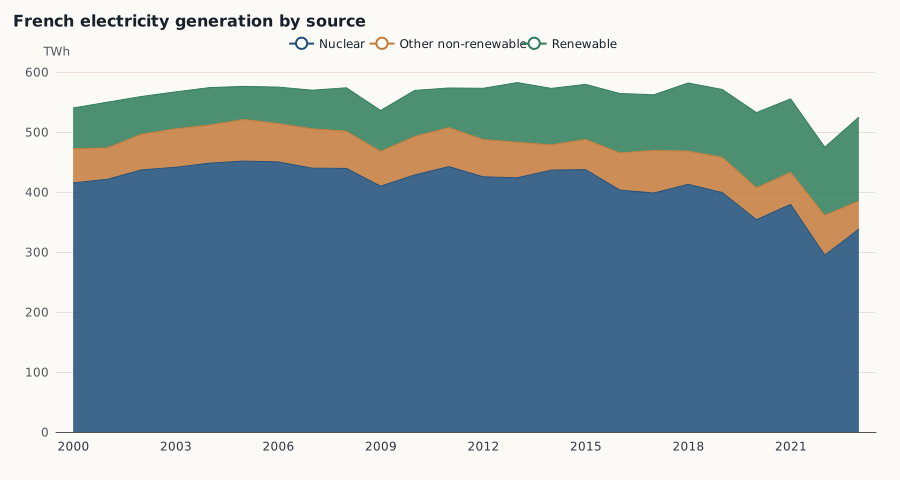
Stacked annual generation in France, terawatt-hours. Nuclear plus other non-renewable plus renewable equals IRENA total electricity. Other non-renewable is total non-renewable minus nuclear. Source: IRENA Renewable Energy Statistics.
Europe’s nuclear electricity is increasingly a French fact
IRENA’s Europe regional aggregate generated 1,109.8 TWh of nuclear electricity in 2005 and 748.3 TWh in 2023, a 32.6% decline. France’s share of that regional total rose from 40.7% to 45.2%. Nuclear’s share of all European electricity fell from 29.0% to 21.2%.
The comparison mixes a France country series with a regional aggregate, so overseas territories and regional membership may not line up exactly. The direction is not subtle. As other European countries closed plants, French reactors became a larger piece of what remained. River temperatures in France are now a European electricity constraint, not only a French environmental one.
| Economy | Nuclear share, 2023 | Nuclear, TWh | Total electricity, TWh |
|---|---|---|---|
| France | 64.4% | 338.2 | 525.0 |
| Slovakia | 61.3% | 18.3 | 29.9 |
| Belgium | 39.4% | 32.9 | 83.7 |
| South Korea | 29.6% | 180.5 | 610.7 |
| Europe (IRENA region) | 21.2% | 748.3 | 3,522.3 |
| United States | 18.1% | 808.1 | 4,452.5 |
| World (IRENA region) | 9.2% | 2,738.5 | 29,867.2 |
| Germany | 1.4% | 7.2 | 511.9 |
Nuclear share is nuclear generation divided by renewable plus non-renewable generation. Europe and World are IRENA regional aggregates. Source: IRENA, 2023.
None of this measures how many megawatt-hours the July 2026 curtailments removed. IRENA’s generation series in this snapshot end in 2023. Recorded on-grid nuclear capacity remains 61,400 MW through 2025, so the installed stock in this file does not itself close the generation gap. What the annual record can say is narrower, and more useful than a one-day outage count: France still runs on nuclear, the fleet already produces a quarter less than it did at its mid-2000s peak, and almost half of Europe’s remaining nuclear electricity sits behind the same riverbanks.
Sources and methods
This is retrospective research. The news is from 12 July 2026; the calculations use an IRENASTAT snapshot compiled on 24 August 2026, which includes later releases than a reader on digest day would have had. Generation is annual gigawatt-hours on all grids; figures in the text and charts are converted to terawatt-hours (GWh ÷ 1,000) and rounded to one decimal. Capacity is on-grid nuclear megawatts. Implied capacity factor uses hours in the calendar year and year-end-style capacity, which is not an IRENA-published indicator and will not match a plant-level availability factor.
Total electricity is renewable plus non-renewable generation. Nuclear is inside the non-renewable total; “other non-renewable” is the residual. Country series are used for France and the 2023 cross-section; World and Europe come from IRENA regional tables. Dictionary names such as “USA” and “Korea Rep” returned no observations on the country generation series; the United States and South Korea figures use IRENA’s full country names. Empty is not zero.
The France 24 and South China Morning Post items are feed excerpts, not full articles. They support the fact of the shutdowns and the Korean heat alert, not the megawatt-hours lost. SVG charts were rendered with ECharts; they have not been separately checked in a browser or on a phone.
Research Date
The displayed date matches the related news edition. Research was completed 2026-09-10.
Related news: Daily · 2026-07-12
More Research
France Still Gets Most Of Its Electricity From Nuclear. The Plants Are Producing Less Of It.
France still generated 64 percent of its electricity from nuclear in 2023, a quarter below the 2005 peak, so river-temperature limits are a first-order grid risk.
Pakistan Got Bigger. Its Neighbours Got Richer.
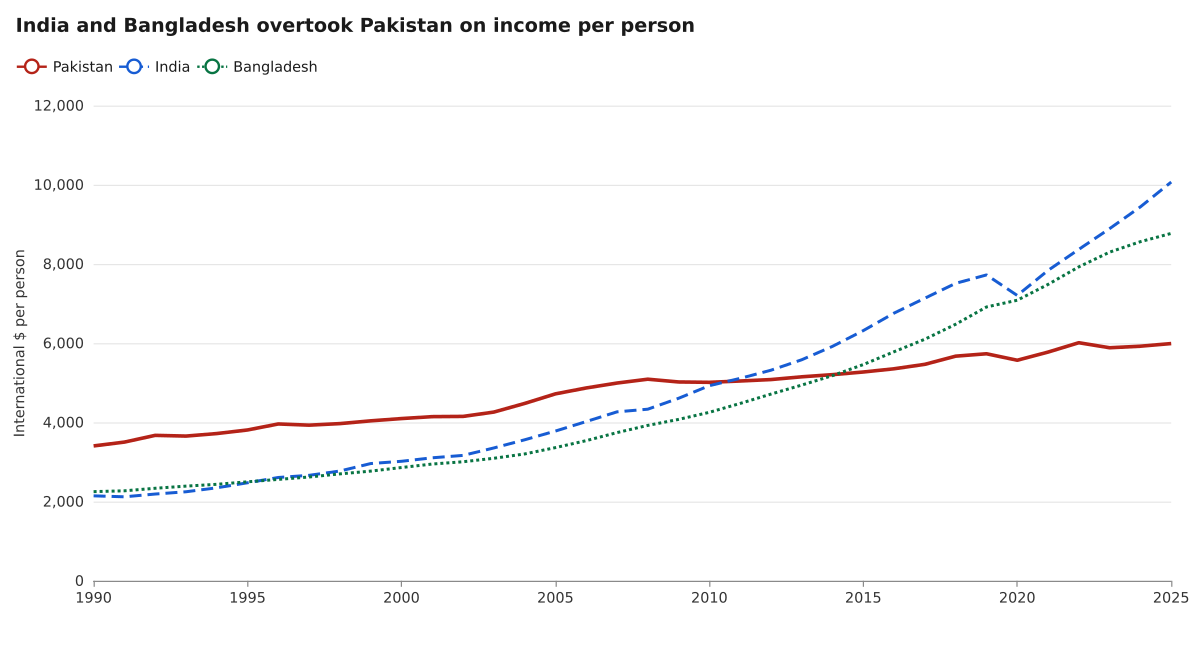
Pakistan added 105 million people after 2000 while India and Bangladesh overtook it on real income per person.
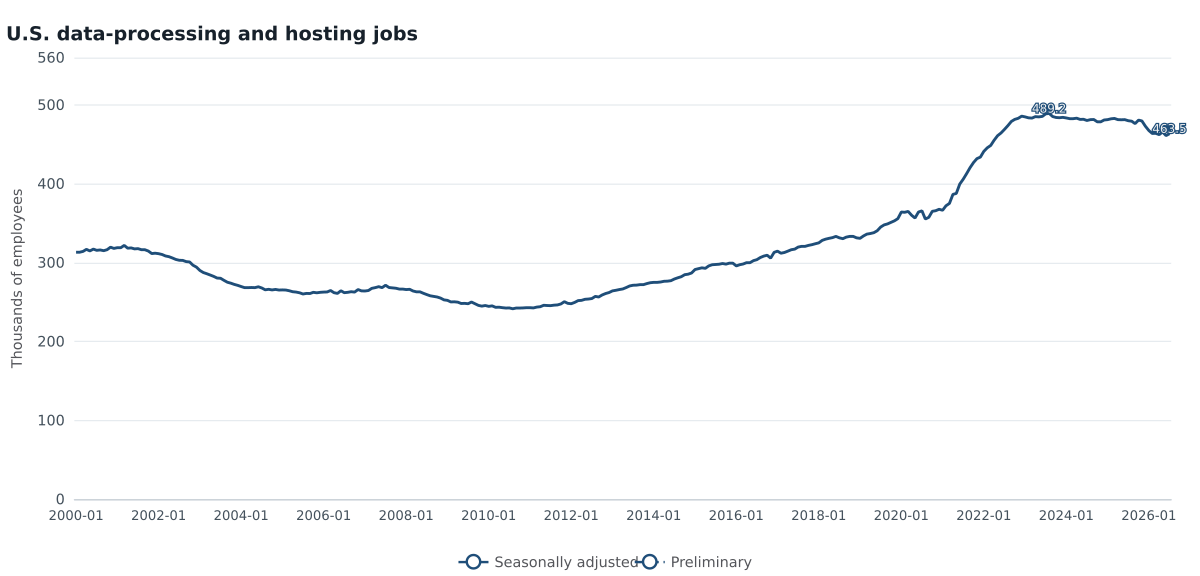
The Data-Center Boom Is Not A Jobs Boom
New York paused large data centers over power and community strain. National hosting still employs about 464,000 people, below its 2023 peak.