LunarWeave
Finland’s Data-Center Freeze Is About Forests. The Power Is Nuclear And Wind.
A Finnish watchdog has told Google to halt preparatory work on two data-center sites after more than 300 hectares of forest were cleared without a required environmental assessment, Le Soir reported, citing AFP. The Muhos and Kajaani projects sit inside a €13 billion artificial-intelligence investment — described as Google’s largest single European bet. The pictures are of stumps. The argument that follows is that Finland is sacrificing woodland for servers.
The electricity argument is different. Cloud operators come north for cold air and a reputation for clean power. IRENA’s generation accounts, through 2023, show that the grid those campuses would use is not a coal system short of plants. It is a nuclear-and-renewable system that had already expanded.
Ninety-four percent nuclear and renewable
Finland generated 81.5 terawatt-hours of electricity in 2023. Nuclear produced 34.3 TWh, or 42.1% of the total. IRENA’s renewable aggregate — hydropower, onshore wind, solid biofuels and smaller sources — was another 51.9%. Nuclear plus renewables were 94.0% of generation. Coal and peat, recorded as one series, were 3.4 TWh (4.1%). Natural gas, 10.1 TWh in 2000, was 0.7 TWh.
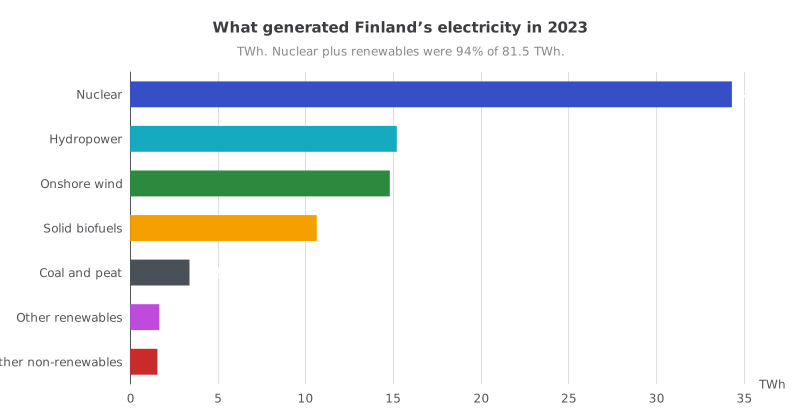
Finland electricity generation by source, 2023, terawatt-hours. Totals are IRENA renewable plus non-renewable generation. Nuclear is classified as non-renewable; solid biofuels are classified as renewable. Coal and peat are a single series. Source: IRENASTAT country electricity generation.
That mix is recent. In 2000, nuclear plus renewables were 65.5% of a 70.0 TWh system. Coal-and-peat generation still reached 21.4 TWh in 2010. The last step-change is nuclear. Output rose 13.0% in a single year, from 72.2 TWh in 2022 to 81.5 TWh in 2023, as nuclear generation rose 9.0 TWh. On-grid nuclear capacity jumped 1,600 MW in 2023, from 2,794 MW to 4,394 MW.
Wind is the other build. Onshore wind generated 14.8 TWh in 2023 — 18.2% of electricity, essentially matching hydropower’s 15.2 TWh (18.6%). Capacity has kept rising after the last generation year in this snapshot: 2,252 MW in 2019, 5,645 MW in 2022, 9,351 MW in 2025, a 4.15-fold increase in six years. Combined on-grid capacity (renewable plus non-renewable) went from 17,438 MW in 2019 to 26,016 MW in 2025, up 49.2%. Other non-renewable capacity continued to shrink.
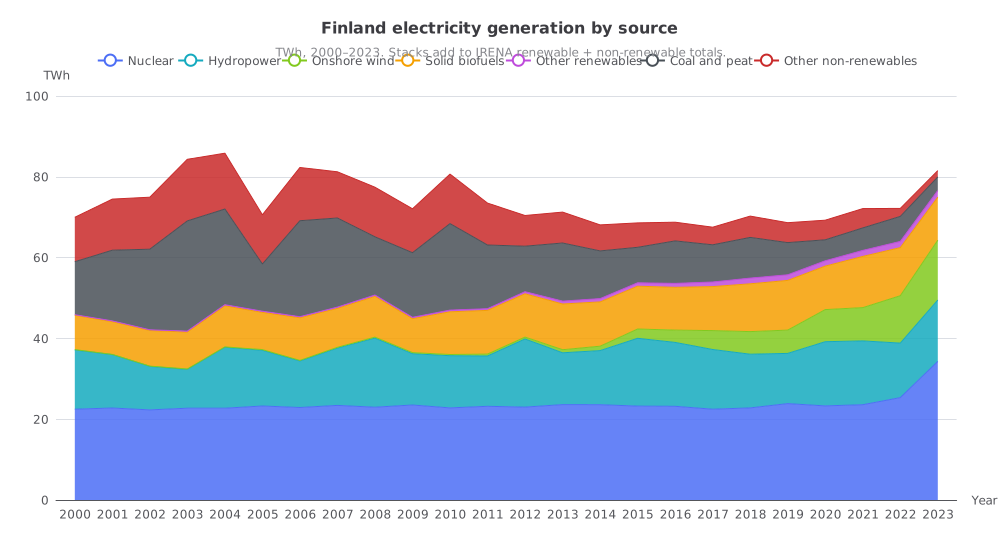
Finland electricity generation by source, 2000–2023, TWh. Stacked series sum to IRENA’s renewable plus non-renewable totals. “Other renewables” is the renewable residual after hydro, onshore wind and solid biofuels; “other non-renewables” is the non-renewable residual after nuclear and coal-and-peat (including gas and oil). Source: IRENASTAT.
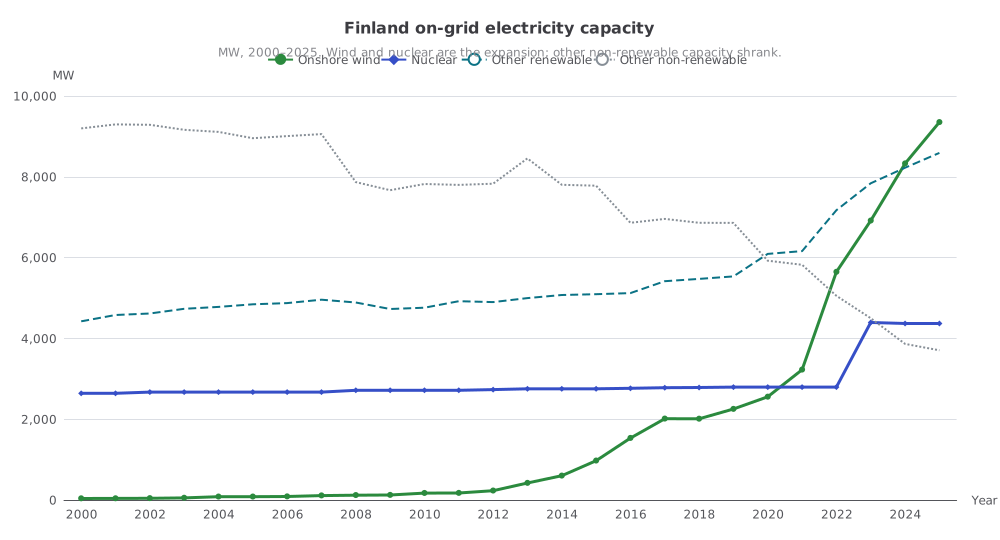
Finland on-grid electricity capacity, 2000–2025, megawatts. Onshore wind and nuclear are plotted separately; other renewable capacity is total renewable minus onshore wind; other non-renewable is total non-renewable minus nuclear. Generation in this snapshot ends in 2023; capacity continues through 2025. Source: IRENASTAT.
Google’s Finnish sites were not trying to land on a grid that had stopped adding plants. Finland has been installing onshore wind at speed and added a reactor-scale block of nuclear in 2023. What the watchdog cited was land and procedure — not a fossil-heavy, stagnant power system.
The forest that remains in the kilowatt-hour
The trees still show up in the electricity accounts. IRENA counts solid biofuels as renewable. They generated 10.6 TWh in 2023, 13.1% of Finland’s electricity — more than coal, peat, gas and oil combined. That share is about twice Sweden’s 6.2% the same year and far above Ireland’s 1.1%. Ireland, another European data-center host, generated 44.8% of its electricity from renewables in 2023 and 55.2% from non-renewable sources; this snapshot has no nuclear-generation observations for Ireland. Sweden, like Finland, is already a nuclear-plus-renewable system (98.6% in 2023). Finland’s distinctive renewable slice is wood.
Solid-biofuel capacity was still rising, from 1,500 MW in 2000 to 3,587 MW in 2025, even as generation slipped from 12.7 TWh in 2021 to 10.6 TWh in 2023. That is not the same fact as Google’s 300 hectares. Construction clearing is land use; biofuel generation is a fuel. These series do not show whether those hectares would have been harvested for power. They do show that a country selling itself as a clean-compute host still runs a large wood-fired fleet inside the renewable total.
| Source (2023) | TWh | Share of 81.5 TWh |
|---|---|---|
| Nuclear | 34.31 | 42.1% |
| Hydropower | 15.2 | 18.6% |
| Onshore wind | 14.8 | 18.2% |
| Solid biofuels | 10.64 | 13.1% |
| Coal and peat | 3.38 | 4.1% |
| Other renewables | 1.66 | 2.0% |
| Other non-renewables | 1.55 | 1.9% |
TWh figures are rounded; shares use unrounded gigawatt-hours and sum to 100% of 81,541 GWh. Other renewables are the residual after hydro, onshore wind and solid biofuels (including 0.7 TWh of solar photovoltaic). Other non-renewables are the residual after nuclear and coal-and-peat.
None of this settles the environmental assessment. IRENA’s renewable label does not resolve biomass carbon accounting, and nuclear siting is a separate argument. Generation through 2023 cannot show whether 2024–26 output kept up with the extra wind turbines, or what a €13 billion computing load would draw. If the worry is that AI campuses will force Finland back onto coal or gas, the recorded mix and the 2019–25 capacity build do not look like that system. The electrons Google wanted are mostly nuclear, hydro, wind — and wood.
Sources and methods
This is retrospective research completed on 7 October 2026, using an IRENASTAT snapshot dated 24 August 2026. It is not an as-of reconstruction of what was published on 6 October 2026. Electricity generation in the snapshot runs 2000–2023; on-grid capacity runs 2000–2025. Country totals are the sum of IRENA’s “total renewable” and “total non-renewable” electricity generation (all grids, GWh). Nuclear is inside non-renewable; solid biofuels are inside renewable. Coal and peat cannot be separated. Onshore wind is used because IRENA’s combined wind series in this catalogue is regional, not national. Empty nuclear observations for Ireland are not treated as zero. The €13 billion investment, 300-hectare clearing and site names are reported by AFP via Le Soir, not measured here.
Research Date
The displayed date matches the related news edition. Research was completed 2026-10-07.
Related news: Daily · 2026-10-06
More Research
Brazil’s 8 Percent Deficit Is An Interest Bill
IMF accounts show Brazil’s projected 8% of GDP headline deficit is almost entirely interest; the primary deficit is near zero while public debt returns toward its 2020 peak.
Hospitals Kept Hiring. Finance Started Shrinking.
Through July 2026, U.S. health care added more jobs than the entire net payroll gain while finance and insurance lost 95,100. Banks and insurers, not leftover mortgage lenders, account for t
Argentina Is Selling Passports. The Budget Is Already In Surplus.
Argentina’s citizenship-for-dollars programme arrives after the IMF already records a 2024 budget surplus. Inflation is still about 30% and output per person remains below 2011.