LunarWeave
Argentina Is Selling Passports. The Budget Is Already In Surplus.
Argentina has put citizenship on a price list. The Dong-a Ilbo, citing Reuters and the economy ministry, reports that Javier Milei’s government will take applications from the fourth quarter of 2026 for a “golden visa”: a non-refundable $350,000 payment to the treasury, or $800,000 in government bonds that must be held for seven years. A couple with two children would pay $500,000 in cash. The programme is being sold as South America’s first, and as a way for a cash-strapped administration to pull in dollars.
The passport price is real as reported. The “cash-strapped” part is the claim that needs checking. In the International Monetary Fund’s World Economic Outlook, Argentina’s public accounts are no longer the hole they were when Milei took office. The unfinished business is elsewhere: inflation that is still about 30 percent, and output per person that has not recaptured its 2011 peak even after a rebound.
The treasury flipped before the visa
Argentina’s general-government budget ran a deficit of 5.3 percent of GDP in 2023. In 2024 it recorded a surplus of 0.5 percent of GDP — a swing of 5.8 percentage points in a single year. The IMF’s 2026 forecast is another 0.5 percent surplus. Brazil, on the same measure, is still looking at a 7.7 percent deficit.
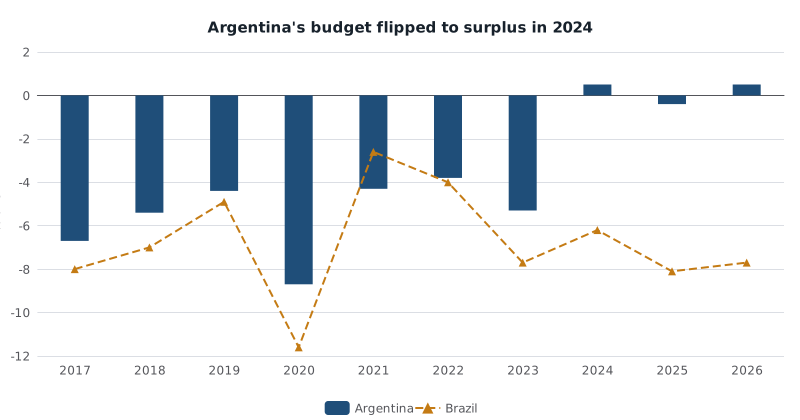
The surplus did not come from a tax windfall. Public spending fell from 37.6 percent of GDP in 2023 to 31.0 percent in 2024, a cut of 6.6 points. Revenue slipped only slightly, from 32.3 to 31.5 percent of GDP. The surplus is a spending shock, not a tax boom.
Gross debt as a share of GDP also collapsed, from 154.6 percent in 2023 to 84.7 percent in 2024, and the IMF sees 70.4 percent in 2026. Treat that drop with care. A year of 220 percent inflation inflates the peso value of output and can shrink a debt ratio even when the underlying stock has not been paid down. The spending cut and the surplus are the cleaner evidence that the budget, as the Fund records it, is no longer the emergency.
A current-account deficit of 0.8 percent of GDP in 2026 and unemployment of 7.2 percent are ordinary readings, not a 2001-style collapse. If the government still wants dollars, it is not because the IMF’s fiscal books show an empty till.
Inflation fell. Thirty percent is not normal.
The disinflation is genuine, and it is incomplete. Average consumer-price inflation ran at 133.5 percent in 2023 and 219.9 percent in 2024. The Fund’s 2025 estimate is 41.9 percent; its 2026 forecast is 30.4 percent. End-of-year inflation, which captures the late-year pace, is lower still: 117.8 percent in 2024 and 25.0 percent in 2026.
That is a crash from the peak. It is not convergence. Brazil’s 2026 inflation is 4.0 percent on the same average-CPI measure; Chile’s is 2.9 percent; Uruguay’s is 4.0 percent. Argentina’s 2026 rate is about 7.6 times Brazil’s. A family paying $350,000 for a passport is buying into an economy where prices are still rising several times faster than in the neighbours.
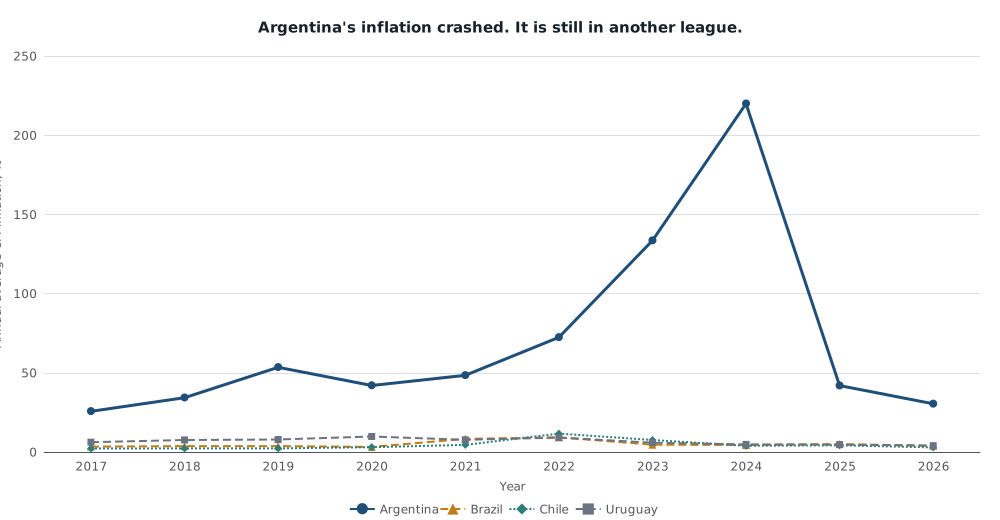
The IMF file has no average-CPI observations for Argentina in 2014–16, a gap that lines up with the old fight over official statistics. The 2017–26 comparison does not depend on those missing years. What it shows is a country that has come off a hyperinflationary peak and has not yet rejoined the region’s price club.
The lost decade-and-a-half of living standards
The deeper scar is in real output per person. Constant-price GDP per capita, in national currency, peaked in 2011. By 2024 it was 12.7 percent below that peak. The IMF’s 2026 forecast still leaves it 7.4 percent short. The Fund does not see the 2011 level regained until 2029.
The same story appears in GDP per capita at constant purchasing-power parity, which lets neighbours be compared on one chart. Indexed to 2011, Argentina is at 92.6 in 2026. Uruguay is at 127.4, Chile at 121.2, Brazil at 109.4. Over those fifteen years Uruguay became more than a quarter richer per person; Argentina became poorer.
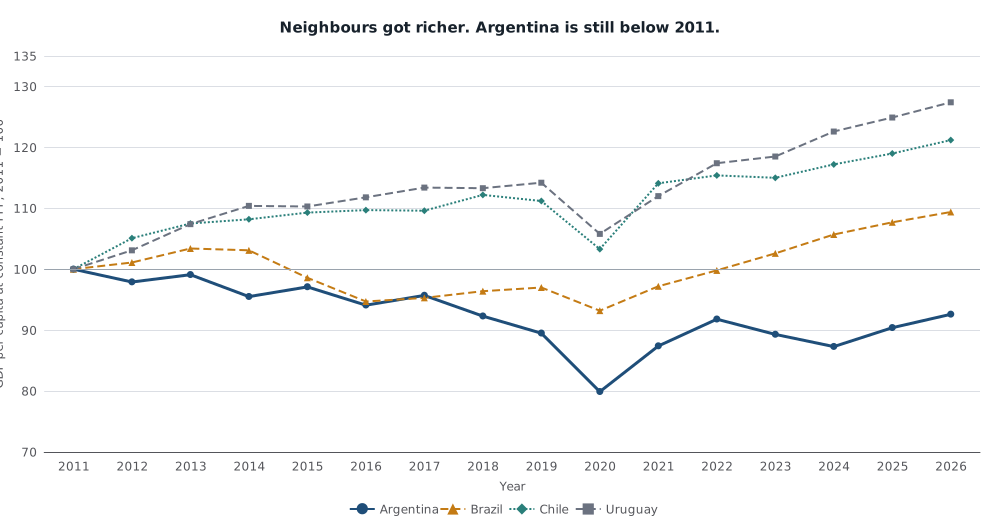
Total real GDP did recover: the IMF has a 1.9 percent contraction in 2023, a 1.3 percent contraction in 2024, then 4.4 percent growth in 2025 and 3.5 percent in 2026. Population growth means the per-person series heals more slowly than the headline. Dollar GDP per capita in 2026 is about $14,400 — above Brazil’s $12,300, but well below Chile’s $20,200 and Uruguay’s $27,600. Those dollar figures bounce with the peso; the constant-PPP path is the better measure of whether people are actually producing more.
| 2026 IMF reading | Argentina | Brazil | Chile | Uruguay |
|---|---|---|---|---|
| Average CPI inflation, % | 30.4 | 4.0 | 2.9 | 4.0 |
| Constant-PPP GDP per person vs 2011, % | −7.4 | +9.4 | +21.2 | +27.4 |
| Budget balance, % of GDP | +0.5 | −7.7 | −2.5 | — |
2026 figures are IMF forecasts in the pinned snapshot. Uruguay’s budget balance was not used in this comparison. Inflation is the annual average, not the month-to-month rate.
What $350,000 can buy the state
The cash visa is large for a household and small for a government. Argentina’s 2026 dollar GDP is about $688 billion. A thousand $350,000 payments would be $350 million, or 0.05 percent of that output; ten thousand would still be about half a percent. The $800,000 bond option is a seven-year loan, not a gift: it can help the dollar side of the capital account, but it is not the 2024 spending cut.
None of this proves the programme will fail, or that it has no logic. A government that has already closed the peso budget can still want hard currency, a deeper local bond market, and a headline that says Argentina is open. What the IMF numbers do not support is the idea that citizenship is being sold because the treasury is empty. The budget surplus arrived first. Inflation and a 2011 living-standards peak that still has not been retaken are the problems that a passport price list cannot solve.
Methods and sources
This is a retrospective reading of the 3 October 2026 reporting, using IMF World Economic Outlook series from a snapshot dated 24 August 2026. It is not an as-of reconstruction of what was known that morning. Values through 2024 are treated as historical WEO observations; 2025–31 are IMF estimates and forecasts. Average CPI inflation is series PCPIPCH; the budget figures are general-government net lending/borrowing (GGXCNL_NGDP), expenditure (GGX_NGDP) and revenue (GGR_NGDP). Living-standards comparisons use constant-PPP GDP per capita (NGDPRPPPPC) and constant-price GDP per capita in national currency (NGDPRPC), not current-dollar PPP, which moves with the PPP price level. Gross debt/GDP is reported with the inflation-denominator caveat above. Visa prices and start date are as reported by Dong-a Ilbo; they have not been checked against an official Argentine legal text. Charts use the same extracts; 2025–26 points are forecasts. SVG rendering was not a browser or mobile layout test.
Research Date
The displayed date matches the related news edition. Research was completed 2026-10-04.
Related news: Daily · 2026-10-03
More Research
U.S. Hiring Stalled In 2025. Real Pay Has Now Flattened Too.
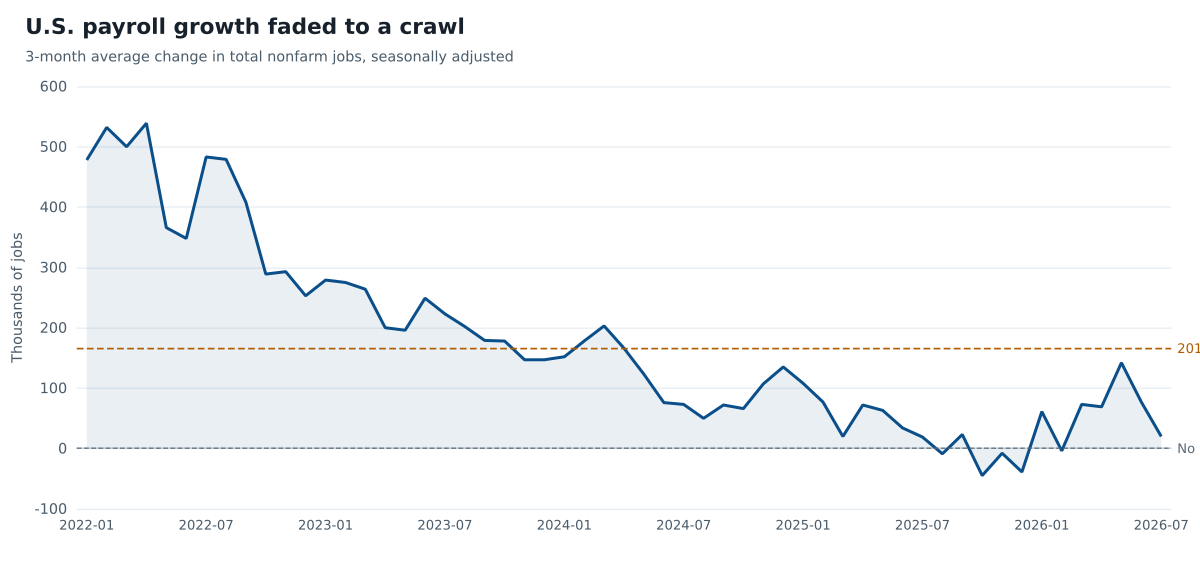
BLS payroll data through July 2026 show U.S. job growth had already slowed to about 20,000 a month on a three-month average, while real hourly earnings stopped rising.
Ukraine Is Heading Into Winter With A Third Less Electricity Than Before The Invasion
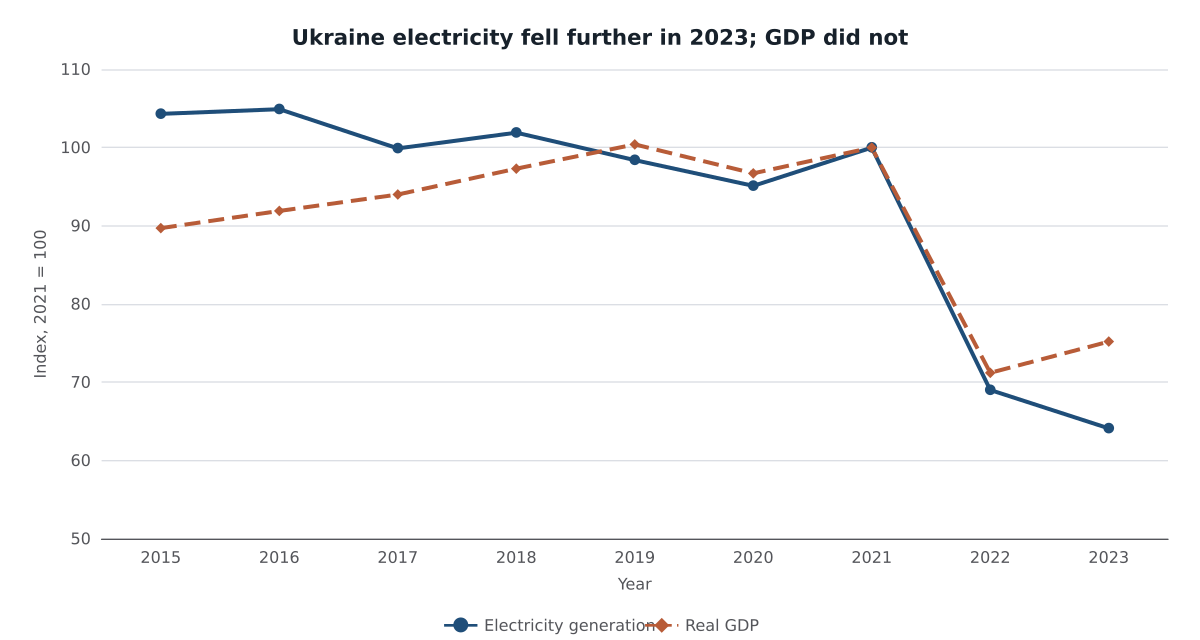
Ukraine generated 36 percent less electricity in 2023 than in 2021. Real GDP began to recover that year; the grid did not.
France Still Owes Less Than Italy. Its Budget Has Not Closed.
IMF figures show France’s public debt still below Italy’s and Greece’s. The open 5% of GDP deficit is why the ratio is still rising.