LunarWeave
Brazil’s 8 Percent Deficit Is An Interest Bill
After Flávio Bolsonaro finished ahead of President Luiz Inácio Lula da Silva in Brazil’s first-round vote, investors pushed stocks and the real higher on a bet that the next government would impose austerity. The runoff is on 25 October. The trade treats Brazil as a country with a budget that has come unglued.
The International Monetary Fund’s fiscal accounts say something more precise. Brazil does have a large headline deficit. Almost all of it is interest on existing debt. The operating budget — revenue minus spending other than interest — is nearly balanced.
A headline that looks like an emergency
In the IMF’s World Economic Outlook, general-government net lending/borrowing is −8.07% of GDP in 2025 and −7.71% in 2026. Those are Fund estimates and projections in an August 2026 snapshot, not audited year-end outcomes. On 2025 current-dollar GDP of $2.28 trillion, an 8.07% deficit is about $184 billion.
That is a large number. It is close to the IMF’s 2026 overall deficit for the United States (−7.50% of GDP) and India (−7.41%). It is far larger than Mexico (−4.37%), Colombia (−5.15%) or Chile (−2.47%). Argentina, after a different and harsher adjustment, is projected to run a small overall surplus.
A reader could stop there and conclude that Brasília is overspending by eight points of national income. The primary balance says otherwise.
The operating budget is not the eight-point hole
The IMF’s primary net lending/borrowing series excludes interest. For Brazil that primary balance is −0.39% of GDP in 2025 and −0.45% in 2026 — about $9 billion on 2025 GDP. The gap between the two balances is implied net interest: 7.68 points of GDP in 2025 and 7.25 points in 2026. That is 95% of the 2025 headline deficit and 94% of the 2026 deficit.
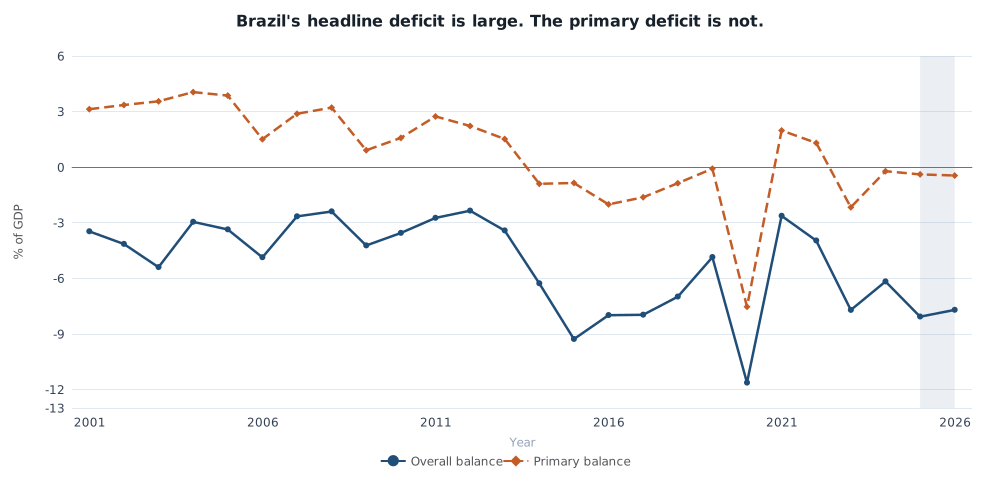
General-government net lending/borrowing and primary net lending/borrowing, percent of GDP, Brazil, 2001–2026. Negative values are deficits. The gap is implied net interest. Shaded 2025–2026 observations are IMF estimates/projections. Source: IMF World Economic Outlook.
The identity is mechanical: primary balance minus overall balance equals interest in these accounts. It is not a separate market yield, and it is not an effective rate on every real of gross debt. It is the cleanest way the WEO lets a reader split “the government is spending more than it takes in, before interest” from “the government is servicing a large stock of claims.”
Brazil has been here before, and not here. The primary balance was in surplus through 2013, slipped into small deficit in the 2014–16 recession, then crashed to −7.54% of GDP in the 2020 pandemic year, when the overall deficit reached −11.64%. Primary surpluses returned in 2021 (+1.98%) and 2022 (+1.31%). From 2023 the primary has been slightly negative again. The eight-point headline of 2025–26 is not a repeat of the 2020 spending surge. It is a large interest wedge on a budget that is otherwise close to balance.
Expenditure is 47.42% of GDP in 2025 against revenue of 39.35%. Subtract the 7.68-point interest wedge and the remaining spending sits almost on top of revenue. That is the opposite of an 8% primary binge.
Debt is climbing back to the pandemic peak
Interest this large has a stock behind it. General-government gross debt fell from 96.01% of GDP in 2020 to 83.94% in 2022 as the emergency deficit closed and inflation and growth lifted the denominator. The IMF then has the ratio rising again: 87.03% in 2024, 93.33% in 2025 and 96.54% in 2026 — back to the pandemic peak.
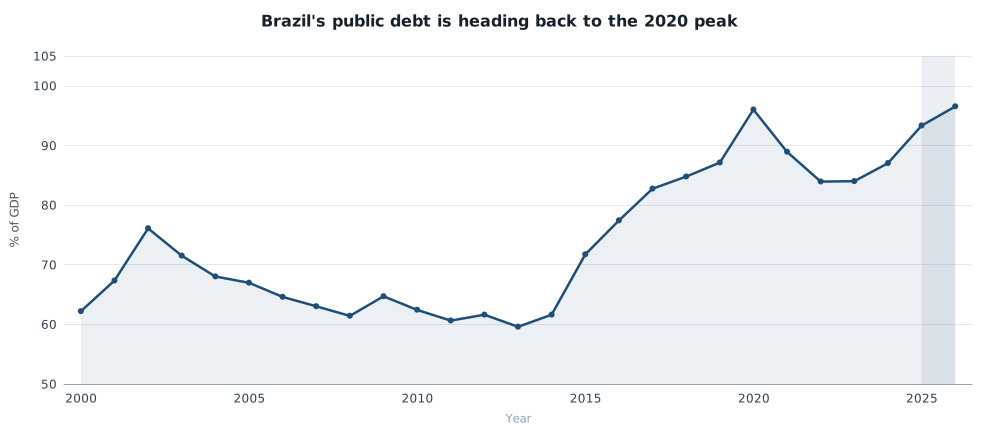
General-government gross debt, percent of GDP, Brazil, 2000–2026. Shaded 2025–2026 observations are IMF estimates/projections. Source: IMF World Economic Outlook.
A near-zero primary balance does not stabilize a debt ratio when interest costs 7% of GDP. It merely means the new hole is not coming from a fresh wave of non-interest spending. Debt dynamics still deteriorate unless growth, inflation, or a later primary surplus does the work.
Among peers, Brazil’s distinctive problem is interest
The pattern is easier to see next to other large emerging economies and the United States, all in the same 2026 WEO vintage:
| Country | Overall balance | Primary balance | Implied interest | Gross debt |
|---|---|---|---|---|
| Brazil | −7.71 | −0.45 | 7.25 | 96.5 |
| Mexico | −4.37 | +1.60 | 5.98 | 62.7 |
| South Africa | −4.87 | +0.63 | 5.49 | 78.9 |
| India | −7.41 | −1.92 | 5.49 | 83.4 |
| United States | −7.50 | −3.67 | 3.83 | 125.8 |
| Colombia | −5.15 | −2.36 | 2.79 | 60.9 |
| Peru | −1.97 | −0.48 | 1.48 | 30.0 |
| Argentina | +0.45 | +1.89 | 1.43 | 70.4 |
| Chile | −2.47 | −1.68 | 0.78 | 42.5 |
Percent of GDP, 2026 IMF WEO projections. Implied interest is primary minus overall. Gross debt is general-government gross debt. The group is a comparison set, not a world ranking.
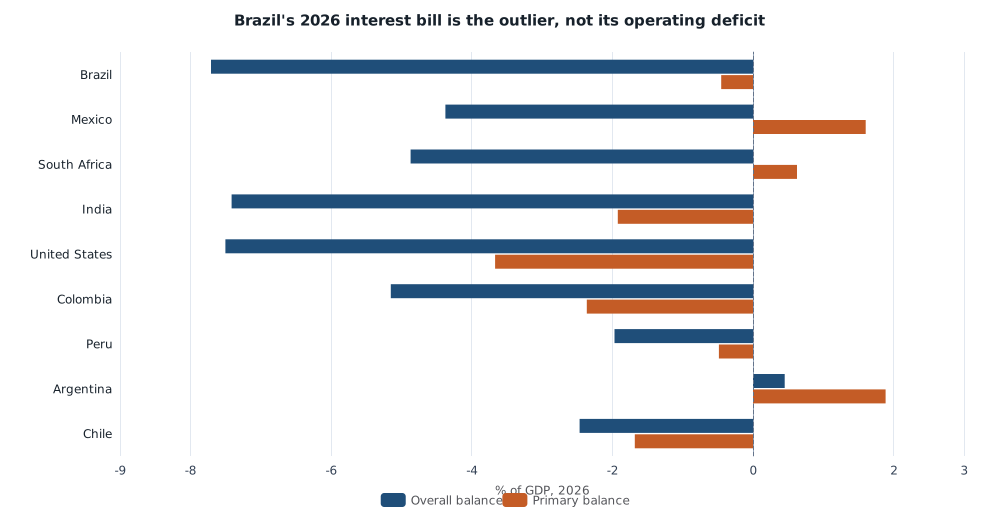
Overall and primary general-government balances, percent of GDP, 2026. Countries are ordered by implied net interest, smallest at the bottom. Source: IMF World Economic Outlook.
Brazil’s overall deficit is among the widest in this set. Its primary deficit is one of the smallest. Mexico is projected to run a primary surplus of 1.60% of GDP; South Africa a surplus of 0.63%. The United States matches Brazil’s headline hole with a much larger primary deficit (−3.67%) and a smaller interest wedge (3.83 points). Argentina’s tiny implied interest despite still-high debt is a reminder that this identity is not a bond-market yield; restructurings and financial repression can compress the WEO interest gap without making the comparison a model of Brazil’s path.
What the table can support is narrower. If investors are pricing “austerity,” the IMF books say the cut that would change the headline is a primary surplus large enough to cover a 7-point interest bill — not the closing of an 8-point operating deficit that is not there.
This is not the 2015 slump or the 2022 inflation spike
The last time Brazil’s overall deficit was in this range for several years, the real economy was shrinking. Real GDP fell 3.55% in 2015; average consumer-price inflation was 9.03%. In 2022, inflation was still 9.28%. The same WEO vintage now has inflation at 4.37% in 2024, 5.02% in 2025 and 4.00% in 2026, with real growth slowing from 3.42% in 2024 to 1.91% in 2026. The current-account deficit is about 3% of GDP, not an external crash.
Those figures do not say the next government has an easy job. Slowing growth makes a heavy interest bill harder to outrun. They do say the 2026 fiscal problem is not the 2015 recession and not the 2022 price spike. It is a debt-service problem on a budget that has already, in the IMF’s primary accounts, stopped adding much new non-interest red ink.
What the austerity bet is actually on
The Guardian reported that Bolsonaro took 47.03% to Lula’s 45.16% in the first round, and that no first-round runner-up has come back to win since Brazil restored democracy in 1985. Those are reported election results, not figures from the WEO. They explain why markets moved. They do not tell a president how to close a budget.
Austerity language often implies that the state is living eight points beyond its means on salaries, pensions and programmes. In these accounts, Brazil is living about half a point beyond its means before interest, and more than seven points beyond its means after it. Generating a primary surplus of several points of GDP would be a real political choice. Calling that choice “closing an 8% spending gap” misstates the starting point.
The IMF snapshot cannot say whether a Bolsonaro or Lula government would run that surplus, whether markets have already priced it, or whether a lower interest rate would do more of the work than spending cuts. It can say what kind of hole the winner inherits: a debt-service hole, with the operating budget already near balance and the debt ratio heading back to where it stood in the pandemic year.
Sources and methods
Figures are from the IMF World Economic Outlook dataset in a pinned snapshot ingested 10 August 2026 (catalogue snapshot 24 August 2026). This piece was researched on 6 October 2026 and is retrospective relative to the 5 October 2026 news; later WEO revisions are not used here and were not available as this snapshot. Years 2025–2026 are Fund estimates/projections in that vintage.
Overall balance is general-government net lending/borrowing (GGXCNL_NGDP). Primary balance is general-government primary net lending/borrowing (GGXONLB_NGDP), which excludes interest. Gross debt is GGXWDG_NGDP. Inflation is average consumer prices (PCPIPCH). Growth is real GDP (NGDP_RPCH). Dollar GDP is current-price GDP (NGDPD). Implied interest is calculated as primary minus overall; expenditure minus revenue matches the overall deficit to rounding error. Balances are for general government, not the central government alone, and are percent of GDP, not percent of revenue. The comparison group is a chosen set of large peers, not an exhaustive ranking. The analysis does not forecast the runoff or attribute the market rally to any single policy.
Research Date
The displayed date matches the related news edition. Research was completed 2026-10-06.
Related news: Daily · 2026-10-05
More Research
Hospitals Kept Hiring. Finance Started Shrinking.
Through July 2026, U.S. health care added more jobs than the entire net payroll gain while finance and insurance lost 95,100. Banks and insurers, not leftover mortgage lenders, account for t
Argentina Is Selling Passports. The Budget Is Already In Surplus.
Argentina’s citizenship-for-dollars programme arrives after the IMF already records a 2024 budget surplus. Inflation is still about 30% and output per person remains below 2011.
U.S. Hiring Stalled In 2025. Real Pay Has Now Flattened Too.
BLS payroll data through July 2026 show U.S. job growth had already slowed to about 20,000 a month on a three-month average, while real hourly earnings stopped rising.