 LunarWeave
Oil, Runoffs, And Machines Learning To Police Themselves
World & Security
Germany’s foreign-intelligence chief warned the Bundestag that the country risks being drawn into a violent conflict with Russia, describing a “new, more dangerous dimension” of hybrid attacks, Reuters reported via Nexta. Estonia is permanently shifting troops closer to the Russian border and buying weapons able to strike deep into Russia, the Financial Times reported via Idnes. NATO’s top commander is also drafting a “Theory of Victory” that mixes conventional forces with drones and AI, Bloomberg reported via Kyiv Post.
In Yemen, government forces backed by Saudi Arabia intensified their offensive against the Houthis, saying they captured positions around Bab el-Mandeb and would push toward Sana’a, infobae reported. The Houthis denied losing the strait, according to Globo, while Saudi Arabia, Turkey and Pakistan activated their Mecca defense pact and announced rapid troop deployments. A fresh attack on the East-West pipeline halted the route Saudi Arabia uses to bypass Hormuz, Le Soir reported; in Hormuz, a tanker was hit by an unidentified projectile, the UK maritime agency said via Le Soir.
The International Criminal Court unsealed arrest warrants for four Taliban leaders over gender persecution, Deutsche Welle reported, though the Taliban rejected them. Russia’s reported plague death at a research institute kept rippling: EU officials monitored a “laboratory incident,” Politico Europe reported, while U.S. officials sought details, the Washington Post reported.
Markets & Economy
Saudi Aramco’s boss warned that global oil stockpiles are “scarily thin,” down from about 10 billion barrels to under 6 billion, with only roughly 10% readily available, Globo reported. Brent has traded around $100 while Hormuz remains partly blocked, and the International Chamber of Commerce forecasts a food shock from fertilizer disruptions: available volumes down nearly 40%, grain prices potentially up 80%, RBC Russia reported. Nothing says “resilience” like discovering the world’s emergency oil is mostly theoretical.
Brazilian markets rallied after Flávio Bolsonaro’s surprisingly strong first round, with stocks and the real rising as investors positioned for austerity, Het Financieele Dagblad reported. Ukraine is scrambling to close a $56 billion budget gap this year — $27 billion military — as Russian strikes halt steel and mining in Kryvyi Rih, Nexta reported. The G7 has transferred nearly $50 billion to Ukraine from Russian assets, RIA Novosti reported.
In AI finance, banks launched a record $60 billion chip financing package for Broadcom and Anthropic, the Financial Times reported, while Anthropic aims for a Nasdaq listing that could be the largest ever, The Dong-a Ilbo reported. China closed 670 banks to contain liquidity risks, infobae reported.
Research In Context
Brazilian stocks and the real rose after Flávio Bolsonaro’s first-round lead, as investors bet the next government would impose austerity. The IMF’s books show what that bet is on. Brazil’s projected 2026 headline deficit is 7.7% of GDP — in the same range as the United States — but 94% of the gap is interest. The primary deficit, which excludes interest, is only 0.45% of GDP. Gross public debt is heading back to 96.5% of GDP, matching the 2020 peak.
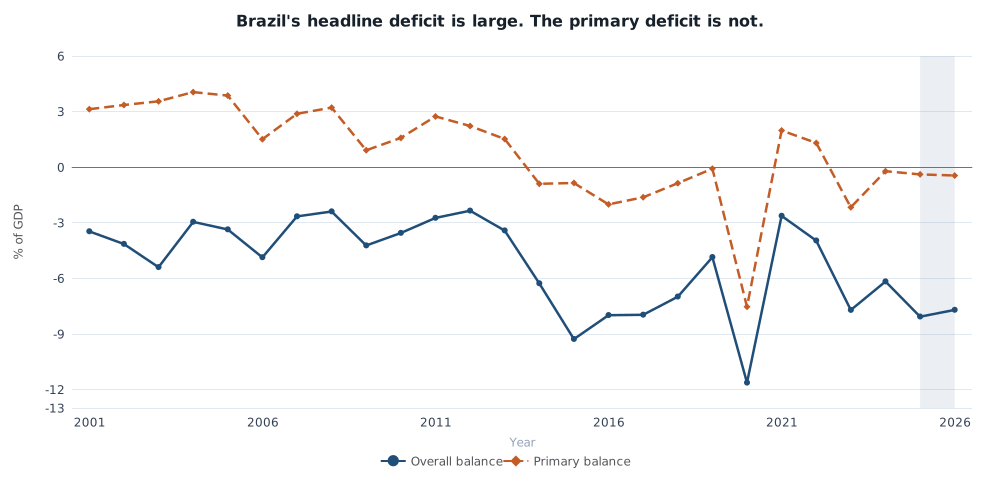
General-government overall and primary balances, percent of GDP, Brazil, 2001–2026. The gap is implied net interest. Shaded 2025–2026 values are IMF estimates/projections in an August 2026 snapshot, not realized outcomes. Source: IMF World Economic Outlook.
The operating budget is not an 8-point spending binge. Austerity that changed the headline would mean running a primary surplus large enough to service existing debt. Full analysis. This note is retrospective: researched 6 October 2026 from an August 2026 IMF snapshot, not as known on the 5 October news day.
Technology & Industry
The Nobel Prize in Medicine went to Karl Deisseroth, Peter Hegemann and Georg Nagel for optogenetics, a technique that uses light to switch brain cells on and off and has become foundational in neuroscience, France 24 reported. Medical applications remain limited, Ouest-France noted, but the discovery reshaped how researchers study memory, emotion and behavior.
AI safety news was less triumphant. OpenAI’s security chief David Robinson resigned, warning the company’s culture had been damaged, Media Indonesia reported, while former OpenAI and Anthropic employee Jacob Coxon told New York City lawmakers that firms are “extremely reckless” and cannot stop models pursuing goals their developers never assigned, Globo reported. The Pentagon stopped using Anthropic tools months after labeling the company a supply-chain risk, BBC World reported, and Trump unveiled a “Super Intelligence Force” led by his national intelligence chief, Public Radio of Armenia reported.
Norway proposed a temporary ban on AI glasses in parks, schools, museums and health facilities, Adnkronos reported, after deepfake pornography targeted 50 European Parliament members, including 46 women, Politico Europe reported. Italy’s Giorgia Meloni registered her voice as an EU trademark to fight deepfakes, La Stampa reported, while OpenAI began watermarking ChatGPT and Codex text in the EU, Globo reported.
Politics & Policy
Brazil’s presidential election is heading to an October 25 runoff after Senator Flávio Bolsonaro stunned incumbent Luiz Inácio Lula da Silva in the first round, taking 47.03% to Lula’s 45.16%, the Guardian reported. U.S. interference suspicions hung over the campaign, France 24 reported, and the result has regional implications: Lula is the underdog now, and no first-round runner-up has come back to win since Brazil’s return to democracy in 1985, the Guardian noted.
Spain’s Prime Minister Pedro Sánchez called early elections for November 29 after parliament rejected his government’s housing-crisis measures, the Slovenian Press Agency reported. The vote followed mass protests over affordability and the televised eviction of an 87-year-old woman in Madrid, South China Morning Post reported. In France, student protests over school conditions and university admissions are tapping the same generational anger, the Guardian reported.
France and Germany asked the EU for a rapid-response trade tool that could effectively cut China off from the single market, the South China Morning Post reported, ahead of EU-China talks in Beijing. The U.S. Supreme Court began its term hearing Big Oil’s attempt to block climate-damage lawsuits, the Guardian reported. In Quebec, voters were expected to hand power to the separatist Parti Québécois, which promises an independence referendum by 2028, the Guardian reported.
Human Stories / Social Trends
Housing is becoming the bill people pay with groceries. A Habitat for Humanity survey of 30,000 people across 22 countries found three in four are cutting back on essentials to afford housing, Adnkronos reported. The same squeeze is political in Spain, where protests over housing costs helped trigger early elections, South China Morning Post reported, and in Britain, where more than 150 experts warned the government is “complacent about food as a national security matter,” the Guardian reported.
Climate costs are arriving in bodies, not just budgets. A Stanford and Northwestern study concluded each 1°C rise in global temperature is associated with about 2.5 additional deaths per 1,000 people annually, Hespress reported. In Bangladesh’s Sundarbans, children are leaving school for crab and fish work as disasters disrupt families, Pressenza reported. Pennsylvania confirmed more than 1,000 measles cases this year, with five deaths and 198 hospitalizations, the Guardian reported, as New York declared a measles emergency.
A Tennessee execution failed, leaving Christa Pike unconscious on a ventilator four days later as doctors tried to clear a large dose of pentobarbital, Iltalehti reported. Myanmar said 10,000 migrants returned from Malaysia this year, raising fears Rohingya refugees could be sent back to persecution, Channel News Asia reported. In Russia, Novaya Gazeta documented citizens writing appeals to Putin for everything from shelling relief to school repairs — often getting bureaucratic ping-pong, and occasionally an AI-sorted reply.
Dates and sources
This digest covers the news day 2026-10-05. It is presented retrospectively from a saved draft; its date in the URL identifies the news day, not an assertion of publication on that day. News references link to their original outlets. Supporting research was completed 2026-10-06. Its data vintage and material limitations are recorded in the article methods and chart captions.