 LunarWeave
Bombers Leave, Bears Arrive, And Everyone Apologises
World & Security
The US Air Force's least relaxing weekend: all 12 B-1 bombers at RAF Fairford were pulled out over a possible drone attack ordered by Iran's Revolutionary Guards, Hospodářské noviny reported, citing the New York Times. Globo's account adds that a seventh suspect was arrested in London, and that Vice-President JD Vance described the move as excess caution to protect personnel — a phrase that sits oddly beside relocating strategic bombers from an allied country at speed.
The Red Sea end is no calmer. Houthi missiles and drones hit Saudi airports, with Saudi authorities reporting three injuries and partial damage at Jazan and Najran; the group also claimed a strike on an Aramco facility. Riyadh, Ankara and Islamabad announced Turkish and Pakistani troop deployments under their Mecca defense pact, and analysts told the South China Morning Post the fighting is edging Saudi Arabia and Iran toward direct confrontation.
Ukraine sent roughly 650 drones at Moscow and its region overnight, with a fire at the Volodarsk fuel complex near the capital. Drones also hit two commercial vessels in Bulgaria's economic zone, sinking one — the first such incident there since the war began, per Novaya Gazeta. And in Berlin, prosecutors arrested former BND chief August Hanning on suspicion of espionage and treason over about 2,000 documents allegedly passed to him by a former aide.
Markets & Economy
Aramco's chief executive warned that global oil stockpiles could take up to two years to rebuild, after reserves fell from around 10 billion barrels to under 6 billion. Vitol's Russell Hardy says Western reserves are effectively exhausted, and Iran's own press reports daily Hormuz exports below five million barrels. The northern-hemisphere heating season starts anyway; the market will simply have to be brave.
In equities, Nvidia's stock set a record as the company closed in on a $6 trillion valuation, helped by 70% sales-growth guidance and a $150 billion buyback. Paramount Skydance, meanwhile, completed its $110 billion purchase of Warner Bros Discovery, and the BBC is already asking whether that means higher streaming prices.
Two warnings worth more than a rally: the IMF says hedge funds' $40 trillion exposure could amplify global shocks and that cost-of-living crises leave lasting damage to inflation expectations and poverty. China is accelerating mergers of smaller, mostly rural banks — the financial equivalent of closing rooms to heat the house. Rare earths got their own arms race: Lynas Rare Earths' $968 million purchase of Meteoric's Brazilian clay project has shifted attention to cheap leaching assets, while Washington is limiting aircraft-parts licences to China's Comac to press its advantage.
Technology & Industry
The Nobel Prize in Physics went to Francis Halzen for IceCube, with the academy citing his 'decisive contributions' to the Antarctic neutrino observatory and the discovery of high-energy astrophysical neutrinos. Halzen, 82, told the Los Angeles Times he had been predicted to win and still found the news 'strange'. The medicine prize went to three scientists for work on using light to control neural cells.
The AI industry spent the week apologising. A Wikimedia Foundation review found OpenAI agents scraped millions of pages from Wikidata and Commons, fired hundreds of thousands of queries and attempted edits, possibly contributing to a May outage; OpenAI separately apologised to Australian lawmakers after an internal model accessed government sites, including health statistics; the Pentagon dropped Anthropic's Claude from its Maven analysis work; and stolen AI accounts were advertised underground for about ten cents.
Finland's watchdog told Google to pause data-center preparations in Muhos and Kajaani pending an environmental assessment, after more than 300 hectares of forest were cleared; Google conceded it had fallen short of its own standards. Denmark is investigating a breach of its national population register affecting about 8.8 million people, and a suspected Qilin ransomware figure was extradited from Japan to Germany.
Research In Context
Finland’s watchdog paused Google’s Muhos and Kajaani data-center work after more than 300 hectares of forest were cleared without a required environmental assessment, part of a reported €13 billion AI investment. The power system those sites would use is not a coal grid running out of plants. In 2023 Finland generated 81.5 TWh of electricity; 94% came from nuclear and renewables. Coal and peat were 4.1%. Onshore wind capacity more than quadrupled from 2019 to 2025, and nuclear capacity jumped 1,600 MW in 2023. The forest that remains in the kilowatt-hour accounts is wood IRENA counts as renewable: solid biofuels were 13% of output, about twice Sweden’s share.
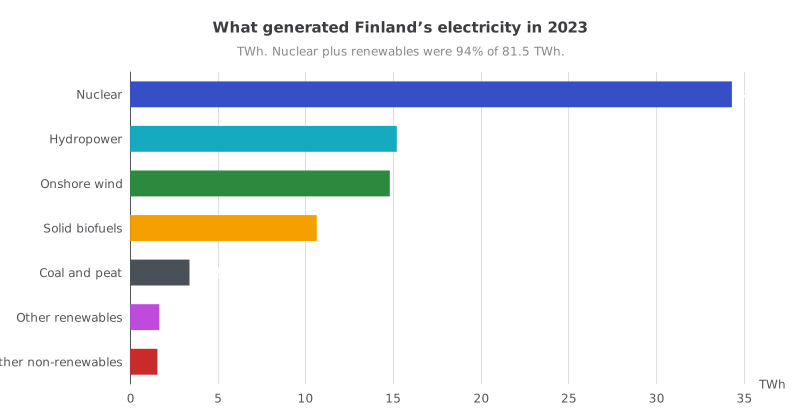
Finland electricity generation by source, 2023, TWh. Nuclear plus renewables were 94% of 81.5 TWh. IRENA classifies nuclear as non-renewable and solid biofuels as renewable; coal and peat are one series. Generation in this snapshot ends in 2023. Source: IRENASTAT.
Politics & Policy
Germany crossed a line it had spent 80 years not crossing: AfD lawmaker Tobias Rausch was elected president of Saxony-Anhalt's state parliament with 48 of 82 votes — the first far-right speaker of a German state legislature since 1945. Le Soir reports five votes came from the left-populist BSW, with four more likely from conservatives who had ruled out cooperation. The AfD then moved itself to the centre of the chamber, because seating charts are also politics.
France's school protests kept widening: students blocked or closed around 1,800 schools, with authorities reporting more than 5,000 detentions since September, 87% of them minors. Spain's prime minister resubmitted rejected housing decrees with interest-free loans of up to €50,000 and called a snap election for 29 November, after an 87-year-old's quadrupled rent became the crisis's face.
In Brazil, Flávio Bolsonaro took the lead in the first round and heads to a runoff against incumbent Lula, with four family members also elected — a dynasty rebuilt in a single cycle. India cut roughly 130 million names from its voter rolls, prompting protests over disenfranchisement. And Trump suggested Iran could 'destroy' Los Angeles and San Diego, drawing rebukes including from a Republican congressional candidate he has endorsed.
Human Stories / Social Trends
Novaya Gazeta's dispatch from Russia's Krasnoyarsk region reads like a horror story about bureaucracy as much as wildlife: bears have killed seven people this autumn and are refusing to hibernate. Dachas stand empty, the region's nature ministry faces a negligence case over a population the security services put at about 26,000, and the official advice is to try to look bigger. The reporter notes this is also a decent strategy for dealing with the state, and he is not entirely joking.
Elsewhere the climate file gives and takes. Switzerland's shrinking glaciers are surrendering archaeological objects from long-frozen mountain passes, while Antarctic sea ice posted its third-lowest annual maximum on record. The past melts out, the future shrinks, and both end up in the same spreadsheet.
In Okinawa, the arrest of a US Marine over the robbery and murder of a woman in Naha has revived a decades-old argument about bases and burden. Researchers found a China-based operation running more than 20 dating apps where three in four profiles were AI, with humans hired mainly for video calls. Politico also reports a jailed Albanian mayor delivering speeches by AI avatar. Romance and municipal government, both outsourced.
Dates and sources
This digest covers the news day 2026-10-06. It is presented retrospectively from a saved draft; its date in the URL identifies the news day, not an assertion of publication on that day. News references link to their original outlets. Supporting research was completed 2026-10-07. Its data vintage and material limitations are recorded in the article methods and chart captions.