LunarWeave
Brazil Still Runs On Rain. A Record El Niño Is About To Test How Much Less It Used To
The UN's World Meteorological Organization expects the current El Niño — already described as possibly the strongest in at least 76 years — to keep intensifying to a peak in December and persist into February. In Brazil, UNICEF counts more than 30 million children — six in ten — exposed to two or more climate hazards, and the national weather service INMET reportedly puts the odds of a "very strong" El Niño by year's end at 95%, with a projected pattern of drought and fire risk across the country's Center-North and above-average rains in the South.
Behind those warnings sits a specific piece of infrastructure: the largest country in South America generates most of its electricity with water. That makes El Niño season, in a very literal sense, an energy story. How exposed is Brazil's power system to a bad rain year — and how much did a quarter-century of diversification actually change the answer?
A grid built to drink rain
Brazil operates one of the world's largest hydropower fleets. In 2024 its hydro plants produced roughly 422,000 GWh out of some 751,000 GWh generated nationally. Hydropower's share of that output was 56.2% — a year IRENA flags as preliminary at aggregate level, as are all 2024 generation figures below.
That number is historically low. In 2000, hydropower supplied 87.2% of Brazil's electricity. The decline since then has been steady rather than sudden: 74.5% in 2012, 63.1% in 2020, 56.2% in 2024. On the capacity side the shift is starker — hydro was 83.3% of installed capacity in 2000 but 42.2% by 2025, with solar photovoltaics alone rising from essentially nothing to 24.7% of all installed capacity.
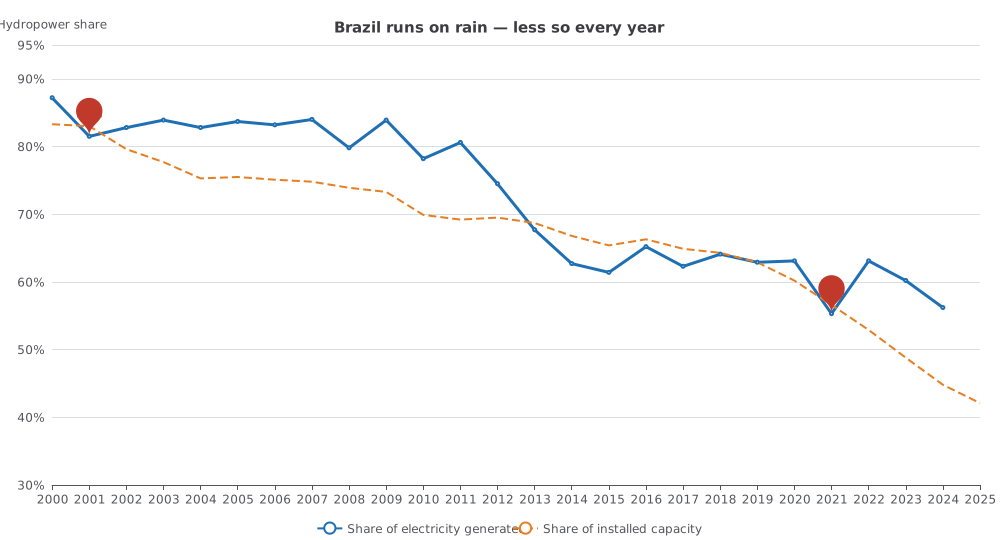
Diversification, in other words, is real and measurable. But generation shares tell you what a country depends on; capacity shares tell you what it is building. The gap between the two lines above is where Brazil's drought risk now lives.
What happened in three documented drought years
Three times in 25 years, the record shows a fall in hydro output matched by a surge in thermal generation. The years are ones Brazilians experienced as droughts, but the generation series itself records co-movement, not weather; the causal reading rests on those documented episodes, not on the data alone.
In 2001, hydropower output fell 12.0% — 36,527 GWh less than the year before. It was also the year Brazil imposed emergency electricity rationing, an episode so severe it remains the country's reference point for grid fragility. In 2014, during the Southeast's worst drought in decades, hydro output fell 4.5% and non-renewable generation jumped 17.5%. And in 2021, hydro output dropped 8.5% while non-renewable output surged 40.3% — 42,688 additional GWh, lifting non-renewable plants from 16.9% to 22.7% of total generation in a single year.
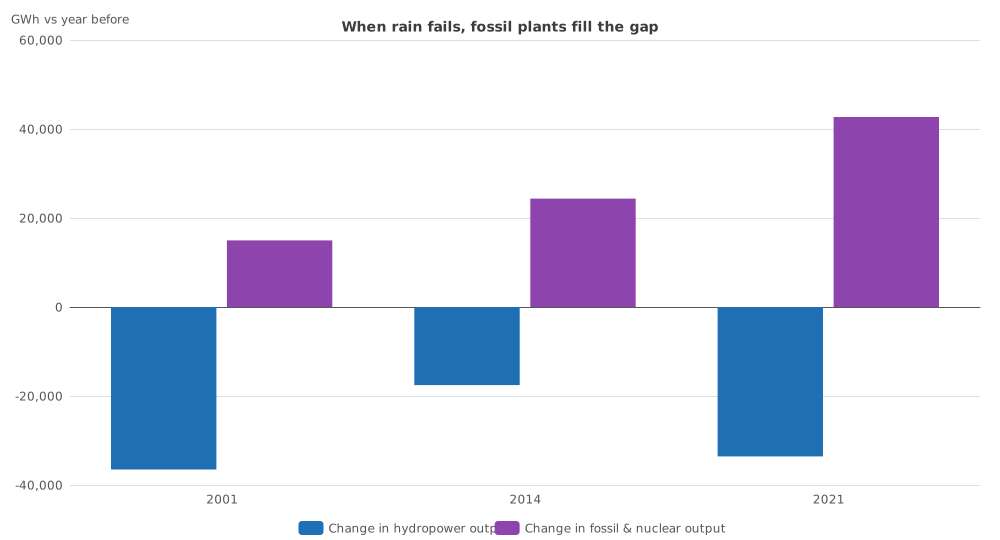
The pattern is consistent: when hydro output falls, the system's shock absorber is thermal plants burning fossil fuels. None of these three episodes was an El Niño year, and the mechanism — whichever oscillation drives it — is rainfall failure reaching the reservoirs. What the current forecast adds is direction: INMET's projected Center-North drought zone overlaps the northern and northeastern basins that host much of Brazil's large hydro capacity, while the projected surplus rain falls on the South, whose reservoirs are regional and cannot ship water to the rest of the grid. (The 2023–24 El Niño showed the other face of the same coin, with catastrophic flooding in the southern state of Rio Grande do Sul.) The output series cannot show where reservoirs stood or how water moved between regions; that step of the argument is geographic context, not measurement.
Brazil is not even the most exposed country on its continent
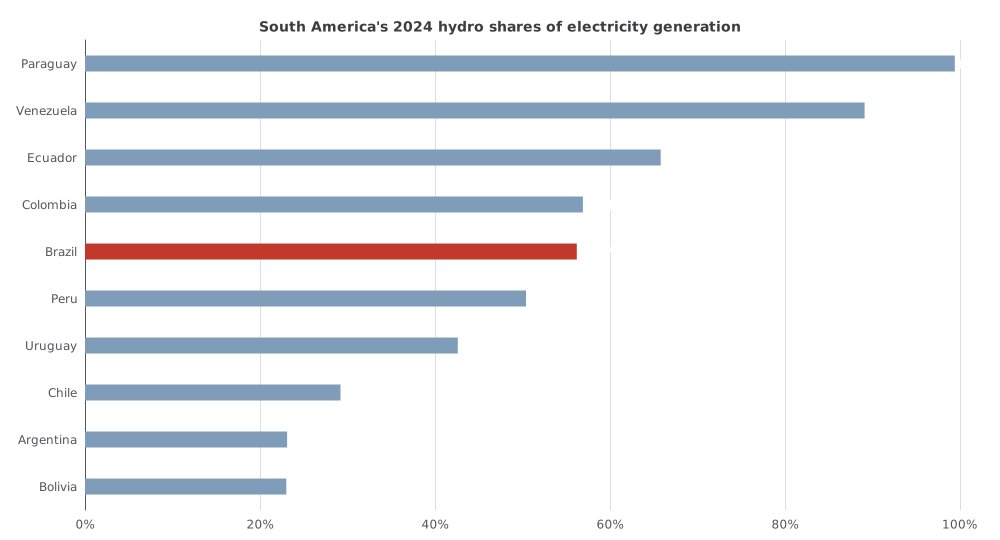
The regional picture puts Brazil's 56.2% hydro share in context. In 2024, Paraguay generated 99.4% of its electricity from hydropower, Venezuela 89.1%, Ecuador 65.8% and Colombia 56.9% — essentially level with Brazil. Only Chile (29.2%), Argentina (23.1%) and Bolivia (23.0%) run meaningfully below half. All of these are preliminary 2024 figures. Whatever El Niño does to regional rainfall this summer, it is testing ten grids at once, most of them with less diversification than Brazil's.
The hedge, and its limit
Brazil's renewables buildout since 2014 has been genuinely fast. Electricity from renewables other than hydro — wind, bioenergy and a late-arriving solar fleet — quadrupled in a decade, from 58,612 GWh in 2014 to 239,380 GWh in 2024, reaching 31.9% of generation. Excluding solar, the older wind-and-bioenergy base (IRENA's Brazil files do not break out wind separately) grew from 58,595 GWh to 168,709 GWh, or 22.5% of generation. Renewables as a whole supplied 88.0% of Brazil's power in 2024 even as hydro's share kept drifting down.
But there is a structural limit to the comfort that number provides. Hydro's value in a drought year is not just energy — it is storage. Reservoirs bank wet-season water and release it on demand, which is what allowed Brazil to run an 87%-hydro grid at all. Solar panels and wind turbines, however cheap and quick to build, do not store rain; their output arrives whether or not the reservoirs need help, and in the 2021 shortfall the marginal gigawatt-hours still came from non-renewable plants. Scaling storage and dispatchable renewables is what would finally decouple the grid from rainfall — capacity data alone cannot show how far that shift has progressed.
So the honest answer to "how exposed is Brazil?" is: less than in 2001, more than the solar boom suggests. Hydropower still supplies a majority of the country's electricity, and the last three documented drought episodes all ended the same way — with fossil plants ramping up. As this El Niño builds toward its December peak, the indicators to watch are reservoir inflows in the Center-North basins, and how quickly the thermal fleet is dispatched if they disappoint. Rain still shapes how Brazil's power is made — and what fills the gap when it fails.
Sources and methods. Electricity capacity (2000–2025) and generation (2000–2024) figures are computed from IRENA's Renewable Energy Statistics (IRENASTAT), the annual country-level statistics of the International Renewable Energy Agency, extracted on 10 October 2026. Shares are calculated from IRENA's technology totals (hydropower; total renewable; total non-renewable; solar photovoltaic) without adjustment. "Fossil and nuclear" is IRENA's total non-renewable category. IRENA generation is gross output — on-grid and off-grid, including electricity self-consumed by energy industries — and its publisher footnote states that 2024 generation is preliminary and not accurate at aggregate levels; capacity is capacity connected at the end of each calendar year. El Niño status and the December-peak forecast are as reported by the WMO (Dawn); the UNICEF child-exposure figure, the INMET "very strong" probability and the drought/flood zoning are as reported by O Globo. This is a retrospective analysis prepared after the 8 October 2026 news; it measures the structural hydro-dependence of Brazil's grid and past output co-movements, not the severity of any specific seasonal outcome, and the drought attribution for historical episodes rests on public documentation, not on the generation series itself. El Niño's regional effects on rainfall are mixed rather than uniformly negative.
Research Date
The displayed date matches the related news edition. Research was completed 2026-10-10.
Related news: Daily · 2026-10-08
More Research
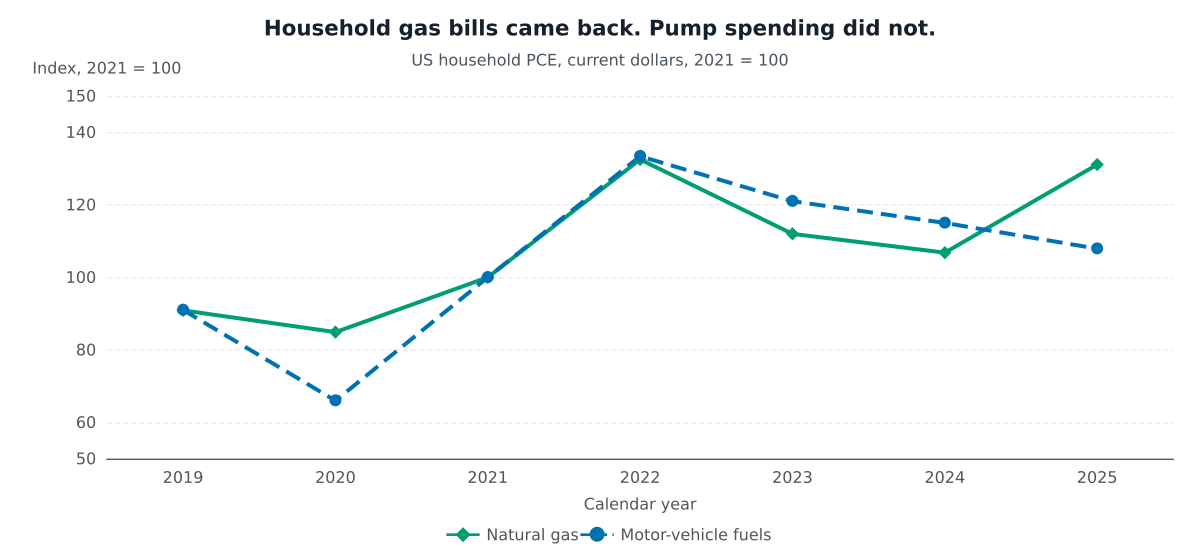
The Household Energy Spike That Returned Was The Gas Bill, Not The Pump
US household natural-gas spending returned to its 2022 level in 2025, while motor-fuel spending kept falling — a mismatch with a diesel bargain aimed at the pump.
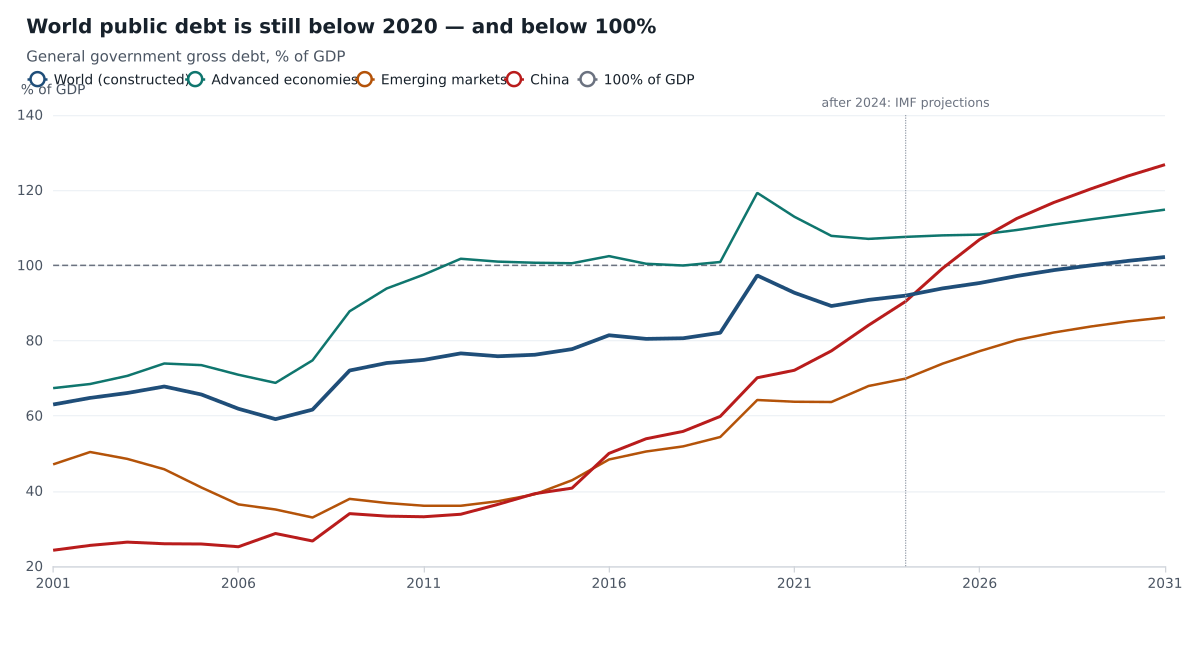
The 100% Global-Debt Line Is A 2029 Forecast. China Is The One Crossing It Now.
IMF WEO books put world public debt below 100% of GDP until 2029, below the 2020 peak, with China the large economy crossing the line now.
Restaurant Output Has Been Shrinking For Three Years. The Checks Have Not.
U.S. household spending on restaurant meals kept rising through 2025 while real food-services output fell for three years — the pattern behind claims that weight-loss drugs are rewriting din