 LunarWeave
Missiles, Markets And A Nobel For The Ancients
World & Security
The Korean peninsula’s missile one-upmanship got another installment: South Korea test-fired a domestically developed hypersonic glide vehicle, days after North Korea launched a medium-range hypersonic missile. In Ukraine, Russia’s war produced the grimmest sort of news: a strike on two buses in Kramatorsk killed 30 and wounded 18, while a Kh-101 missile partially destroyed a five-story apartment block in Pryluky, killing 22 people, including five children. Kyiv endured blackouts and water cuts, with Mayor Vitali Klitschko urging residents to leave.
Ukraine also hit Russian digital infrastructure: drones struck a Yandex data center in Ryazan, the first known attack on a Russian data hub, knocking services offline and coinciding with a wider RuNet outage; Ukrainian special operations also struck the Omsk oil refinery. In the Middle East, Houthi attacks on Saudi airports killed three people, and Riyadh reportedly intercepted ballistic missiles aimed at the capital. The US-Iran file stayed volatile: Trump said he would not attack Iran before the midterms, even as the Pentagon was reported to be preparing large-scale strike options.
Elsewhere, Russia’s opaque handling of a suspected plague death in Siberia drew WHO and EU demands for information. Eritrean forces entering Tigray raised fears of a wider Ethiopia conflict. A sobering reminder that “world and security” is often a polite label for people trying to survive their governments.
Markets & Economy
Oil was the day’s loudest economic signal: Brent rose more than 5%, topping $105, and WTI climbed 4.76% to $92.48, after attacks on tankers around Hormuz and reports the White House might resume strikes on Iran. Wall Street took the hit: Nasdaq fell 1.25%, the S&P 500 dropped 0.47%, and only the Dow eked out 0.10%, as tech sold off and conflicting reports about OpenAI’s revenue shook confidence.
The chip side looked sunnier. Samsung forecast third-quarter operating profit of 107.4 trillion won, up 782.5% year on year, driven by AI memory demand, while TSMC reported record quarterly revenue that beat forecasts. The WTO raised its 2026 merchandise trade growth forecast to 3.9%, crediting an AI investment boom, and said Pakistan’s sea-freight transport exports jumped 73% as shipping rerouted.
But the bill is coming due elsewhere. EU auditors warned unpaid EU loans could reach €1 trillion by 2027; Germany upgraded its 2026 growth forecast to 1.3% while inflation ran at 3.3%; and the IMF cautioned that AI may widen inequality between countries. With global debt nearing 100% of GDP, markets are pricing a world where AI capex is the engine and war is the fuel additive.
Technology & Industry
The AI price war got more literal: OpenAI opened its latest GPT-6 model to free users and added an Intelligent UI, while Anthropic cut the price of Claude Haiku 5.5 to a tenth of previous costs. The Wall Street Journal framed it as OpenAI gaining ground on Anthropic. For users, cheaper chatbots; for competitors, another round of margin-squeezing.
Infrastructure is where the real money is going. The Pentagon unveiled a roughly $350 million quantum computing push; Google agreed to turn to nuclear energy for AI data centers, modernizing 11 reactors; and French startup Sesterce announced a €10 billion Finland data center project. Finland’s data center tally has topped €67 billion, though opposition killed a 90-megawatt project near Sydney over power, water and noise concerns.
Governance remains messy. Trump said anyone using the term ‘artificial intelligence’ instead of ‘superintelligence’ is an enemy, which is one way to settle a vocabulary debate. An AP-NORC poll found 65% of Americans think AI is developing too fast; Spain’s advisory council argued AI companies should be liable for harms; and Japanese and US business leaders called for interoperable AI governance. Meanwhile, CrowdStrike linked a Chinese-speaking hacker using AI tools to breaches at South Korean banks, Seoul warned AI-aided hacking could spread, and the suspect allegedly left a trail by chatting with AI.
Politics & Policy
South Korea recalled its ambassador to Ukraine after Kyiv publicly disclosed the transfer of two North Korean prisoners of war, a disclosure Seoul said endangered their families; Ukraine rejected the claim of a non-disclosure agreement. In Washington, the US suspended Microsoft, Adobe and other major IT firms from the PERM green-card programme, with Vance accusing Microsoft of abusing H-1B and officials naming Cognizant, Infosys, Tata, Wipro, HCL and Capgemini. Nine universities, including Harvard, Yale and Stanford, were also put under investigation.
Israel declared the British consulate in Jerusalem closed and expelled 20 diplomats, but Britain said the building would remain open as the UK Mission, Jerusalem, serving Palestinians. France’s student protests entered a third week, with hundreds of schools shut, the government suspending shock grenades after a 15-year-old lost a hand, and Liège imposing a ban on gatherings of more than three people after riots.
In India, Gen Z-led protests demanded the election commissioner’s resignation over a voter-roll revision that excluded 133 million names; the Cockroach Janta Party has made itself a real headache for Modi. Italy’s Giorgia Meloni staked her government on a controversial electoral reform vote. And the US opened direct talks with Myanmar’s generals, even as Malaysia hosted Min Aung Hlaing. Russia, not to be outdone, demanded the Netherlands hand over the ICC president and eight others.
Human Stories / Social Trends
Spain’s housing crisis found its martyr. Maricarmen Abascal, 87, died two weeks after being forcibly evicted from the Madrid apartment she had lived in for more than 70 years. Her case fuelled protests across the country; unions called a general strike for 11 November, Congress rejected a package that would have suspended evictions, and Sánchez called early elections for 29 November. Mourners left candles and flowers at the Puerta del Sol camp, where activists called her ‘the grandmother of an entire country’.
In the US, Christa Pike survived two doses of pentobarbital after what was supposed to be Tennessee’s first execution of a woman in more than 200 years. Her lawyer told the BBC she could stand and walk but remained confused and very weak, possibly with permanent damage. The state suspended executions and its prison chief resigned.
Culture and science lost a giant: Margaret Hamilton, whose software powered Apollo 11, died at 90. Anne Carson won the Nobel Prize in Literature for work that plays with classical tradition. On the health front, an NHS England review warned of ‘system failures’ as ADHD and autism demand soars, and a South Korean survey found 69.2% of teens used generative AI for emotional support. El Niño could be one of the strongest since 1950, with 30 million Brazilian children exposed to climate risks.
Research In Context
Research attachment: what a record El Niño means for Brazil's power grid
The day's headline that an El Niño possibly unmatched since 1950 will peak in December lands hardest in Brazil, where UNICEF says six in ten children — over 30 million — already face multiple climate hazards. The reason a weather pattern is an energy story: Brazil still generated 56.2% of its electricity from hydropower in 2024 (a preliminary IRENA figure), even after two decades in which that share fell from 87.2% in 2000.
The record shows what a bad rain year costs. In 2001 hydropower output fell 12.0% and the country rationed power; in 2021 it fell 8.5% and non-renewable plants ramped up 40% to cover the gap. Solar (24.7% of capacity by 2025) and other renewables have diversified the system, but panels do not store rain — in drought years the shock absorber is still thermal fuel, and Brazil is only mid-pack in a South America where Paraguay (99%) and Venezuela (89%) are even more hydro-dependent.
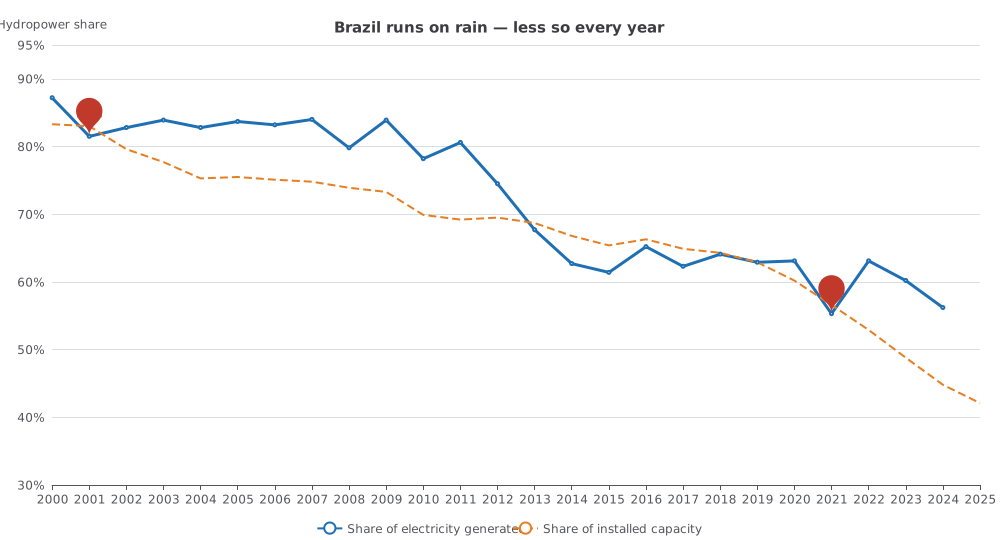
Full analysis: Brazil still runs on rain — the drought ledger, the regional comparison, and what would finally break the link between rainfall and Brazilian power.
Dates and sources
This digest covers the news day 2026-10-08. It is presented retrospectively from a saved draft; its date in the URL identifies the news day, not an assertion of publication on that day. News references link to their original outlets. Supporting research was completed 2026-10-10. Its data vintage and material limitations are recorded in the article methods and chart captions.