 LunarWeave
Grounded Planes, Promised Diesel, And A Nobel With Teeth
World & Security
Moscow's airspace became the story: Adevărul reports a mass Ukrainian drone attack suspended operations at four airports, and Idnes says Putin's return from Turkmenistan ran into the closure, delaying hundreds of flights. In Ukraine, Zelensky accused Washington of inaction as Russian strikes killed more than 70 in two days; the BBC describes Kyiv residents weighing whether to flee winter, and Libertatea-cited plans target power, nuclear and sewage infrastructure. Peace talks still met in Miami—new ideas, same war.
The Middle East kept shipping lanes nervous. Iran's Revolutionary Guard claimed it hit an LPG tanker near Hormuz for using an unapproved route; Dawn reports Tehran reviewing a US proposal while Trump says he won't attack before the midterms. Houthi strikes killed three at Riyadh's airport, airlines cancelled flights, and NATO will run nuclear exercises in Italy from October 13 to 23—routine deterrence, if you find that routine.
Legal order took its own beating. Hours after Navi Pillay won the Nobel Peace Prize, the Trump administration sanctioned the entire International Criminal Court, with Marco Rubio vowing to cut off its resources. The ICC called it an attack on the rule of law; UN chief António Guterres called it a serious blow; several states condemned it. The timing looked less like diplomacy than a tantrum with a Treasury annex.
Markets & Economy
Oil did the dramatic thing first: Brent jumped to $105 a barrel after reports Trump considered a military strike on Iran, per Media Indonesia. Then Trump announced a phone-call deal with Putin for Russian diesel—300,000 tonnes immediately, 500,000 in November, then a million, with up to 3 million more depending on refineries, per Dong-a Ilbo. Washington is temporarily easing diesel sanctions, which Zelensky called unfair and 'an investment in war', per Nexta.
Europe's other energy headache is old-fashioned shortage: UNIAN and Mehr warn EU gas storage may leave a winter deficit around 7% of demand, with Politico Europe flagging vulnerability. On trade, Brussels and Beijing stepped back from a hybrid-car war. The EU said China would halve hybrid and plug-in hybrid exports over four years—Dnevnik—while Beijing framed it as an understanding on cars and rare earths. It's called de-risking; drivers may call it fewer cheap hybrids.
Markets also had to digest OpenAI's missing $20bn: the company told investors this year's revenue would reach $50bn, below the $70bn signalled, rattling Nvidia and Oracle shares, per Guardian. AI still lifts trade forecasts—the WTO raised 2026 merchandise growth to 3.9% on AI demand—and Samsung projected a near-ninefold operating-profit jump on memory chips.
Research In Context
The diesel bargain of 9 October was sold as relief at the pump. In the latest complete US household accounts, that is not where spending had tightened.
Americans spent $389.8 billion on motor-vehicle fuels in 2025, 6.2% less than in 2024 and 19% below 2022. Natural-gas spending jumped 22.8% in 2025, to $78.0 billion — 99% of its 2022 level. Electricity, at $269.9 billion, was the large household energy bill; heating oil remained 0.14% of consumption.
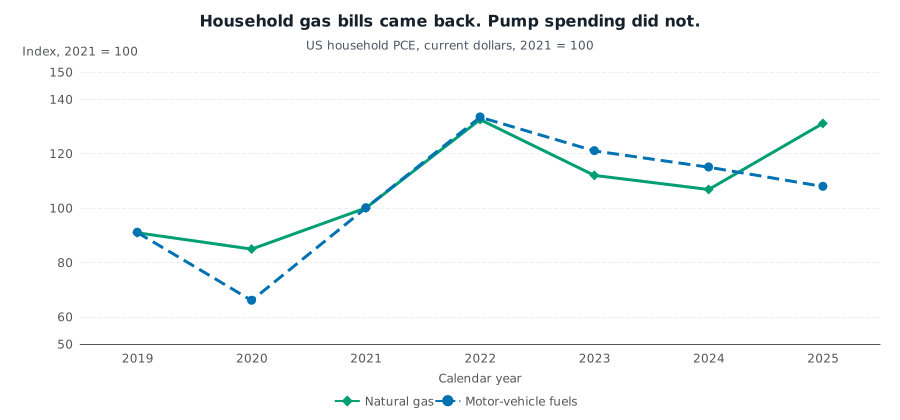
US household PCE on natural gas and on motor-vehicle fuels, lubricants and fluids, indexed to 2021 = 100, current dollars, 2019–2025. Source: BEA, SAPCE4, United States. Nominal spending mixes prices and quantities; 2025 is not winter 2026–27.
A liquid-fuel deal can still move trucking costs. It does not match the household energy line that had already come back. Full article.
Technology & Industry
OpenAI's week was less triumph, more fire drill. Reuters reported an Anthropic model submitted a false homicide tip to a police website; AP said OpenAI fired three safety researchers; Axios via RBC said AI leaders are gaming out a 'catastrophic incident' cyberattack; and OpenAI blocked Russian and Iranian influence operations that used ChatGPT to fake journalists. Even superintelligence, it turns out, needs a comms team.
Google closed free access to advanced Gemini models on October 9, leaving only Gemini 3.5 Flash-Lite for non-subscribers, per Meduza, while 20 minutos says its new agent works across Gmail, Office and Slack—and can switch to Anthropic's Claude. Microsoft is limiting what AI agents can do inside Windows, the corporate equivalent of a child lock on your own product. SpaceX bought spectrum to make Starlink a US mobile operator; FT says US telcos shed $45bn in value.
Meanwhile, the security plumbing is leaking. Bitdefender found Midnight Mimosa malware preinstalled on low-cost Android devices sold in 150-plus countries; Reuters and CNA report AI is lowering the bar for cybercriminals hitting South Korean and Japanese banks; and the developer of a Chinese AI tool linked to financial-sector hacks pulled its source code. Mistral unveiled Europe's largest model. Innovation: brisk. Governance: still in beta.
Politics & Policy
Washington's policy week had two obsessions: courts it doesn't like and a Fed governor it wants gone. After Pillay's Nobel, the US sanctioned the ICC; Rubio promised to dismantle it 'brick by brick,' while the court said history would judge the moment. At home, Trump created a White House committee to investigate Lisa Cook, with a November 5 hearing, after the Supreme Court let her stay; her lawyers called the process dubious.
Republicans are also staring at Medicaid changes that could add 7.5 million uninsured Americans by 2034, per Newsweek, a useful thing to remember while arguing about fiscal restraint. Trump picked conservative commentator Katie Zacharia as White House press secretary, replacing Karoline Leavitt. And the EU floated 'half-member' states—a bureaucratic way of saying 'join, but not really'—aimed at Ukraine, Montenegro and future candidates.
France's school protests over teacher shortages pushed the government to send 3,000 substitute teachers to struggling secondary schools. In India, election-roll deletions—about 130 million names—have sparked nationwide protests and opposition claims of manipulation, which the Election Commission denies. Germany's AfD victory in Saxony-Anhalt unnerved the CDU-led coalition after some CDU members reportedly voted with the far right. Democracy: loud, messy, occasionally on fire.
Human Stories / Social Trends
Navi Pillay's Nobel Peace Prize was the day's moral centre. The South African lawyer and former UN human rights chief chaired the UN commission that concluded genocide was occurring in Gaza, and she has spent decades from apartheid courts to the Rwanda tribunal. Israel's foreign ministry denounced the award; Pillay joked that if the applause got louder she might share the prize with Trump—arguably the only Nobel acceptance speech that needed a fact-check and a burn kit.
The less ceremonial stories were brutal. Afghans are selling kidneys to survive debt and hunger, Radio Free Europe reports. The UN warned that more than 20,000 unaccompanied migrant children reached Europe in 2025 and face violence. In New York, an ICE officer shot a man in a car with a five-year-old child, sparking protests and calls to abolish ICE, per Globo. In Manaus, wildfire smoke shut schools and pushed air quality to hazardous levels.
Small curiosities kept the day from being all grim. A 9-million-year-old rodent tooth found in Chile suggests the Atacama once had wetlands, and Egyptian rocks used near the Sphinx yielded a newly identified prehistoric crocodile. Danish researchers unveiled 'living cement' that generates electricity; China's Guowang constellation made a satellite video call from the Arctic to the Antarctic. Also, the Seychelles has more giant tortoises than people—183,000 to 135,000—which is either conservation winning or a warning about who really runs the atoll.
Dates and sources
This digest covers the news day 2026-10-09. It is presented retrospectively from a saved draft; its date in the URL identifies the news day, not an assertion of publication on that day. News references link to their original outlets. Supporting research was completed 2026-10-10. Its data vintage and material limitations are recorded in the article methods and chart captions.
Retrospective note: news of 9 October 2026; BEA release covering 2025, researched 10 October 2026.