LunarWeave
The AI Boom Is Real. The Software-Jobs Boom Isn't.
For three years, the public argument about artificial intelligence has been about whether it is going too fast. Chip stocks wobble whenever "slowdown" talk surfaces; Nvidia's chief executive argues against hitting the brakes, Anthropic's argues for them; OpenAI is reportedly discussing a fundraising that would value it around $1.2 trillion ahead of an IPO (Dong-a Ilbo, Bloomberg). Meanwhile a study reported on September 15, 2026 found that US computer-science graduates exposed to AI saw their initial income fall 13 percent after ChatGPT's arrival (Dong-a Ilbo).
The official jobs data add a fact that both camps have mostly talked past: the software workforce itself has been shrinking since ChatGPT arrived. The United States employs fewer people writing, designing and hosting software today than it did in November 2022 — not fewer than at some pandemic peak, fewer than when the AI era began — while the overall economy added 4.6 million jobs.
What the payroll data show
The Bureau of Labor Statistics' Current Employment Statistics survey counts payroll jobs monthly, by industry, nationwide. Four series bracket the industries that build and run software:
| Industry (payroll employment, seasonally adjusted) | Nov 2022 | Jun 2026 | Change | Same window before Nov 2022 (annualized) |
|---|---|---|---|---|
| Computer systems design & related services | 2,482,900 | 2,369,200 | −113,700 (−4.6%) | +3.7%/yr |
| Software publishers | 664,300 | 659,700 | −4,600 (−0.7%) | +11.3%/yr |
| Data processing, hosting & related (incl. data centers) | 483,000 | 461,100 | −21,900 (−4.5%) | +10.6%/yr |
| Information supersector (incl. telecom & media) | 3,115,000 | 2,769,000 | −346,000 (−11.1%) | +2.6%/yr |
| All US nonfarm payrolls | 154,242,000 | 158,881,000 | +4,639,000 (+3.0%) | +0.7%/yr |
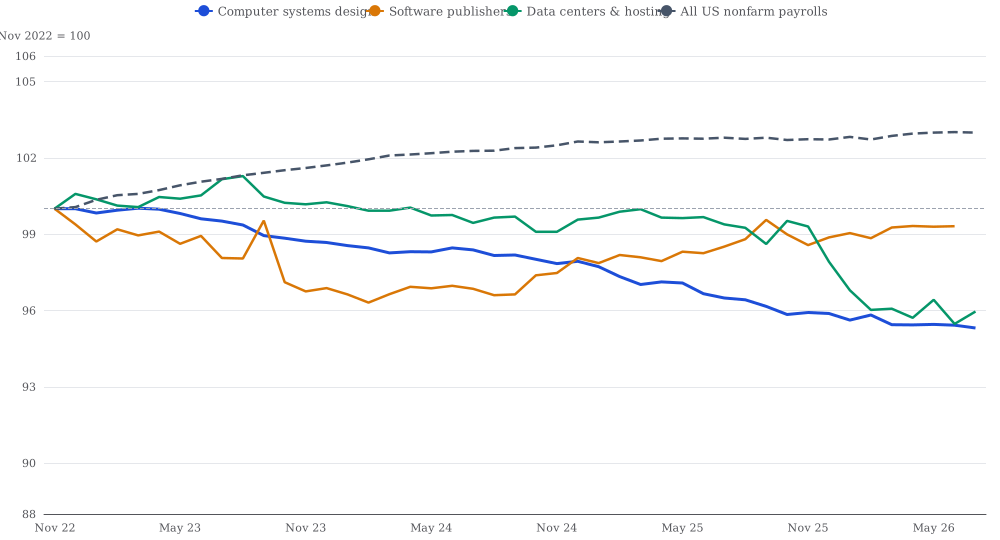
Computer systems design and related services — the NAICS category that captures the consultants, integrators and custom-software firms that employ most US coders outside of product companies — peaked in March 2023 at 2,483,500 jobs, barely three months after ChatGPT launched. It has declined almost continuously since: as of June 2026 it stood at 2,369,200, a loss of 113,700 jobs (−4.6 percent), rewinding the industry to its October 2021 headcount. Even the data-center and web-hosting category — the industry one might expect to be booming with AI compute spending — is down 4.5 percent from November 2022. The broader information supersector, which also contains telecommunications and legacy media, peaked the very month ChatGPT was released and has fallen 11.1 percent, to its lowest level in the entire 2007–2026 series. (Software publishers is the exception that proves the point: it merely stopped growing, after adding jobs at 11.3 percent a year in the equivalent pre-ChatGPT window.)
Meanwhile, total nonfarm payrolls rose 3.0 percent over the same 43 months. Whatever is happening to software employment is not happening to the labor market as a whole.
A break in the trend, not just pandemic payback
The obvious objection: 2021–22 was a pandemic-era hiring binge, so the "before" numbers are inflated. They are. But the comparison survives that objection. Compare equal-length windows — the 43 months before ChatGPT's launch (April 2019–November 2022) against the 43 months after (November 2022–June 2026):
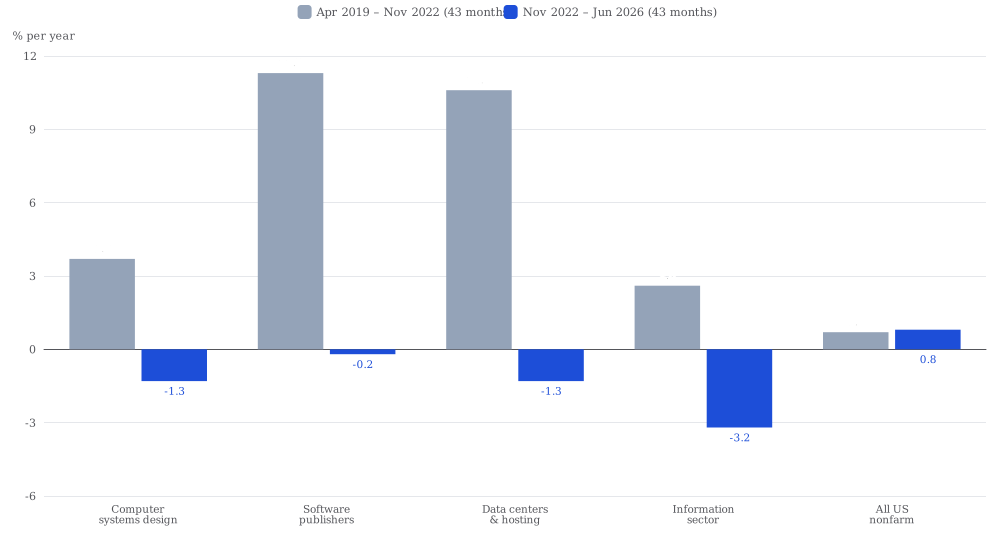
Even against a more sober seven-year baseline — November 2015 to November 2022, which averages the pandemic surge with the ordinary years before it — computer systems design grew 3.5 percent a year. After November 2022 it has contracted 1.3 percent a year. The sign flipped. For an industry that grew through the 2008–09 financial crisis (a dip of roughly 2 percent that lasted about a year) and a global pandemic, a decline that is now three and a half years old, 4.6 percent deep and still unfinished, is a genuinely new regime — the deepest sustained contraction in this series' two-decade history.
The long view
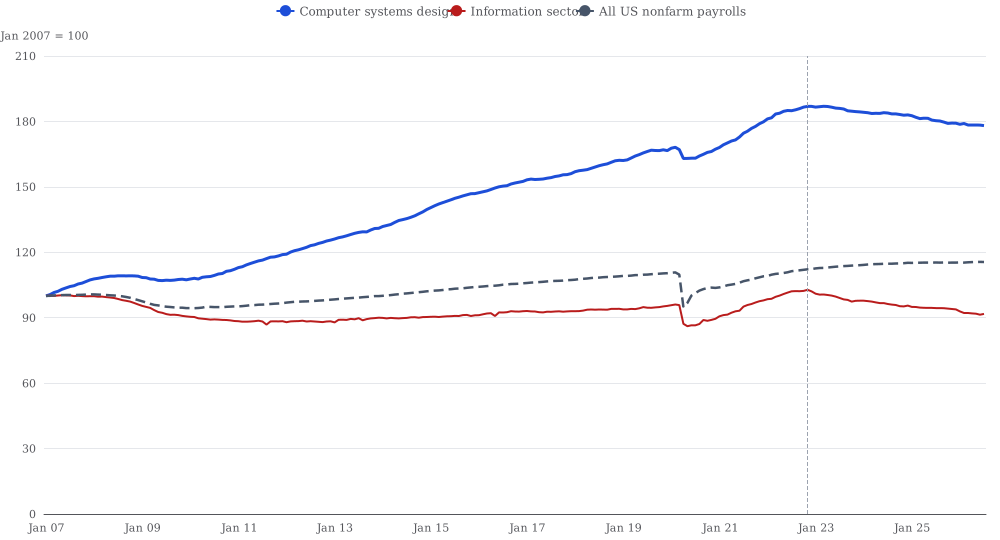
Put on a chart starting in 2007, the story is stark. Computer systems design employment nearly doubled from January 2007 to its 2023 peak, shrugging off the financial crisis with a dip so shallow it is barely visible. The line then bends down and keeps drifting: −3 percent just over the past two years (June 2024 to June 2026), with no recovery in sight through June 2026. The July 2026 reading, 2,366,400, is preliminary and essentially unchanged.
Paychecks say less than they seem to
Two labor-market signals move in the opposite direction, and both deserve care. Average hourly earnings in computer systems design rose from $56.03 in November 2022 to $63.69 in June 2026 — up 13.7 percent, roughly matching its pace over the pandemic-era window before it. That is an average across everyone still employed: it is consistent with an industry shedding its newest, cheapest workers and keeping its seniors, which is exactly the pattern the reported 13 percent drop in CS graduates' starting income would predict. Average pay and entry-level pay can move in opposite directions when the bottom of the pyramid is thinning out. Neither number proves AI is the cause; both are compatible with a cooler market for junior technical labor.
What the data cannot settle
Payroll counts establish the what, not the why. At least three forces plausibly overlap. First, correction: firms over-hired technologists in 2021–22 and have been normalizing since — though normalization that lasts four years and deepens through 2026 starts to look structural. Second, money: with the 10-year Treasury yield above 5 percent and the Federal Reserve raising, not cutting, rates — the backdrop to September 15, 2026's market news — labor-intensive expansion everywhere gets harder, and rate-sensitive software firms especially so. Third, substitution: if AI tools let a smaller team ship the same output, the first place it shows up is exactly here — flat output per firm with fewer entry-level coders. The employment data cannot adjudicate among these, and this analysis does not claim to.
What they do establish is the ground truth under a very loud debate. The AI economy of 2026 is one of record capital valuations, booming spending on chips and data centers — and a software workforce that is 114,000 jobs smaller than when it started. Whatever "speeding up" is doing, it is not, so far, doing it through software hiring. That is the context in which a 13 percent starting-income decline for new CS graduates, a "cognitive surrender" debate about students outsourcing their thinking, and a $1.2 trillion fundraising round all land on the same day.
Methods and sources note
This is a retrospective research analysis prepared on September 16, 2026, using data available at that time; it revisits the news of September 15, 2026 and does not imply any data were known on that date. Employment figures are from the US Bureau of Labor Statistics Current Employment Statistics national payroll series (all employees, seasonally adjusted, thousands), pinned public snapshot of August 24, 2026, retrieved through the 2026-08-24 release: computer systems design and related services (NAICS 5415/5412, series CES6054150001), software publishers (CES5051320001), computing infrastructure providers, data processing and web hosting (CES5051800001), the information supersector (CES5000000001), total nonfarm (CES0000000001), and average hourly earnings in computer systems design (CES6054150003). July 2026 observations carry BLS preliminary ("P") status and are used only as a footnote, not in the calculations, which end at June 2026 — the latest month available for all series. Window comparisons use equal 43-month spans; annualized rates are compound monthly growth. CES estimates are subject to benchmark revision. The 13 percent CS-graduate income figure and the $1.2 trillion OpenAI valuation are reported claims from the linked news sources, not findings verified here. Computer systems design sits in the professional and business services supersector, not the information supersector; the two are reported separately above. Detailed series metadata, extracts and calculation code are retained with this article's evidence files.
Research Date
The displayed date matches the related news edition. Research was completed 2026-09-16.
Related news: Daily · 2026-09-15
More Research
The Border Surge Ended. Florida's Detention Boom Had A Different Engine
When the Department of Homeland Security's inspector general reported this month that detainees at the now-closed "Alligator Alcatraz" centre in Florida had been held in…
Trucking Jobs Are Below 2019. The Rest Of The U.S. Job Market Is Not.
U.S. truck transportation payrolls peaked in 2022 and were still below July 2019 in July 2026, even as total nonfarm jobs grew — the starting point for a reported diesel-margin spike.
The American Workweek Already Left 40 Hours. It Has Not Reached 32.
U.S. private payrolls already average 34.3 hours a week. A 32-hour bill would still cut factories, mines and trucks, not a four-day national norm.