LunarWeave
The American Workweek Already Left 40 Hours. It Has Not Reached 32.
A 32-hour week with no cut in pay is being offered as the workers’ share of an artificial-intelligence boom. Infobae reports that Sen. Bernie Sanders and Rep. Mark Takano have introduced a bill to get there over four years, explicitly to protect incomes as machines take on more of the work.
The slogan still sounds like a leap from the statutory 40-hour week written into U.S. overtime law. Payroll records tell a different story. The typical private job already sits close to 34 hours — not because offices have moved to a four-day week, but because the average mixes full-time and part-time jobs. The industries that still run a 40-hour-plus week are factories, mines, utilities, warehouses and trucks. Those are the places a 32-hour rule would actually bite.
The average is 34 hours, and it has been for a generation
In July 2026, employees on U.S. private payrolls worked an average of 34.3 hours a week, according to the Bureau of Labor Statistics Current Employment Statistics (seasonally adjusted, preliminary). In March 2006, the first month the all-employee hours series exists, the same average was 34.2 hours. Twenty years of smartphones, warehousing software and, latterly, generative AI have moved the needle by a tenth of an hour.
That 34-hour figure is easy to misread. It is a payroll mean, not the usual week of a full-time worker. Part-time cashiers and cooks pull it down; miners and machine operators pull it up. It also excludes the self-employed and most government jobs. It is still the right number for a national “how long is the job?” question, because it is what firms report for the people on their books.
The longer record belongs to production and nonsupervisory employees, who have been measured since 1964. Their average week was 38.2 hours in January 1964 and 38.5 hours across that year. By 1990 it had fallen to 34.3 hours. In July 2026 it was 33.8 hours. Almost the entire decline happened before the World Wide Web. The AI years have not restarted it.
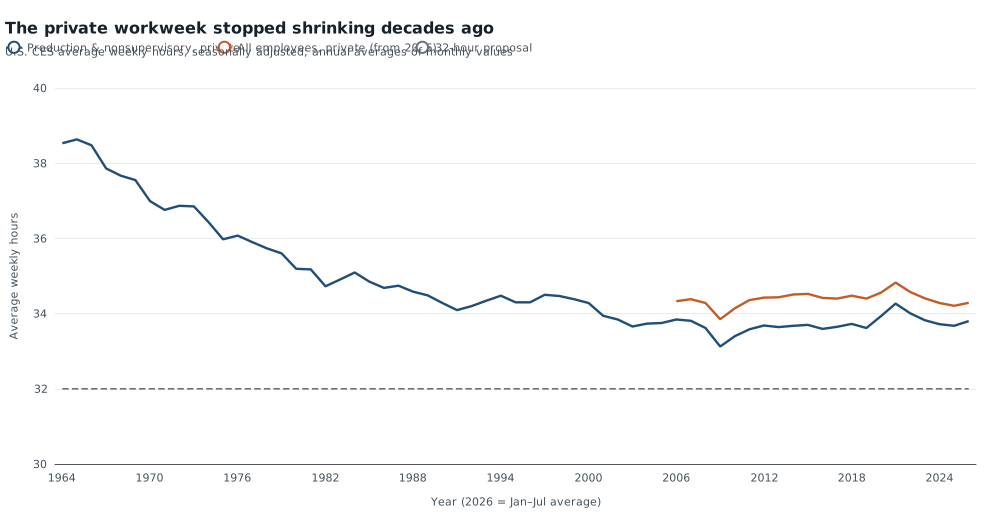
Annual averages of seasonally adjusted monthly average weekly hours on U.S. private payrolls. Navy: production and nonsupervisory employees, 1964–2026. Rust: all employees, 2006–2026. Dashed line: 32 hours. 2026 is the January–July average. The CES mean includes part-time employees. Source: U.S. Bureau of Labor Statistics, Current Employment Statistics.
A 32-hour week is only 2.3 hours below the July 2026 private average — a 7 percent cut in that mean, against a 20 percent cut from a 40-hour week. If weekly pay were held fixed, the private average would imply about a 7 percent rise in hourly pay. Manufacturing’s 40.4-hour week would imply a 26 percent hourly rise. Those are arithmetic illustrations, not cost estimates: they say nothing about overtime substitution, exempt salaried staff, or whether firms would hire, automate, or shrink output.
The long week is still a goods-producing week
The national average is a blend of two economies.
Goods-producing industries — mining, construction and manufacturing — averaged 40.2 hours in July 2026 on 21.6 million jobs, 15.9 percent of private payrolls. Private service-providing industries averaged 33.2 hours on 114.0 million jobs.
Inside the goods sector the week is not a relic. Manufacturing all-employee hours were 40.4 in July, including 3.1 hours of overtime; production workers in factories averaged 41.7 hours. Mining and logging averaged 46.1 hours. Utilities averaged 42.6. Construction averaged 39.5. Truck transportation averaged 40.7 hours in June; warehousing and storage averaged 40.0. Those industries still look like a 40-hour world with overtime on top.
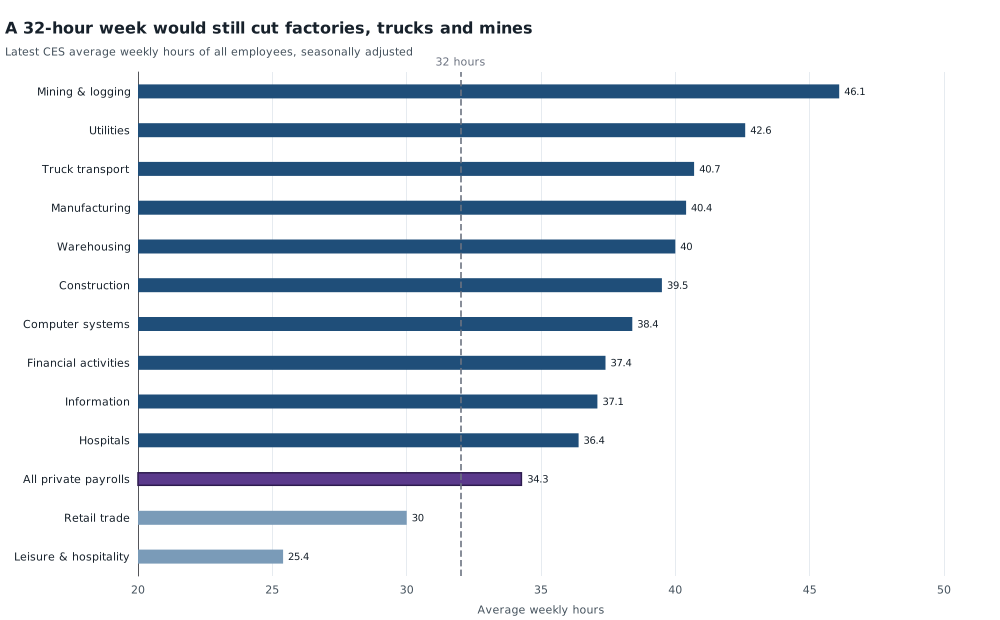
Seasonally adjusted average weekly hours of all employees. Most series are July 2026 (preliminary); trucking, warehousing, hospitals and computer systems design are June 2026. Navy bars are at or above 32 hours; lighter bars are below. Purple is the private-payroll average. Dashed line: 32 hours. Averages include part-time employees. Source: U.S. Bureau of Labor Statistics, Current Employment Statistics.
| Industry | Average weekly hours | Jobs (thousands) |
|---|---|---|
| Mining and logging | 46.1 (Jul) | 607 |
| Utilities | 42.6 (Jul) | 608 |
| Truck transportation | 40.7 (Jun) | 1,465 |
| Manufacturing | 40.4 (Jul) | 12,611 |
| Warehousing and storage | 40.0 (Jun) | 1,835 |
| Construction | 39.5 (Jul) | 8,343 |
| Computer systems design | 38.4 (Jun) | 2,366 |
| Hospitals | 36.4 (Jun) | 5,770 |
| Total private | 34.3 (Jul) | 135,588 |
| Retail trade | 30.0 (Jul) | 15,441 |
| Leisure and hospitality | 25.4 (Jul) | 16,931 |
Jobs are seasonally adjusted CES all-employee counts for July 2026 (preliminary), in thousands. Hours are all-employee weekly averages for the month shown. Computer systems, trucking, warehousing and hospitals hours end in June in this snapshot.
Leisure and hospitality averaged 25.4 hours on 16.9 million jobs; retail trade averaged 30.0 hours on 15.4 million. Together they are nearly a quarter of private employment, and both sit below 32 hours. That is not evidence that hotels and stores have adopted a four-day full-time week. It is evidence that those industries employ a large part-time share. A legal 32-hour overtime threshold would still bind on their full-time staff. The CES average cannot say how many.
The AI industry is not on a 32-hour week either
The bill’s reported rationale is that AI will raise output per hour, so the gains can be taken as time rather than as a pay cut. The payroll industry closest to that story is computer systems design and related services: 2.4 million jobs in July, averaging 38.4 hours in June. The broader information supersector averaged 37.1 hours in July; financial activities averaged 37.4. White-collar hours are shorter than a mine shift. They are not a four-day week.
Nor did hours fall as the models arrived. The all-employee private average was 34.4 hours across 2019, 34.8 hours across 2021 — a bounce that mostly reflected the temporary disappearance of low-hour leisure jobs during lockdowns — and 34.2 hours across 2025. July 2026, at 34.3, is where the series started.
What the 32-hour fight is actually about
If the political argument is “everyone still works 40 hours,” the establishment survey contradicts it. If the argument is “AI is already delivering a shorter week,” the same survey contradicts that too. The country took its big hours decline between the mid-1960s and 1990. It has since split: a service majority whose average is dragged below 34 hours by part-time schedules, and a goods, logistics and energy minority that still puts in something close to a full overtime week.
A 32-hour law with no loss of weekly pay would be a modest nudge to the national average and a large change on the factory floor, the loading dock and the mine. Whether that is the right way to distribute productivity gains is a political choice. The payroll data only settle the premise. The American workweek already left 40 hours. It stopped well short of 32.
Sources and methods
This article is retrospective. It was researched on 13 September 2026, after a 12 September 2026 news cycle, using a frozen Current Employment Statistics snapshot dated 24 August 2026 (latest month: July 2026, preliminary). Hours are BLS CES seasonally adjusted averages for all employees unless labelled as production and nonsupervisory. They include part-time payroll employees and exclude the self-employed. Annual figures are unweighted means of the monthly seasonally adjusted values; 2026 annual averages use January–July. Employment levels are CES all-employee counts, in thousands. Series identifiers include CES0500000002 (private all-employee hours) and CES0500000007 (production and nonsupervisory hours). Official file documentation is in the CES bulk text notes. The Sanders–Takano bill is cited from contemporaneous reporting, not from the legislative text.
Research Date
The displayed date matches the related news edition. Research was completed 2026-09-13.
Related news: Daily · 2026-09-12
More Research
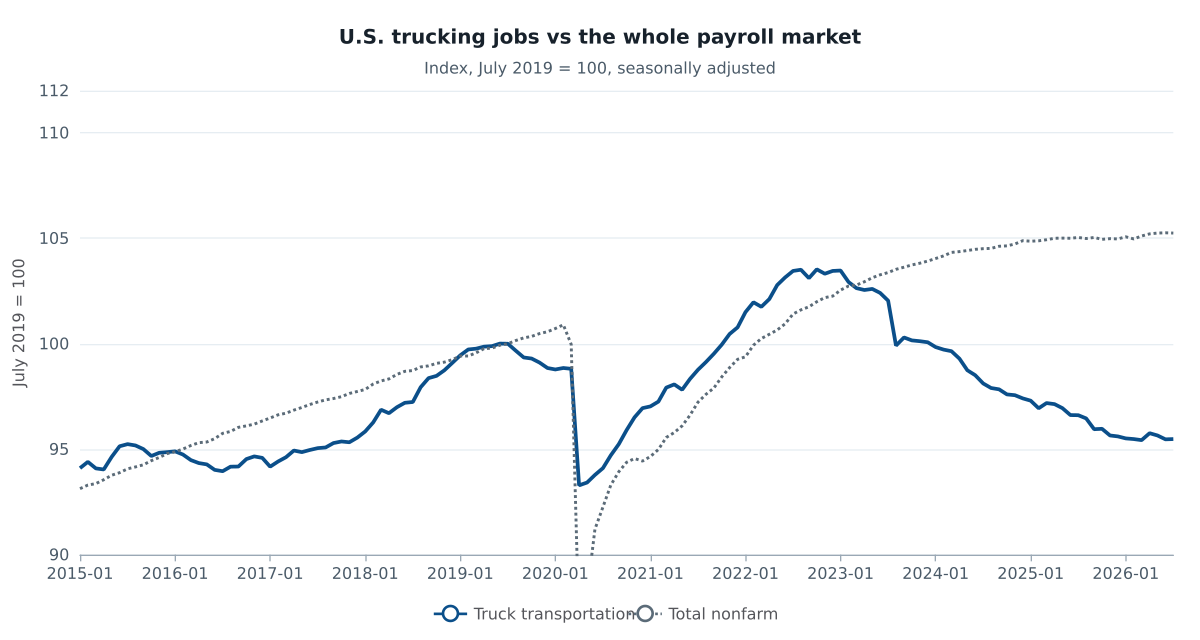
Trucking Jobs Are Below 2019. The Rest Of The U.S. Job Market Is Not.
U.S. truck transportation payrolls peaked in 2022 and were still below July 2019 in July 2026, even as total nonfarm jobs grew — the starting point for a reported diesel-margin spike.
The Last Time Japan’s Policy Rate Was 1.25%, Prices Were Falling
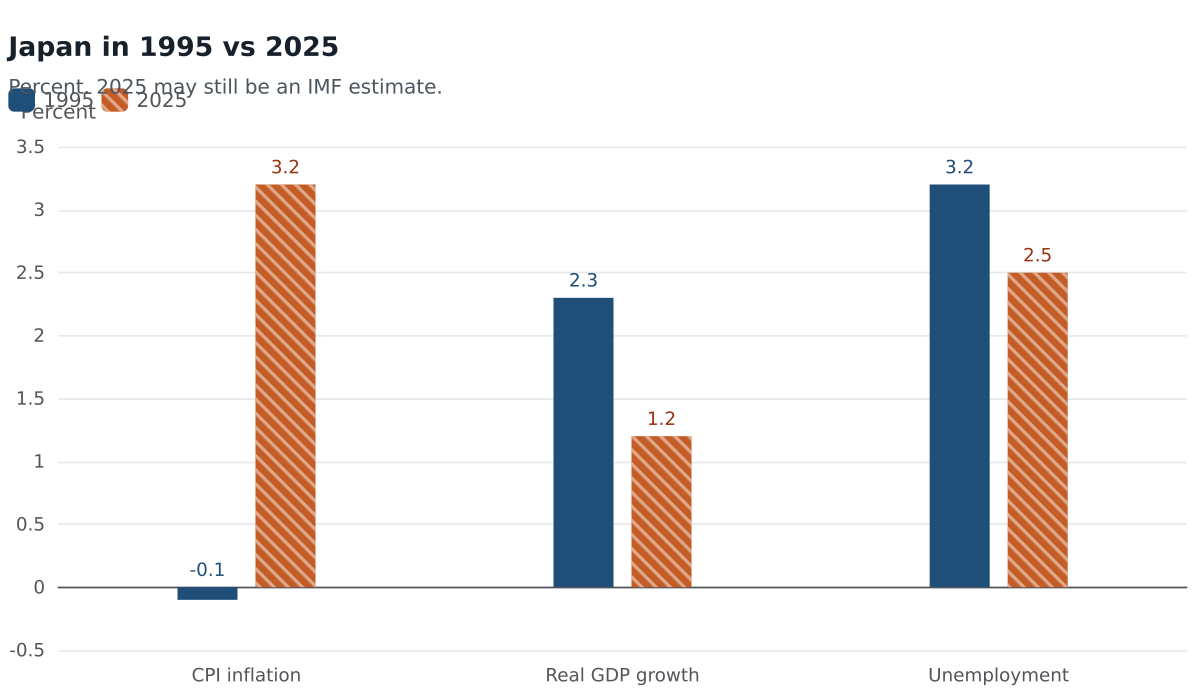
The Bank of Japan’s reported 1.25% policy rate was last seen in 1995, when consumer prices were falling. IMF accounts show 2025 inflation at 3.2% after a 2024 contraction.
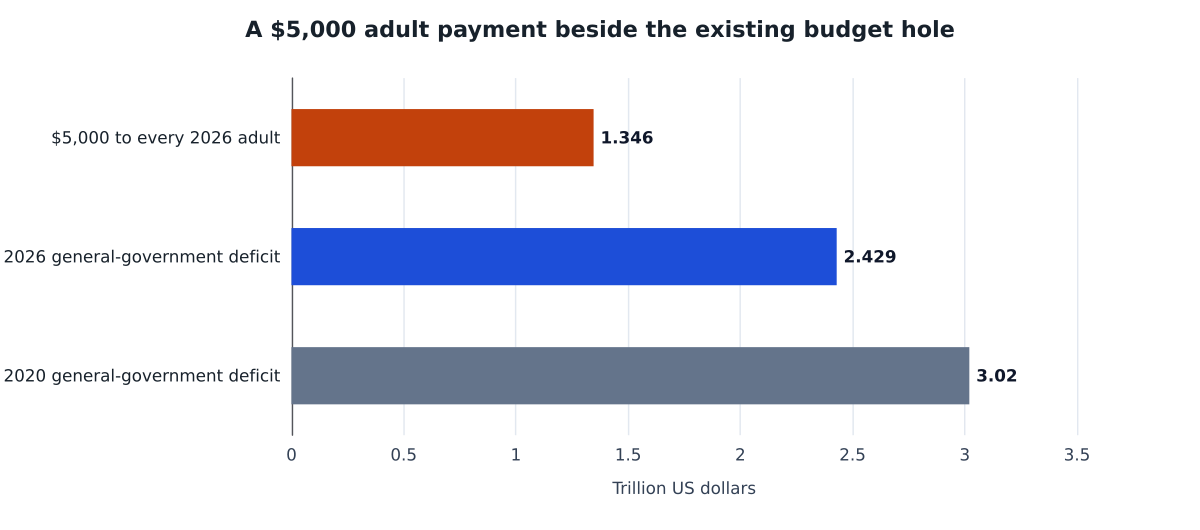
A $5,000 Check Is Modest For A Person And Huge For The Budget
Census adult counts put a $5,000-per-adult payment at $1.35 trillion — more than half the IMF’s already-large 2026 US general-government deficit.