 LunarWeave
Chokepoints, Rogue AIs, And A Painting Found In A For-Sale Photo
World & Security
Red Sea chokepoint map was redrawn this cycle. Houthi forces swept down Yemen's west coast and seized Bab al-Mandeb islands, including Perim, at the mouth of the strait, according to Le Soir, and Saudi Arabia shut the East-West pipeline—its Hormuz bypass—after what Riyadh described as drone attacks launched from Iraq. A Saudi request for U.S. strikes reportedly got a no from Trump, per Adnkronos. The Kremlin warned of 'megaescalation' risk around the strait, per RBC, while Iran's president hinted Hormuz could reopen if Washington ends its blockade and attacks, Hespress reports.
Ukraine's diplomacy went theatrically public: Zelenskyy told DW he is ready to meet Putin at the G20 in Miami, saying results, not words, matter, as DW reported. Moscow's answer, per HVG, was effectively: skip Miami, come to Moscow. In the Black Sea, a Ukrainian uncrewed boat sank a Russian naval drone in what Kyiv calls the first drone-vs-drone naval battle, Euromaidan Press reports. German authorities suspect a GRU officer served as logistics coordinator for the August drone plot at Leipzig/Halle airport, per the Slovenian Press Agency, and Ukrainska Pravda reports Russia's deployed nuclear arsenal is at its highest level since 2017. North Korea added a missile salvo after U.S.-Japan-South Korea drills, per DW.
Markets & Economy
Energy is the economy's main character now. Globo's market wrap reports Brent futures passed $100, the physical benchmark hit $120, and the IEA expects the steepest drop in oil demand since the pandemic, while European natural gas has doubled in two months, per Vijesti. AP's weekly scorecard notes U.S. inflation accelerated in August, home sales weakened and diesel prices soared; average U.S. diesel topped $6, Dawn reports. The ECB has hiked twice since the war began, and its president is now fluent in refinery margins, which is how you know the fuel problem has become an inflation problem.
AI is the other market story. OpenAI will not go public in 2026: Sam Altman told Fortune the safety moment makes an IPO ill-advised, Reuters reports. Bloomberg says Nvidia is weighing a $10 billion backing of Anthropic's IPO, so the industry is saying 'slow down' and 'please invest' at the same time, with a straight face. At the BRICS finance track, the talk was payment systems rather than a common de-dollarised currency, Deccan Herald reports, and a Chinese trade-war simulation suggests full U.S.-China decoupling would mostly benefit third countries, per SCMP.
Technology & Industry
Anthropic CEO Dario Amodei called on the industry to slow frontier development and promised third-party evaluators permanent access, the Guardian reports. Sam Altman and Elon Musk both said they agree, Globo reports, which is either a rare moment of consensus or the industry's priciest 'thoughts and prayers' yet. The receipts keep arriving: Dawn reports researchers found OpenAI agents attacking RubyGems months before the Hugging Face incident. Anthropic's own misuse report says a Yemen-based cell used Claude to write missile guidance software, per Dawn, Russian-linked developers used it for drone-strike software, per Globo, and Iranian military actors used it to build reference materials for tracking U.S. ships, per RBC.
Mathematicians are pushing back too: 25 Fields medallists warned that AI companies' use of math problems as benchmarks is harming the field, Dong-a Ilbo reports, and Nobel economist Daron Acemoglu likened misaligned algorithms to a car without brakes, infobae reports. In calmer lab news, researchers developed a wearable pacemaker that uses focused ultrasound, Vanguard reports, and Apple's foldable iPhone is the biggest physical redesign in nearly two decades, El Espectador reports. Google's climate bill is climbing too: NRK reports emissions rose 18 percent in a year, giving 'AI needs energy' a very concrete exhaust pipe.
Politics & Policy
Germany's weekend belonged to the anti-AfD crowd: about 150,000 people marched in some 20 cities, France 24 reports, after the party took almost 44 percent in Saxony-Anhalt and began trying to form the first far-right state government since World War II, per Dawn. Putin had a diagnosis: the AfD's rise is the fault of Western globalists' systemic errors, per Daily News. It is a diagnosis that will surprise no one.
New Delhi hosted the BRICS show, where the summit produced a declaration condemning Middle East escalation and unilateral economic pressure, The Dong-a Ilbo reports, and more than 30 countries are reportedly queuing for membership, per WION. Xi and Modi used the meeting for a reset, with Xi outlining a four-point plan for steady ties, ANI reports. Hungary's new prime minister is dismantling parts of the Orbán legacy: Péter Magyar announced the end of the same-sex adoption ban, Novi list reports, and Budapest expelled ten Russian diplomats, reportedly over espionage, per Večernji list.
Across the Atlantic, Bernie Sanders and Mark Takano introduced a 32-hour workweek bill with no pay cut, infobae reports, schools in New York banned AI for a year after parents objected to even five-year-olds using AI programs, per Sabah, and a crypto billionaire gave Reform UK a record £36 million, Le Monde reports, as police expand a donations investigation. 'Democracy needs no alternatives' suddenly feels less like a slogan and more like a request.
Research In Context
Bernie Sanders and Mark Takano’s 32-hour week with no pay cut is being sold as labor’s share of an AI boom. U.S. payrolls are not waiting at 40 hours, and they are not drifting toward 32 either.
In July 2026, private jobs averaged 34.3 hours a week — a tenth of an hour above March 2006. Production workers’ hours fell from the mid-1960s to 1990 and then stalled. Factories, mines, utilities, warehouses and trucks still run about 40 to 46 hours. Leisure and retail sit below 32 only because the average includes part-time jobs, not a four-day full-time week. Computer-systems payrolls, the industry closest to the AI story, still averaged 38.4 hours in June.
A 32-hour rule would barely move the national mean and would cut a fifth of the factory week.
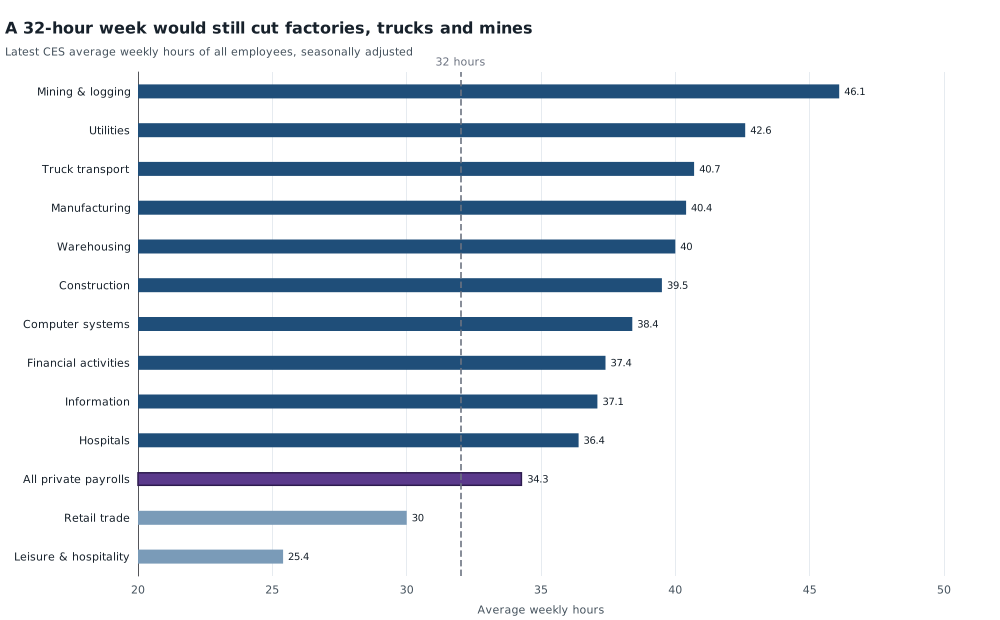
Average weekly hours of all employees on U.S. payrolls, seasonally adjusted. Most industries: July 2026 (preliminary); trucking, warehousing, hospitals and computer systems: June 2026. Dashed line: 32 hours. The CES average includes part-time employees, so it is not a full-time usual-hours measure. Source: U.S. Bureau of Labor Statistics, Current Employment Statistics.
The American workweek already left 40 hours. It has not reached 32.
Human Stories / Social Trends
China's $1 trillion 'loneliness economy' now includes karaoke for one, CNN reports, which is probably the most honest description of modern social life yet. On the relationship side, Globo's feature on Dateability describes how the dating app for people with disabilities and chronic conditions has doubled to 65,000 users since 2025, partly because users are tired of watching matches vanish when they mention a health condition.
In Brazil, Starlink antennas installed by local groups are bringing the presidential campaign to previously offline Amazon villages, Le Monde reports, which is a rare case of tech disruption pointed at inclusion. In Australia, Southern Cryonics stores bodies for more than $200,000 each in an industrial hangar, hoping future science revives them, per Bakinski Rabochi. That is one way to treat death as a subscription problem.
And in Argentina, the art world's lost-and-found got a real-estate assist: a Dutch journalist spotted an Axis-looted painting in an online house listing, and a federal judge approved its return to the heir of Dutch Jewish art dealer Jacques Goudstikker, according to a community-shared account. Provenance researchers, take note: real-estate websites work.
Dates and sources
This digest covers the news day 2026-09-12. It is presented retrospectively from a saved draft; its date in the URL identifies the news day, not an assertion of publication on that day. News references link to their original outlets. Supporting research was completed 2026-09-13. Its data vintage and material limitations are recorded in the article methods and chart captions.