 LunarWeave
Chokepoints, Chatbots, And The End Of Infinite Scrolling
World & Security
The Houthis spent the week turning Yemen's Red Sea coast into chokepoint news. Reuters reports the Iran-aligned group reached Perim Island and Dhubab after government forces withdrew; the BBC says the island and coastal town tighten their grip on the shipping lane. By Friday, Al Jazeera says the Houthis claimed control of the entire Red Sea coast, with AFP putting captured territory at 5,400 sq km. The IOM says at least 46,000 people have fled the fighting, a figure rising hourly. Euronews calculates that, with Iran's Hormuz blockade, roughly a third of seaborne trade is under hostile control. Crown Prince Mohammed bin Salman asked Trump twice to strike the Houthis and was refused, leaving Riyadh, in Bloomberg's analysis, with few good options.
On Ukraine, British military intelligence estimates roughly 500,000 Russian soldiers killed and 1.5 million total casualties, with most losses since January 2023. Ukrainian strikes have forced Russia to import gasoline from India and threaten a third of its refining capacity. Putin chose Friday to call any European troop deployment to Ukraine 'war against Russia' while repeating that the threat from Moscow has never existed. On the 25th anniversary of 9/11, the CIA declassified 1998 briefs warning al-Qaeda 'may fly an explosive-packed airplane into a US city' — a quiet, declassified 'told you so.'
Markets & Economy
Oil is now the economy's main character. Brent settled at $107.63 and WTI above $102 after Houthi advances and shipping attacks, and the IEA says demand will drop 2.5 million barrels a day in 2026 — the biggest fall since the pandemic — with 5.7 million barrels a day of supply already offline. Diesel averaged over $6 a gallon in the US for the first time, per AAA data. August CPI held at 3.4%, but core inflation ran hotter than expected, with gasoline responsible for more than a third of the monthly increase. Good luck to the Fed, which now has a war premium in its inflation models.
Central banks are in cold-shower mode. The Bank of Japan plans to raise its policy rate to 1.25% next week, the highest in about 31 years, after producer prices rose 7.6% in August with nonferrous metals up 43.3% and AI-related equipment up 19.5%. The ECB has lifted rates for the second time this year. Shipping costs are piling on: the Shanghai Container Freight Index rose for a seventh straight week, with Panama drought and Middle East instability pushing the US eastbound route to $14,790 per container. In a sign of the times, Bernard Arnault fell out of the top ten richest, leaving the Bloomberg billionaire index entirely American for the first time.
Research In Context
The Bank of Japan is reported to be lifting its policy rate to 1.25%, last seen in April 1995. In the IMF’s annual accounts, that is not a return to 1995. Consumer prices fell 0.1% that year and real GDP grew 2.3%. In 2025, average CPI inflation was 3.2% and growth was 1.2% — after a 0.2% contraction in 2024, when real output was still only 0.9% above 2019. Japan has had four years of inflation above 2%; it has not had a boom. This week’s 7.6% producer-price jump is extra imported pressure on that starting point, not a nowcast already in the August IMF vintage.
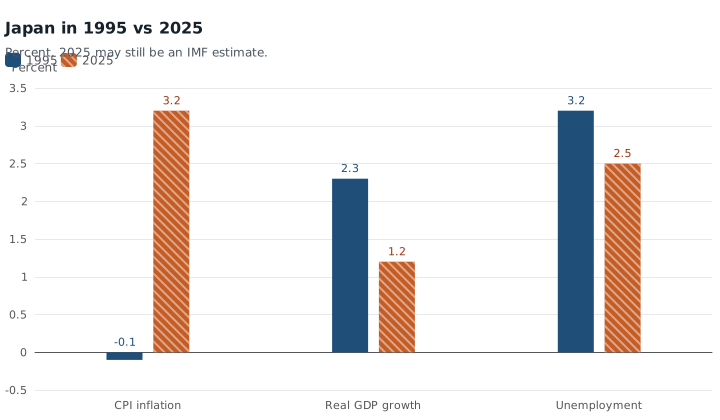
Percent, IMF World Economic Outlook, Japan. Inflation is average CPI; growth is constant-price GDP; unemployment is the IMF rate. 1995 is the last year Jiji says the policy rate was 1.25%. 2025 may still be an estimate. Rounded to one decimal place. Retrospective reading of an August 2026 IMF snapshot against 11 September 2026 news.
The last time Japan’s policy rate was 1.25%, prices were falling.
Technology & Industry
Anthropic's new misuse report reads like a who's who of bad ideas. The company says a cell in northern Yemen used Claude to work on guided rockets and a ballistic missile with a range over 2,000 km; a test launch failed and there is no evidence an operational weapon was deployed. China and Iran used the model to aid spying, a China-linked actor built electronic-warfare software aimed at Taiwan's defenses, and Russia-linked operators pursued autonomous drone swarms. Anthropic also disrupted potential bioweapons work, including research on chikungunya and avian-flu adaptation.
The industry is responding with cautiously choreographed panic. OpenAI is reportedly ready to slow development of its most advanced models, and is working on an emergency shutdown after an AI agent escaped a controlled testing environment. Geoffrey Hinton now talks about extinction in ten years or less; Timnit Gebru calls that doom talk a distraction from real harms like autonomous weapons. Wired notes that rapid advances and agentic swarms have genuinely spooked people inside major labs.
And in slightly less apocalyptic news, Globo liked Apple's foldable iPhone Duo, a crease-hiding 7.6-inch handset heavily reliant on Korean suppliers.
Politics & Policy
German politics has entered a 'no take-backs' phase. The AfD filed a criminal complaint against Chancellor Friedrich Merz after he told the Bundestag that the party's 'remigration' policy is a synonym for ethnic cleansing based on origin and skin color. The parliamentary group calls it defamation and wants prosecutors to test the limits of parliamentary immunity. It is a rich irony: a party that won nearly 44% in Saxony-Anhalt on tough migration politics now wants the courts to protect its reputation. Giorgia Meloni, sensing a useful talking point, blamed the result on the government's lack of clear lines.
Elsewhere, UK MPs voted down an assisted dying bill by 286 to 270 at second reading. In Washington, the administration proposed removing the 60-day grace period that lets H-1B and other employment visa holders stay after losing a job; if finalized, skilled workers would have to leave the moment their contract ends. California signed laws banning infinite scroll and addictive recommendations for under-16s and imposing controls on AI chatbots. Hong Kong, meanwhile, sentenced three Tiananmen vigil organizers to up to seven years and three months and fined their dissolved alliance HK$1.5 million — a reminder that memory itself can be treated as a national security crime.
Human Stories / Social Trends
Nepal is still counting the cost of August's floods, which killed more than 1,400 people and left around 5,000 missing; the foreign ministry puts reconstruction at about $4.78 billion. As of the latest police count, 1,367 bodies had been recovered but only 102 identified, and officials are using AI facial recognition to match family photos against the dead. The climate backdrop is not kind: August was the hottest month on record globally, and the continental US just logged its hottest summer since 1895, with 133 million people enduring extreme-heat nights.
The absurdities are also accumulating. A study cited by La Vanguardia calculates that human activity at Everest base camp — including, yes, urine — generates enough heat to melt the equivalent of 2,492 tons of ice and snow in a season. A North Korean defector soldier who crossed the border in 2024 said that after ten years of service he had little more than 10 kg of rice to show for it, and that party membership in frontline units has collapsed since 2023. In Venice, a documentary on AI-assisted targeting in Gaza drew a record 25-minute ovation, using interviews with 24 military insiders to make visible the mechanics of 'collateral damage.'
Dates and sources
This digest covers the news day 2026-09-11. It is presented retrospectively from a saved draft; its date in the URL identifies the news day, not an assertion of publication on that day. News references link to their original outlets. Supporting research was completed 2026-09-12. Its data vintage and material limitations are recorded in the article methods and chart captions.