LunarWeave
Trucking Jobs Are Below 2019. The Rest Of The U.S. Job Market Is Not.
When diesel prices pull away from crude, the first industry in the blast radius is not a household filling a car. It is freight. Spanish business daily 20 minutos reported in mid-September 2026 that the U.S. diesel-over-crude margin had reached a record, and that Europe’s spread had more than doubled since June — the sort of print that revives talk of an autumn energy crunch. Those price claims are the newspaper’s, not this article’s. What the labor data can answer is different, and more useful: if a diesel shock is coming, is it hitting a trucking industry still stretched from the pandemic freight boom, or one that has already shrunk?
It has already shrunk. U.S. payroll jobs in truck transportation peaked at 1,588,600 in October 2022. By July 2026 they had fallen to 1,465,100, a loss of 123,500 jobs, or 7.8 percent from the peak. That July figure is still 69,400 jobs, or 4.5 percent, below July 2019. The rest of the job market moved the other way: total nonfarm payrolls were 5.3 percent higher in July 2026 than in July 2019, and 3.2 percent higher than at the trucking peak.
A fuel-cost spike would therefore land on a smaller for-hire trucking workforce than the one that hauled the 2021–22 goods boom — not on an industry that has been hiring into a bottleneck.
The boom ended in 2022. The slide did not.
Truck transportation in the Current Employment Statistics is the payroll count at establishments classified in NAICS 484 — general and specialized freight trucking companies. It is not a census of everyone who drives a truck. Drivers employed by manufacturers, grocers or construction firms, and owner-operators without a payroll, sit in other industries or outside the survey. The series still tracks the employers whose main business is moving freight on diesel.
That payroll rose through 2018–19, dropped in the first COVID months, then climbed with the goods boom. The peak, 1,588,600 jobs in October 2022, was not a one-month spike. Employment was still 1,587,800 in January 2023. Almost the entire subsequent loss — 122,700 jobs — accumulated over the next three and a half years, through the July 2026 preliminary estimate. This is a freight hangover, not a sudden 2026 collapse.
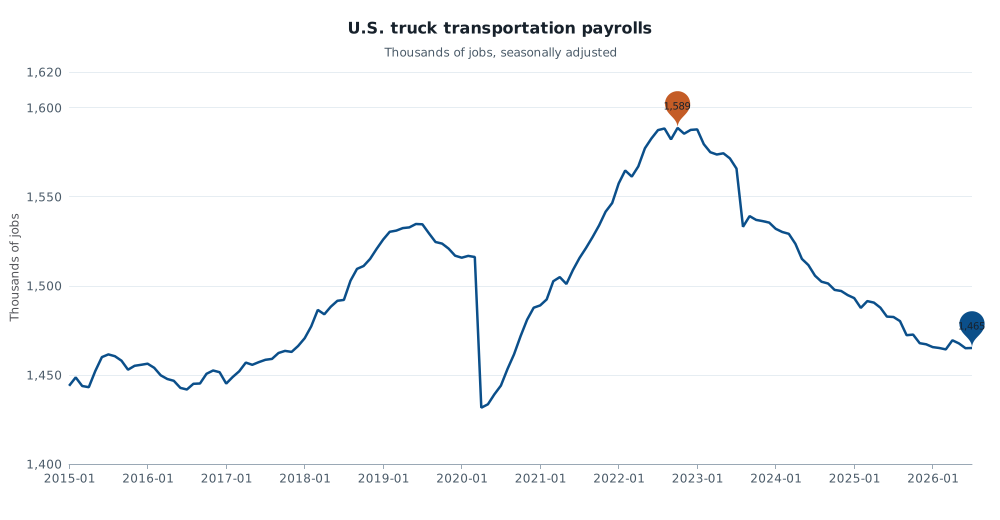
Seasonally adjusted payroll jobs in NAICS 484 truck transportation, thousands, January 2015–July 2026. The series peaked at 1,588,600 in October 2022 and stood at 1,465,100 in July 2026 (preliminary). The vertical axis starts at 1,400,000 jobs, not zero. Source: U.S. Bureau of Labor Statistics, CES4348400001.
July 2026 trucking payrolls were only about 33,500 above the April 2020 COVID low. Relative to the pre-pandemic summer, the industry is smaller. Relative to the rest of the economy, it is also a thinner slice: 0.92 percent of nonfarm jobs in July 2026, down from 1.02 percent in July 2019 and 1.03 percent at the October 2022 peak.
| Month | Truck transportation jobs | Versus July 2019 |
|---|---|---|
| July 2019 | 1,534,500 | — |
| April 2020 (COVID low) | 1,431,600 | −6.7% |
| October 2022 (peak) | 1,588,600 | +3.5% |
| July 2026 (preliminary) | 1,465,100 | −4.5% |
Warehouses kept the boom. Trucking companies did not.
The broader transportation-and-warehousing supersector does not tell the same story. Those payrolls were still 16.0 percent above July 2019 in July 2026. Warehousing and storage is the reason. Warehouse jobs jumped during the e-commerce surge, peaked at 1,939,300 in March 2022, and even after a 5.4 percent retreat remained 47.9 percent above July 2019.
Trucking did not keep that kind of gain. Indexed to the same July 2019 starting point, warehouse payrolls are still far above the old level, total employment is modestly above it, and truck transportation is below it.
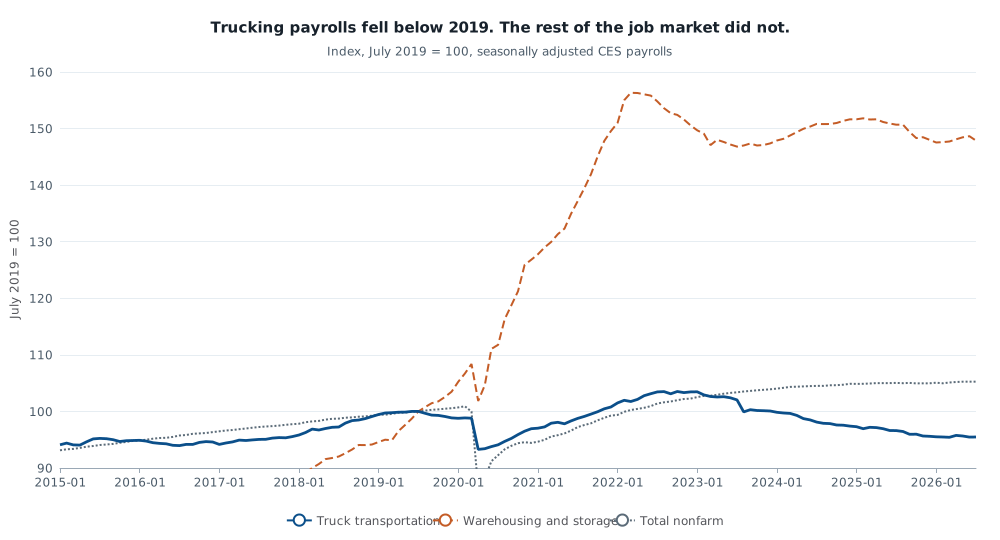
Seasonally adjusted CES payrolls indexed to July 2019 = 100. By July 2026 (preliminary), truck transportation was 4.5 percent below July 2019, warehousing and storage was 47.9 percent above, and total nonfarm employment was 5.3 percent above. Warehousing and trucking are not a complete freight total. Source: U.S. Bureau of Labor Statistics.
That split matters for a diesel scare. Warehouses use fuel, but they do not burn it the way line-haul trucks do. The establishments whose costs move most directly with diesel are the ones whose payrolls have been drifting down for years.
Hours tell a similar, quieter story. Average weekly hours of all employees in truck transportation were 40.7 in June 2026, against 41.2 in July 2019 and 40.9 at the October 2022 employment peak. The workweek has not collapsed, but it has not risen to offset fewer jobs either. Labor input in for-hire trucking is down on both the headcount and the hours margins.
Pay rose in dollars. It barely rose in real terms.
A tight driver market would usually show up as a lasting real-pay boom. Nominal average hourly earnings in truck transportation did jump: from $25.38 in July 2019 to $33.46 in June 2026, a 31.8 percent increase. That is not a special trucking story. Average hourly earnings for all private employees rose 34.1 percent over the same span, to $37.60. Trucking still pays less than the private-sector average on this all-employee measure, which mixes drivers with office and other staff.
Adjusted for consumer prices (1982–84 dollars in the CES files), trucking hourly pay was only 1.4 percent higher in June 2026 than in July 2019. Private real hourly pay was up 3.2 percent. The pandemic-era “driver shortage” wage spike did not leave trucking workers with a large real-pay cushion. A diesel shock that squeezes carriers’ margins would hit an industry that has already been shedding payroll jobs and has not outrun inflation in real hourly pay.
None of this measures the September 2026 diesel-over-crude margin, and it does not prove that fuel prices caused the 2023–26 job losses. Those losses were already in the books before the mid-September reports. What the payrolls show is the starting point: if diesel is about to become more expensive relative to crude, the U.S. companies whose business is hauling freight are fewer than they were at the last freight peak, fewer than in the summer of 2019, and a smaller share of a job market that otherwise kept growing.
Methods and sources
This article is retrospective research completed on 14 September 2026, using a pinned Current Employment Statistics snapshot (BLS CE files dated 24 August 2026) whose latest employment month is July 2026. The news date is 13 September 2026; later diesel-price prints were not in this snapshot and are not used here. July 2026 employment figures carry BLS’s preliminary footnote. Earnings and hours for truck transportation run through June 2026 in the same snapshot.
All series are national, seasonally adjusted, all-employee CES estimates. Truck transportation is CES4348400001 (NAICS 484). Comparisons use July 2019 as a pre-pandemic summer benchmark and October 2022 as the trucking series’ peak in this window. Real earnings are the CES 1982–84-dollar series, not a separately constructed deflator. One real-earnings month (October 2025) is missing in both the trucking and private series and is omitted, not treated as zero.
The 20 minutos diesel-margin report is cited as reporting, not as a verified price series. This research has no diesel or crack-spread dataset. Payroll jobs are not the same as self-employed drivers, and correlation between fuel prices and later hiring is not established here. Charts were rendered from the saved observations; they have not been separately checked in a web browser.
Research Date
The displayed date matches the related news edition. Research was completed 2026-09-14.
Related news: Daily · 2026-09-13
More Research
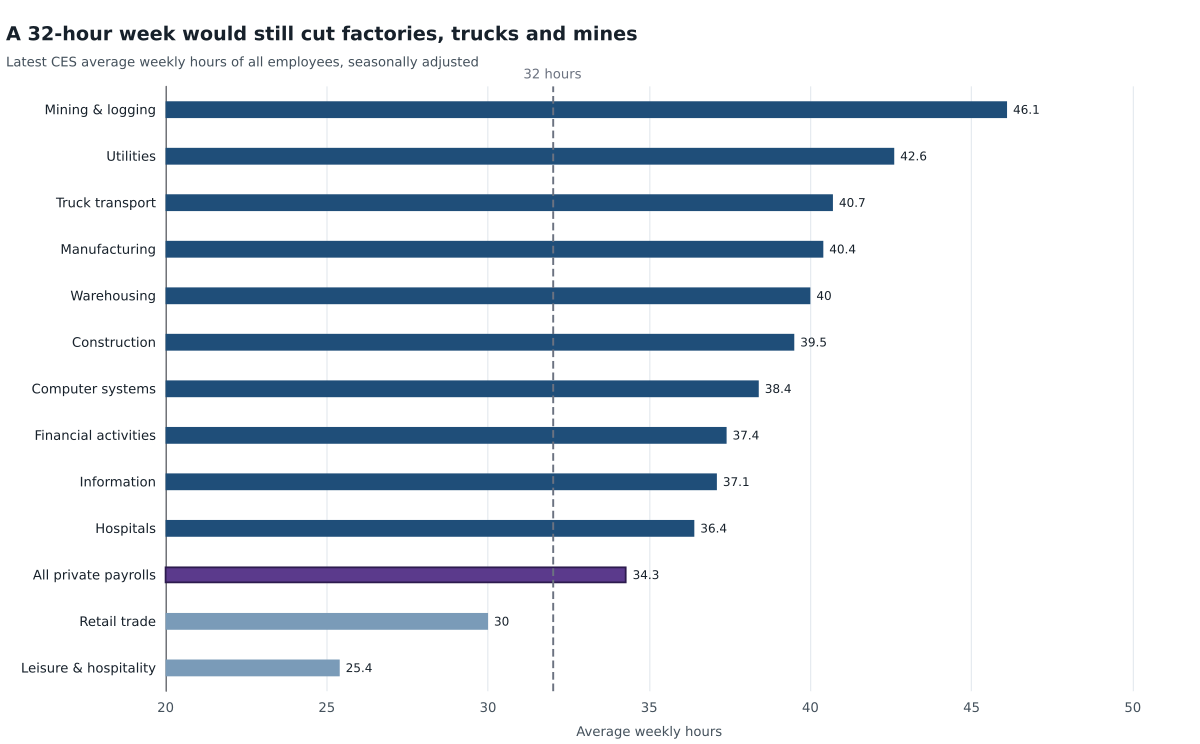
The American Workweek Already Left 40 Hours. It Has Not Reached 32.
U.S. private payrolls already average 34.3 hours a week. A 32-hour bill would still cut factories, mines and trucks, not a four-day national norm.
The Last Time Japan’s Policy Rate Was 1.25%, Prices Were Falling
The Bank of Japan’s reported 1.25% policy rate was last seen in 1995, when consumer prices were falling. IMF accounts show 2025 inflation at 3.2% after a 2024 contraction.
A $5,000 Check Is Modest For A Person And Huge For The Budget
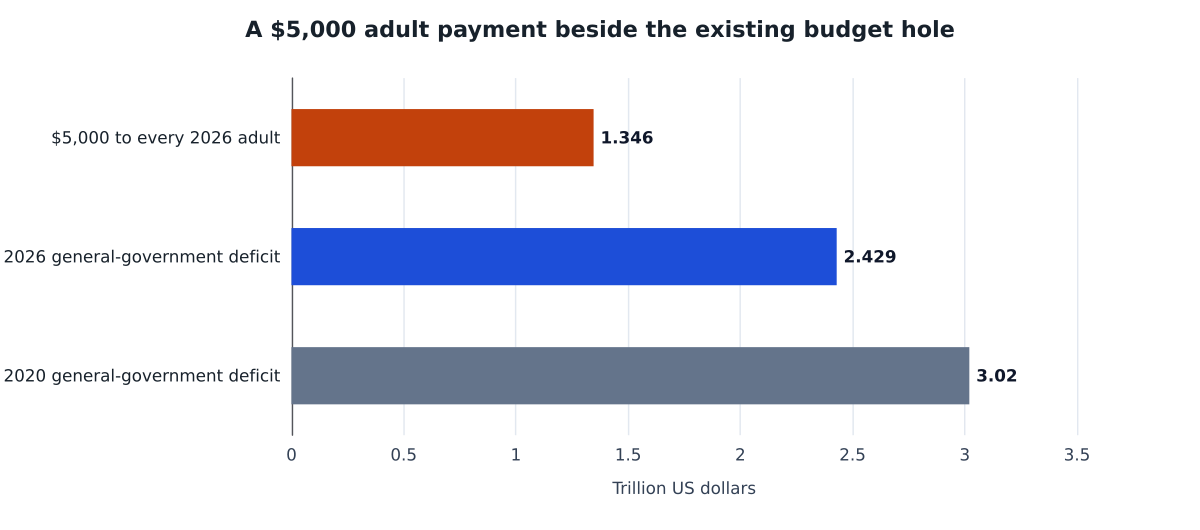
Census adult counts put a $5,000-per-adult payment at $1.35 trillion — more than half the IMF’s already-large 2026 US general-government deficit.