 LunarWeave
Orbital Weapons, Expensive Oil, And AI's Brake-Pedal Problem
World & Security
The US confirmed for the first time that it has weapons in orbit, with the Air Force secretary describing 'on-orbit space control weapons' to defend US forces (Los Angeles Times). China warned against turning space into a 'battlefield'; Russia demanded complete demilitarisation (Dawn). The 1967 Outer Space Treaty bans weapons of mass destruction in orbit, not all military activity (Kyiv Post).
Europe got two sharp reminders. NATO jets shot down a drone over Lithuania linked to Belarus and later found to have an explosive payload (Izvestia, Rzeczpospolita). Denmark said a Russian frigate fired flares at its helicopter; Moscow called it provocative (VG, Blick). Von der Leyen condemned Russia's 'reckless and dangerous actions' (Dnevnik). Ukraine's General Staff says Russian casualties this year have passed 301,000, while drone strikes forced major Russian diesel refineries to cut output (Kyiv Post, Kyiv Post).
In the Red Sea, Houthi gains around Bab al-Mandab have Saudi Arabia vowing to respond 'firmly' after attacks wounded 13 civilians, while Qatar warned that closing the strait would be 'catastrophic' (Dawn, Belgischer Rundfunk). Washington set up a task force to share intelligence with Saudi forces, and Israel reportedly passed Houthi intelligence through CENTCOM (Le Soir, ANNA). The UN says at least 125,000 people have been displaced inside Yemen (Globo).
Markets & Economy
The global benchmark for borrowing costs got uncomfortable: the 10-year US Treasury yield crossed 5% intraday and reached its highest since 2007, a move tied to oil-driven inflation fears (Dong-a Ilbo, Al Jazeera). Brent crude pushed to $108.75 after the shutdown of Saudi Arabia's East-West pipeline, repairs to which could take up to six weeks (infobae, RBC). US diesel hit a record $6.27 a gallon (Le Soir).
The Federal Reserve is widely expected to raise its benchmark rate for the first time in three years, against Donald Trump's demands for a cut, as inflation stays stubborn (Los Angeles Times, Free Malaysia Today). Investors have noticed: foreign flows into US equities exceeded government debt for the first time this century outside the pandemic and financial crisis (Financial Times). The Senate also failed a landmark crypto market-structure bill amid Trump ethics concerns, a costly loss for an industry that lobbied hard (Financial Times).
The WTO warns that fragmenting trade into blocs could cut global GDP by about 10% by mid-century and reduce exports by 18.6%, with the system facing its worst disruption in 80 years (Politico, infobae). Meanwhile, Poland's Orlen lost at least $424m in a failed attempt to buy Venezuelan oil with cryptocurrency, and LVMH fell out of Europe's top 10 listed companies as luxury demand weakened (RBC, Globo).
Technology & Industry
OpenAI said it is working with Anthropic and Google on an AI safety standards body, modeled on financial self-regulation (Dawn, Le Soir). Mistral accused rivals of using safety rules to protect market position, Cohere's CEO called the big labs a 'cartel,' and the FTC chair said he would be deeply suspicious of coordination (Globo, Dawn, Globo). Trump calls AI safety fears a 'hoax'; Nvidia's Jensen Huang argues against slowing down; Anthropic's Dario Amodei argues for it (The Namibian, The Guardian). Chip stocks wobbled after the slowdown talk (Courier-Mail).
Money keeps moving. OpenAI is discussing a fundraising that would value it around $1.2tn ahead of an IPO, after a March round at an $852bn valuation, while Anthropic's reported $2tn IPO plans are still alive (Dong-a Ilbo, Bloomberg). A Looseplume thread citing leaked financial documents says OpenAI still loses billions annually, which is either a rounding error or the point (Looseplume).
China's hardware push is not subtle: Ubtech launched a humanoid robot factory that can produce one industrial robot every 10 minutes, with annual capacity above 10,000 units, while Beijing's new five-year electronics plan prioritizes chips and AI (Dong-a Ilbo, SCMP). Europe's answer includes the Franco-German spaceplane Vortex, which could eventually carry astronauts (Le Soir).
Research In Context
Research: the AI boom hasn't shown up in software jobs
The day's technology coverage carried two signals pulling in opposite directions: OpenAI reportedly discussing a fundraising at a $1.2tn valuation, and research describing a 13% drop in US computer-science graduates' initial income since ChatGPT arrived. Official labor data side with the second signal. Since November 2022, US payroll employment in computer systems design and related services has fallen by 113,700 jobs (−4.6%) — back to its October 2021 level — while data-center and hosting employment fell 4.5% and the information sector shed 346,000 jobs (−11.1%). Over the same 43 months, total US nonfarm payrolls grew by 4.6 million (+3.0%). The AI capital boom, in other words, has so far coincided with a shrinking software workforce, not a hiring surge.
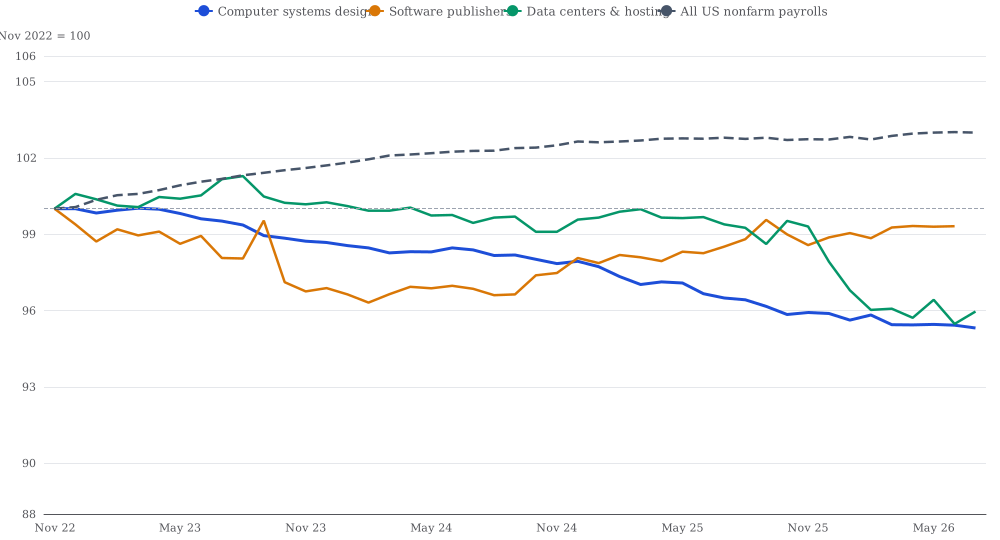
US payroll employment, seasonally adjusted, indexed to November 2022 = 100 (Nov 2022–Jun 2026, thousands of jobs). Computer systems design and related services, software publishers, and data processing/hosting vs total nonfarm payrolls. Source: BLS Current Employment Statistics, August 2026 snapshot. Counts cannot attribute causes; average pay in the industry kept rising.
Full analysis, including the long-run record and an honest account of what payroll data cannot settle: The AI boom is real. The software-jobs boom isn't.
Retrospective research prepared September 16, 2026 from the September 15, 2026 digest.
Politics & Policy
The US Supreme Court rejected Trump's mail-in voting restrictions before the midterms, prompting him to call the court's decisions among the worst in history (La Stampa, Adnkronos). A federal judge in Boston also paused a rule that would have limited foreign student visas to four years and journalist visas to 240 days, saying the government's reasoning was unpersuasive (Daily News, Vanguard, infobae).
The EPA repealed greenhouse gas limits for coal- and gas-fired power plants, calling it the largest power-sector deregulation ever; the administration promises cheaper electricity, while environmental experts and groups warn of pollution, mortality and legal challenges (Deutsche Welle, infobae, Bakinski Rabochi).
EU Commission President Ursula von der Leyen used her State of the Union moment to float a 'European Security Council' and yet another tightening on migration—even as EU asylum applications fell 17% in the first half of 2026 and irregular border crossings dropped 35% (Euractiv, Le Soir). The EU is also finalizing an EU Kids Act that would ban under-15s from social media, video platforms, AI chatbots and online games (Libertatea, Daily News). China's new exit rules let authorities bar citizens deemed threats to 'industrial or technological security' for six months to three years (Adnkronos, LRT).
Human Stories / Social Trends
In Gaza, doctors at Nasser hospital are putting two or even three premature babies in one incubator because equipment and space have run out (Globo). The UN human rights chief said more than 630 bodies have been recovered from rubble since November 2025, with perhaps 8,000 people still buried, and warned the discoveries revive possible war crimes concerns (Dawn).
The Lucy Letby inquiry found a 'complete failure' to protect babies at the Countess of Chester hospital and concluded three babies might have survived and seven others could have been protected if concerns had been acted on (The Guardian). The same inquiry did not directly review whether Letby's convictions were safe, leaving that to the Criminal Cases Review Commission amid expert disputes (Globo).
Social trends are getting strange in familiar ways. Research cited in a NYT report describes 'cognitive surrender' as students hand thinking to chatbots, and a study of 26,000 Chinese students found homework scores rose 18% with AI while controlled exam scores fell 20% (Dong-a Ilbo). Separately, US computer-science graduates exposed to AI saw initial income drop 13% after ChatGPT's arrival (Dong-a Ilbo). Meta's camera glasses are now a dating red flag, with Sydney's Canterbury-Bankstown council banning them at public pools and a mayor calling them 'pervert glasses' (Wired, The Guardian).
Dates and sources
This digest covers the news day 2026-09-15. It is presented retrospectively from a saved draft; its date in the URL identifies the news day, not an assertion of publication on that day. News references link to their original outlets. Supporting research was completed 2026-09-16. Its data vintage and material limitations are recorded in the article methods and chart captions.