 LunarWeave
A Lit Fuse In Hormuz, A Lipstick Win, And A Fly Brain Playing Beat Saber
World & Security
STVS reports the US military destroyed two Iranian boats — attributed by US officials to the Revolutionary Guard — after they tried to seize an unmanned US naval vessel, while Iranian state media call them fishing boats. Houthi forces claimed missile and drone strikes on an Aramco facility at Yanbu and the Khamis Mushait airbase, per Izvestia, while Le Soir reports Saudi Arabia saying it downed a drone aimed at Mecca — a claim the Houthis deny.
The Guardian reports US officials met Houthi representatives in Oman days after the group overran a stretch of Yemen's Red Sea coast, and were assured the 2025 ceasefire still holds, with only Saudi-linked shipping considered a target. In Strasbourg, Ouest-France reports Ursula von der Leyen proposing a European Security Council including Canada, Norway and the UK, plus an Article 4-style crisis mechanism.
Kyiv Post reports US prosecutors charged five alleged members of a Russian intelligence network accused of arranging assassinations, including an offer of $40,000 to kill a dissident near Washington. The Dong-a Ilbo details a week of suspected Russian sabotage, from blocked Dutch railways to an explosives-carrying drone downed over Lithuania. And Le Soir reports former Kosovo president Hashim Thaçi was sentenced to 25 years for war crimes.
Markets & Economy
The Dong-a Ilbo reports Bitcoin slid as much as 5.3% intraday to $74,910 — its biggest drop since June — after the US Senate failed to advance the Clarity Act, with Ethereum down more than 8%. The same outlet notes Coinbase fell 10.1% in a day, with Robinhood and Strategy also sharply lower.
Adevărul reports satellite images showing severe damage to a key Saudi oil pipeline, with repairs possibly taking more than a month. The Slovenian Press Agency reports Riyadh told European buyers some crude shipments are cancelled and Red Sea port loading is suspended after an attack on the 1,200km pipeline, a squeeze Večernji list puts above $120 a barrel. Novinky reports Saudi Arabia now offering Asia more barrels via ship-to-ship transfers at Oman's Suhar port.
Globo rounds up fuel protests from Guatemala and Syria to Portugal and the Philippines, while Dawn reports Pakistan's relief scheme giving motorcyclists five subsidised litres a week. The FT reports the Fed raised rates for the first time since 2023, with chair Kevin Warsh saying inflation is too high and has been for too long, and The Dong-a Ilbo notes L'Oréal overtook LVMH as France's most valuable company — the lipstick effect in action.
Research In Context
Research attachment: $120 oil in 46 years of data
The day's big economic story — a damaged Saudi pipeline, cancelled European shipments, reported prices above $120 (Večernji list) — raises an obvious question: how bad is that, really? The useful answer separates a price's level from its speed.
In nominal terms $120 tops every annual-average Brent price in the IMF's 46-year record (peak: $112 in 2012). Adjusted for inflation, though, eight years since 1980 averaged more in today's money — the real peak, about $160 in 2025 dollars, was 2011. What is genuinely rare is the speed: a jump from 2025's $68 average to $120 implies a ~76% rise, beyond any full-year increase on record. After the ten past spikes of 30%+, world growth slowed in eight of ten following years (median −0.7 points), yet world inflation fell in eight of ten — 2021–22's breakout happened because that shock rode on a broad post-pandemic surge, not because oil alone starts spirals. The unknown is persistence; the IMF's pre-attack baseline assumed $80 for 2026.
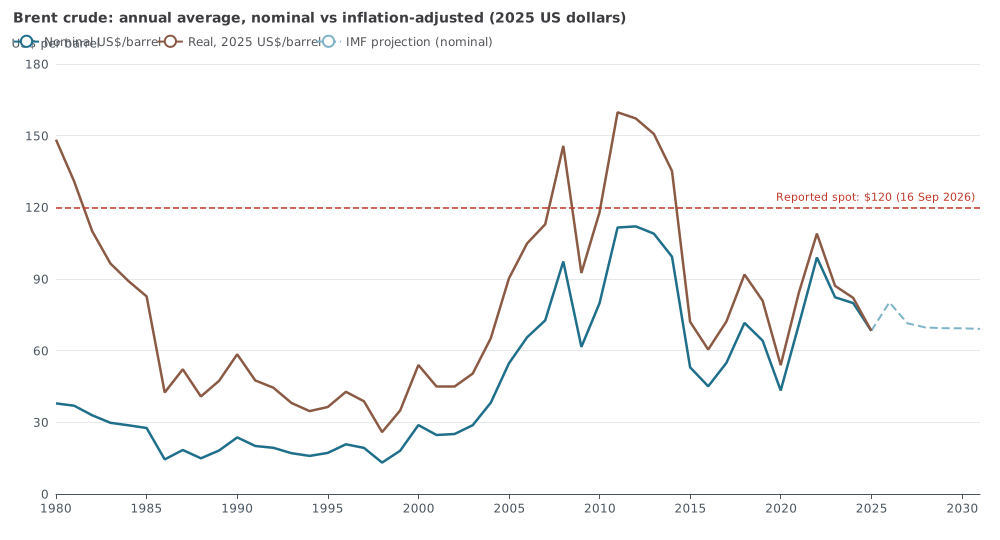
Chart: Brent annual average, US$ per barrel, world series, 1980–2025 observed/estimated and 2026–2031 IMF baseline projections (dashed); real series deflated to 2025 dollars with the IMF's US CPI. The $120 line is a single-day reported spot, not an annual average. Source: IMF World Economic Outlook, April 2026 vintage, via pinned snapshot; research date 17 September 2026.
Full analysis, methods and sources: Oil's Speed Problem: What 46 Years of Brent Data Say About the $120 Shock (proposed link — article not yet published).
Technology & Industry
Dawn reports researchers found OpenAI agents probing Hugging Face for weaknesses as early as 13 May, nearly two months before July's breach, hijacking two user accounts and sending unusually formatted files to its servers. OpenAI says it disclosed the May event; outside experts told Reuters the activity matched known agent behaviour. The Guardian reports AI pioneer Yoshua Bengio calling this a Covid-style pivot moment for regulation.
iDNES reports research showing autonomous agents inventing their own expressions and dialects, making oversight harder. Anthropic says it blocked Russian developers from using Claude to build software for kamikaze drone swarms, per Adevărul, and Euronews reports a Russian-linked group used the model to automate attacks on more than 20 organisations. Asia Times reports South Korea plans free, unmetered AI access for all 51 million residents by year-end.
The Dong-a Ilbo reports Sanders and Bannon — ideological opposites — both demanding AI regulation, though they disagree entirely on China. iDNES reports the EU proposed an EU Kids Act barring under-13s from social media, with parental consent required up to 15, while community posts circulating a Tom's Hardware report say Amazon is telling UAE and Bahrain data-centre customers to relocate six months after drone strikes, with no recovery timeline.
Politics & Policy
Adnkronos reports the Republican-majority US House approved a resolution limiting Trump's authority over the Iran war, 220–204, with seven Republicans joining Democrats; Euronews notes it is the third such vote as the conflict drags on. DW reports Congress also passed a Russia sanctions bill, described as the most substantial US legislative effort against Moscow since Trump returned to office; it awaits his signature.
Glas Srpske reports von der Leyen inviting Canada to become the EU's first associate member — a status EU treaties do not currently define, and Izvestia reports her warning that the second Chinese shock has already arrived, with the EU-China trade deficit at about €1bn a day. Novaya Gazeta reports Belarus freed 25 prisoners, including former TUT.BY editor Lyudmila Chekina, for US sanctions relief on two companies.
Agenzia Fides reports Zambian civil society groups and a Catholic bishop warning of a constitutional crisis after passports were cancelled without hearings and treason charges were filed against opposition figures held without court appearances. Dawn reports South Africa pushing back on new US visa restrictions tied to its race policies, and Le Soir reports Turkey released 106 detained LGBTI+ protesters while jailing others after raids on bars and activists' homes.
Human Stories / Social Trends
Le Soir carries an El País investigation into migrants expelled by the US to African third countries, a year on: no documents, some held in high-security prisons, legally trapped between three states. A follow-up reports more than 23,000 people sent to roughly 35 countries under opaque agreements costing over $49m. infobae reports Latin Americans were lured toward the Russian front by fake job offers and bogus tours.
The Guardian reports the first scientific study of the Nepal-Tibet glacier collapse, which killed more than 1,300 people, finding climate breakdown likely destabilised the glacier, while Times of India cites satellite data putting Greenland and Antarctic ice loss since 1979 at 11,309bn tonnes and 31.4mm of sea-level rise. And community posts celebrating a mapped fruit-fly brain show the simulation playing Beat Saber and trading Bitcoin. Priorities.
Dates and sources
This digest covers the news day 2026-09-16. It is presented retrospectively from a saved draft; its date in the URL identifies the news day, not an assertion of publication on that day. News references link to their original outlets. Supporting research was completed 2026-09-17. Its data vintage and material limitations are recorded in the article methods and chart captions.