LunarWeave
The Diesel Crunch Is Landing On A Much Smaller US Refining Workforce
Diesel is the fuel that moves freight, and in mid-September it was being reported at records: $6.52 a gallon on average in the United States, according to AAA, and €2.41 a litre in France. The usual suspect is crude oil. The more pointed claim, in Dawn’s account of the squeeze, is that this is a shortage of products — diesel and other refined fuels — because refineries, not wells, are the bottleneck. Paul Krugman, quoted there, called the proximate cause “a global shortage of refining capacity.”
Barrels of capacity are not in the payroll files. What the United States does publish, month after month, is how many people the refining industry actually employs. That number is small, and it has been small for a long time.
A 61,000-person industry
In June 2026, US petroleum refineries employed 61,300 people on a seasonally adjusted basis, according to the Bureau of Labor Statistics Current Employment Statistics for NAICS 324110. The June figure is preliminary. It is 0.49 percent of US manufacturing employment that month.
That is not a wartime staffing surge. From January through June 2026 the series stayed between 61,300 and 61,500. It has not climbed toward the 68,400 jobs recorded in December 2019, let alone toward the industry’s own history.
The series high is 159,400 jobs in August 1981. June 2026 is 61.5 percent below that peak — 98,100 fewer jobs — and only 38.5 percent of the 1981 level. December 1990 still had 109,300. The long slide, not a 2026 hiring freeze, is what left the country with a refining workforce this size.
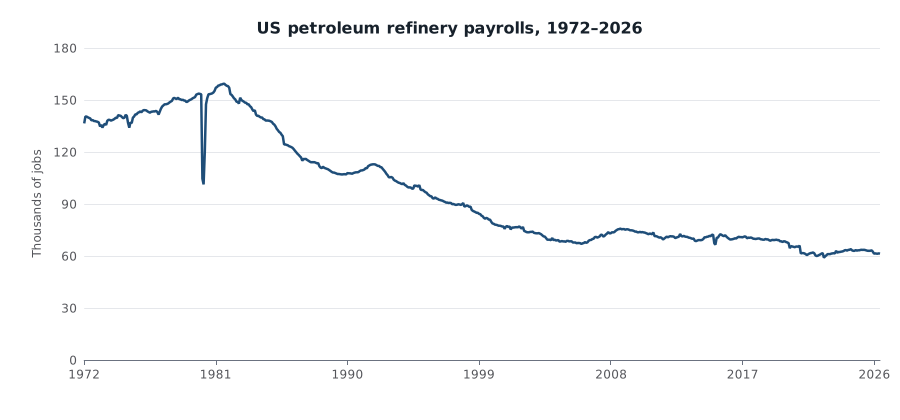
Seasonally adjusted payroll employment at US petroleum refineries, thousands of jobs, monthly, January 1972–June 2026. June 2026 is preliminary. Payrolls are not refining capacity in barrels per day. Source: U.S. Bureau of Labor Statistics, CES series CES3232411001.
The chart’s brief plunge in early 1980 is real in the file — employment dropped from 153,300 in January to 101,300 in March before snapping back — and sits in the months of a national oil-refinery strike. It is not the structural story. After the 1981 peak the decline is slow and mostly one-way.
The series low is 59,000 in August 2022. A modest rebound reached 64,000 in June 2024, then faded. June 2026 is 7,100 jobs, or 10.4 percent, below December 2019.
Wells still hire more people than refineries do
If the product shortage is at the refinery gate, the labor market that does flex with oil prices is upstream.
Support activities for oil and gas operations — the contractors who drill, complete and service wells — employed 207,200 people in June 2026, 3.4 times the refining workforce. Oil and gas extraction itself employed 115,100. Added together, those two well-side industries employed 322,300 people, 5.3 times as many as petroleum refineries. That sum is a combination of two CES industries, not a total BLS publishes.
Those well-side payrolls move. Oilfield support peaked at 337,400 in September 2014 and fell 171,800 by November 2020. Over the same window, refinery payrolls fell by 6,700. Support work is still 130,200 jobs below that 2014 high; refineries barely registered the cycle.
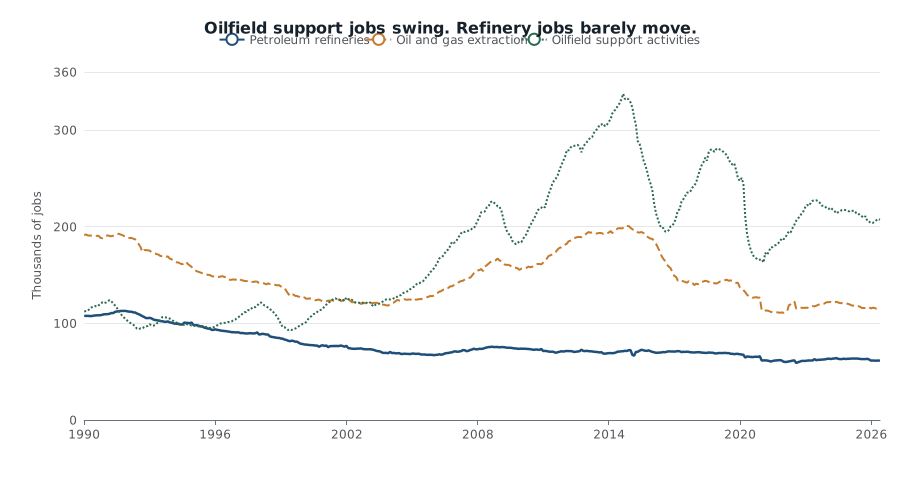
Seasonally adjusted US payrolls, thousands of jobs, monthly, January 1990–June 2026. Oilfield support (dotted) and extraction (dashed) are separate from petroleum refineries (solid). June 2026 figures are preliminary. Source: U.S. Bureau of Labor Statistics, CES.
| Month | Refineries | Oil and gas extraction | Oilfield support |
|---|---|---|---|
| Aug 1981 | 159.4 | 259.1 | — |
| Dec 1990 | 109.3 | 189.0 | 121.0 |
| Sep 2014 | 71.2 | 198.8 | 337.4 |
| Dec 2019 | 68.4 | 141.9 | 250.3 |
| Aug 2022 | 59.0 | 115.2 | 206.1 |
| Dec 2025 | 62.6 | 116.5 | 205.1 |
| Jun 2026* | 61.3 | 115.1 | 207.2 |
Thousands of seasonally adjusted jobs. Support activities begin in 1990 in this file. June 2026 is preliminary. Source: BLS CES.
What payrolls cannot tell you
None of this measures the thing Krugman named. A refinery can run more barrels with fewer people after automation, consolidation, or a shift toward larger plants. US payrolls also say nothing about damaged Russian plants, Aramco’s reported halt of deliveries to European refineries, or how many French filling stations have run dry. Those are reported claims about a global products market.
What the employment file does establish is narrower, and still material. The US industry that turns crude into diesel is a 61,000-person workforce, less than two-fifths its 1981 size, and it had not added jobs through June 2026. The industry that swings when oil prices move is the one that services wells, and it is several times larger. A shortage of refined product, if that is what the price spike is, is landing on an American refining labor force that has not been built to flex.
Methods and sources
Payroll figures are seasonally adjusted all-employee counts from the BLS Current Employment Statistics national estimates, retrieved from a pinned snapshot of the August 24, 2026 CES release. Petroleum refineries are CES3232411001; oil and gas extraction is CES1021100001; support activities for oil and gas operations is CES1021311201; manufacturing is CES3000000001. Combined well-side employment is the sum of extraction and support in the same month. Official series documentation is in the CES time-series handbook.
This article was researched on September 22, 2026, after the September 21 news reports on diesel prices. It is retrospective in that sense. The CES snapshot itself ends in June 2026 for refineries and oilfield support (July 2026 for extraction and manufacturing), so it cannot show whether plants hired in the months when pump prices were being reported at records. June 2026 values carry BLS’s preliminary footnote. Observation dates are not release dates.
Research Date
The displayed date matches the related news edition. Research was completed 2026-09-22.
Related news: Daily · 2026-09-21
More Research
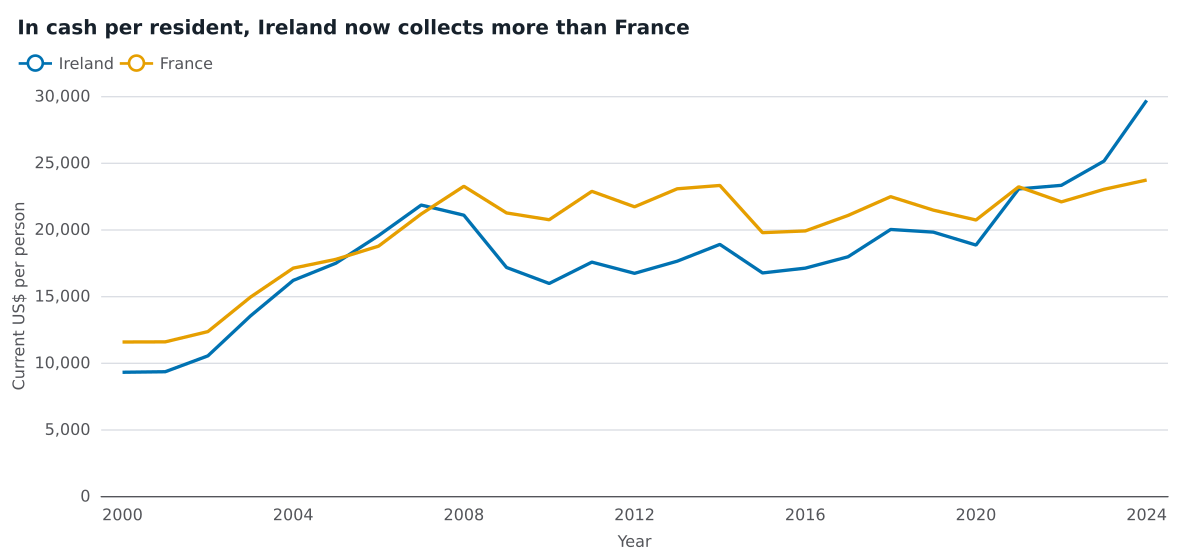
Ireland’s 26 Percent Tax State Now Collects More Per Person Than France
Ireland’s general-government revenue is a much smaller share of GDP than France’s, but in 2024 it still collected more dollars per resident.
Spain Left Its COVID Debt Peak. France Is About To Break It.
France’s coming 120% debt ratio is a national record because the COVID spike barely receded, unlike Spain’s.
Haiti Is Two-Fifths Poorer Than In 1980. Next Door Is Ten Times Richer.
IMF accounts show Haiti’s real economy contracting every year since 2019, with income per person two-fifths below 1980 and about one-tenth of the Dominican Republic’s.