LunarWeave
Spain Left Its COVID Debt Peak. France Is About To Break It.
France’s finance ministry told reporters that public debt will reach 119.3% of GDP in 2026 and 121.7% in 2027 — record levels, and the mechanical result of a budget deficit that is still around 5% of GDP. Le Soir relayed those government figures, citing INSEE comparisons back to 1995.
Those ministry numbers are forecasts, not a ledger. They also sit inside a more useful question. Among large euro-area economies, 120% of GDP is no longer an exotic ratio. What is unusual is the path: France’s COVID debt spike barely receded, and the International Monetary Fund still sees the ratio climbing through a new high.
A national record, on a long ratchet
In the IMF’s general government gross debt series, France’s ratio was 21.3% of GDP in 1980 and 57.8% in 1995, when INSEE’s modern Maastricht series begins. It was already 98.2% on the eve of COVID, in 2019. The pandemic then added 16.8 points in a single year, to 114.9% in 2020.
That 2020 reading is the highest historical figure in this IMF snapshot. The ratio eased to 109.6% by 2023, then turned up again, to 113.2% in 2024. The Fund’s projections take it to 118.4% in 2026 and 120.5% in 2027 — close to the ministry’s 121.7%, though not the same source or definition — and to a peak of 121.3% in 2029.
So 2027 would be a record in this series too, because it would finally overtake the COVID peak. The “highest since 1995” phrasing in the French coverage is mostly an artefact of when the comparable INSEE series starts. Debt was not higher in the mid-1990s. It has been setting new plateaus after each crisis for decades.
The level itself is not an outlier among large rich economies. In 2024, Italy’s ratio was 134.7% of GDP and the United States’ 122.3%. Japan’s was 214.5%. Germany, the relevant euro-area contrast, was 62.2%. Britain was 99.9%. A French ratio near 120% would put France in America’s neighbourhood, still below Italy, and nowhere near Japan.
The COVID spike that did not recede
The distinctive fact is the repair that did not happen.
Spain’s COVID peak was almost the same as France’s: 119.2% of GDP in 2020. By 2024 Spain was at 101.6%. The IMF sees 96.2% in 2027. Italy’s peak was much higher, 154.4% in 2020, but it had fallen back to 134.7% by 2024 — essentially its 2019 ratio. France cut only 1.7 points from 2020 to 2024, the smallest decline among these large rich peers, and the Fund has it rising 7.3 points from 2024 to 2027.
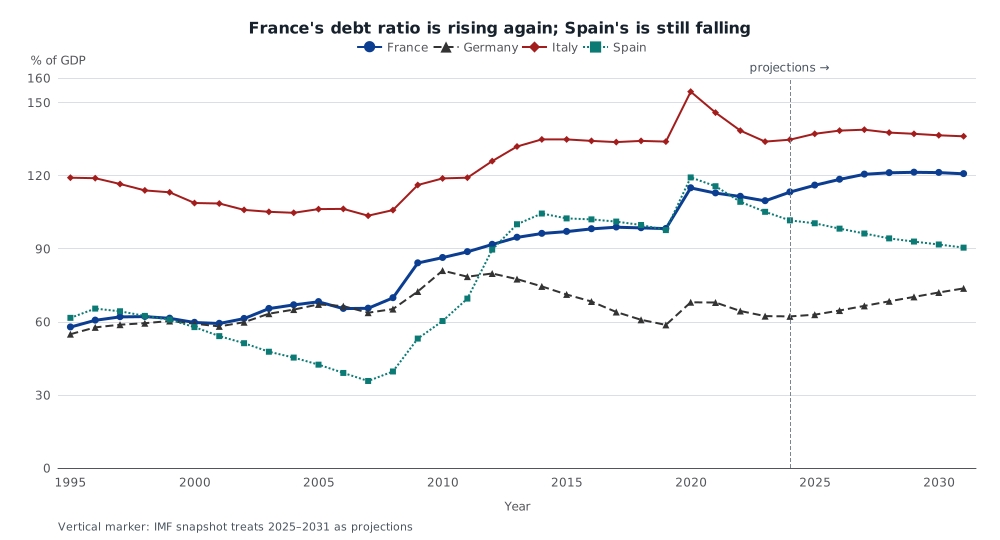
General government gross debt, percent of GDP, 1995–2031. A marker at 2024 separates historical estimates from IMF projections for 2025–2031. IMF World Economic Outlook, pinned August 2026 snapshot. These figures are not identical to Maastricht/INSEE public debt. Choose France, Spain, Italy or Germany in the IMF debt-ratio series.
| Country | 2020 | 2024 | 2027, IMF projection | Change, 2020–24 |
|---|---|---|---|---|
| France | 114.9 | 113.2 | 120.5 | −1.7 |
| Spain | 119.2 | 101.6 | 96.2 | −17.5 |
| Italy | 154.4 | 134.7 | 138.8 | −19.6 |
| Germany | 68.0 | 62.2 | 66.5 | −5.8 |
Percent of GDP. Source: IMF WEO general government gross debt. 2027 is a projection in this snapshot.
The ministry is right that a still-large deficit keeps pushing the ratio up. It is not the whole story. Spain ran a 3.2% of GDP deficit in 2024, against France’s 5.8%. Italy’s 2024 deficit was 3.4%. The IMF still has France near 4.8% in 2027, while Spain and Italy are around 2.3–2.6%.
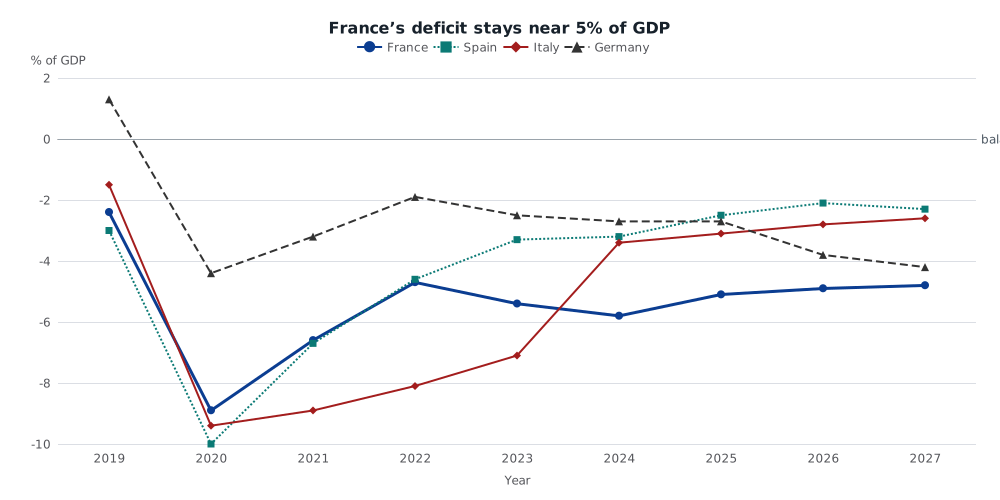
General government net lending/borrowing, percent of GDP, 2019–2027. Negative values are deficits. 2025–2027 are IMF projections. IMF WEO.
Growth did some of Spain’s work as well. Real GDP in Spain compounded 20.3% across 2021–2024; France’s rebound was 12.8%. In 2024 Spain still grew 3.46%, France 1.11%. The Fund’s French growth projections for 2025–2027 are all below 1%. A 5% deficit against ~1% real growth, on a debt stock already above 110% of GDP, is a recipe for the ratio to rise even if there is no new shock. That is an accounting tendency, not a proof that the deficit is the only driver, and not a forecast of a crisis.
Germany shows the other side of the same arithmetic. Its 2024 debt ratio was 62.2% because it entered COVID much lower, not because its recent growth has been strong — real GDP fell 0.87% in 2023 and 0.50% in 2024. The IMF even has Germany’s deficit widening to 4.2% of GDP by 2027. Starting near 60% of GDP is a different problem from starting near 115% and failing to come down.
What the record does — and does not — mean
The 121.7% figure in the French budget documents should be read as a government forecast. The IMF’s 120.5% for 2027 is an independent projection from an earlier vintage. Neither number is an outturn. IMF gross debt is also not a carbon copy of Maastricht debt as INSEE publishes it, so a one-decimal mismatch is not a gotcha.
The comparison also does not say France is “becoming Italy.” Italy’s stock of debt remains larger. It does say that the euro-area country whose COVID peak looked like France’s — Spain — used the subsequent four years to take more than 17 points off the ratio, while France took off fewer than two and is now projected to go through the peak the wrong way.
That is the part of the record that is new. France has been a high-debt country by its own history since the euro crisis. It is becoming a high-debt country that did not reverse the pandemic jump, while still running a deficit the IMF puts near 5% of GDP. The 2027 number is what that combination looks like when someone writes it on a budget line.
Sources and methods
Retrospective research, 20 September 2026, on reporting from 19 September 2026. Figures other than the ministry forecasts come from a pinned IMF World Economic Outlook snapshot ingested 10–24 August 2026. Years 1980–2024 are treated as historical estimates in that vintage; 2025–2031 are IMF projections. Observation dates are not release dates. Debt is general government gross debt as a percent of GDP (GGXWDG_NGDP); the budget balance is general government net lending/borrowing as a percent of GDP (GGXCNL_NGDP); growth is real GDP percent change (NGDP_RPCH). United States debt in this extract begins in 2001, Germany in 1991, Italy in 1988. Charts were rendered to SVG; they were not separately tested in a browser or on a phone.
Research Date
The displayed date matches the related news edition. Research was completed 2026-09-20.
Related news: Daily · 2026-09-19
More Research
Haiti Is Two-Fifths Poorer Than In 1980. Next Door Is Ten Times Richer.
IMF accounts show Haiti’s real economy contracting every year since 2019, with income per person two-fifths below 1980 and about one-tenth of the Dominican Republic’s.
Oil Shocks Alone Rarely Wreck The World Economy. 2026 Starts From A Worse Place.
What 45 years of IMF data say about oil shocks, growth and inflation — and why the September 2026 configuration of a $108 spot price, already-rising world inflation and a resuming Fed resemb
Oil's Speed Problem: What 46 Years Of Brent Data Say About The $120 Shock
The reported $120 oil price is a nominal record but sits far below real peaks of 1980 and 2011–13; what is unprecedented is the speed. IMF Brent data since 1980 show past spikes slowed world