LunarWeave
Ireland’s 26 Percent Tax State Now Collects More Per Person Than France
France has asked for a “fairer” split of the tax money that large technology firms pay in Ireland. The complaint, reported by De Standaard, is that Apple, Google, Microsoft and their peers fill the Irish treasury with tens of billions of euros a year while other European governments see too little of the same profits.
That is a fight about who may tax profits booked in Dublin. It is easy to misread as a story about a tiny state running a tiny treasury. In the IMF’s World Economic Outlook accounts, Ireland does run a much smaller tax state than France — as a share of GDP. In cash per resident, it no longer does.
A small share of a very large GDP
In 2024, Ireland’s general-government revenue was 26.4 percent of GDP. France’s was 51.5 percent. Germany’s was 46.8 percent. The Netherlands, another small European economy that hosts a large multinational footprint, collected 43.5 percent.
Those Irish figures are not a new low-tax experiment. Before 2015, Ireland’s revenue ratio sat in the low-to-mid 30s. In 2015 it dropped from 33.0 percent to 26.1 percent, in the same year that Ireland’s measured GDP in current dollars jumped by about 13 percent. Revenue in cash actually fell that year. The ratio moved because the denominator — GDP — moved.
By 2024, Irish GDP per person in current dollars was $112,356. France’s was $46,054. Ireland’s measured output per person was 2.44 times France’s. A decade earlier, in 2014, that ratio was 1.32.
Irish GDP is not a clean picture of living standards. The same 2024 accounts show a current-account surplus of 16.2 percent of GDP, a scale that ordinary wage-and-consumption economies do not produce. The IMF books here do not isolate intellectual-property onshoring or redomiciled profits. They do show an economy whose GDP is large enough, relative to 5.42 million people, that a “small” tax share is still a lot of money.
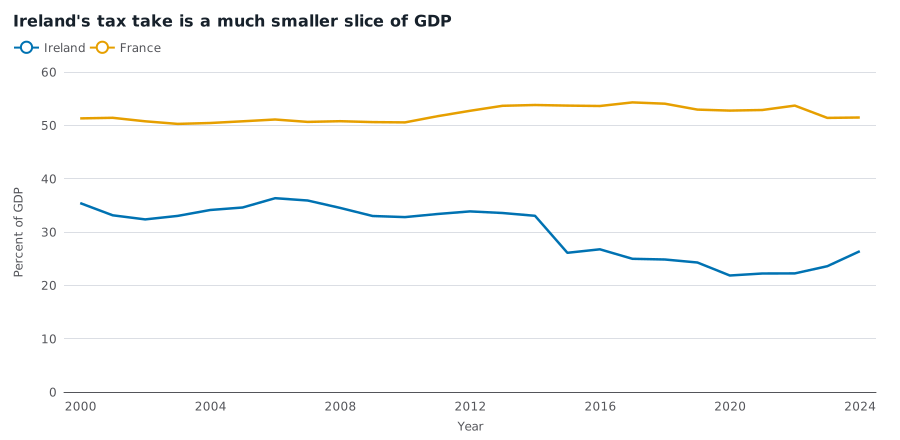
General-government revenue as a percent of GDP, Ireland and France, 2000–2024. Ireland’s ratio fell sharply in 2015 when measured GDP jumped, then rose to 26.4 percent in 2024. France remained near 50 percent. IMF World Economic Outlook series GGR_NGDP. This is not corporation tax.
Per person, Ireland has moved ahead
Multiply that revenue share by GDP and divide by population, and the ranking flips.
In 2024 Ireland collected about $160.8 billion in general-government revenue, or $29,667 per person. France collected about $1.63 trillion — 51.5 percent of a $3.16 trillion economy — which comes to $23,704 per person. The Irish figure is about $6,000 higher.
Ireland is 7.9 percent of France’s population and 19 percent of France’s GDP, and it collected 9.9 percent as much revenue.
That is not a Celtic Tiger leftover. Ireland’s revenue per person ran above France’s in 2006 and 2007, then fell behind after the crash and stayed there through 2021. It moved back above France in 2022 and widened in 2024, when Irish general-government revenue rose by $26.9 billion, or 20 percent, from the year before.
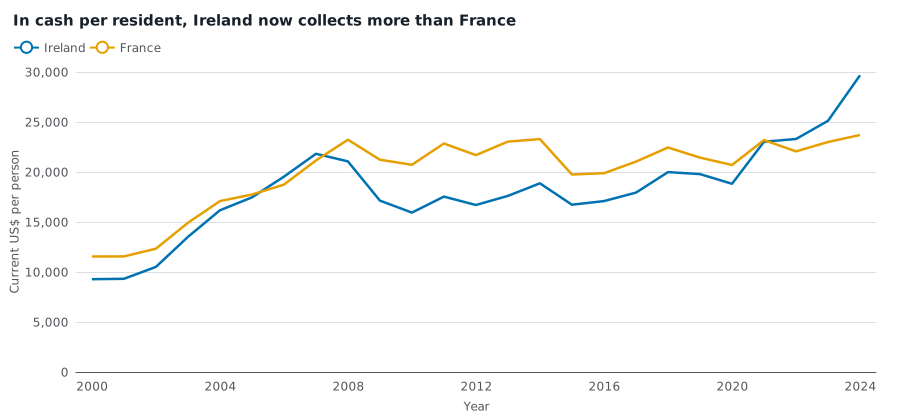
General-government revenue per person, current US dollars, Ireland and France, 2000–2024. Derived from IMF revenue as a percent of GDP, GDP in current dollars, and population. Both countries share the euro, so the dollar conversion is common to both series. Not corporation tax from named firms.
The 2024 cash jump also shows up as a budget surplus. Ireland’s general-government net lending was +4.0 percent of GDP, about $24.5 billion. France’s was −5.8 percent of GDP, a deficit of about $183 billion. Ireland spent 22.4 percent of GDP; France spent 57.3 percent. France is taxing more of a smaller measured income in order to fund a much larger public sector. Ireland is taxing less of a swollen GDP and still covering a small state with room to spare.
| 2024, IMF WEO | Ireland | France |
|---|---|---|
| Revenue, % of GDP | 26.4 | 51.5 |
| Expenditure, % of GDP | 22.4 | 57.3 |
| Net lending, % of GDP | +4.0 | −5.8 |
| GDP per person, current US$ | 112,356 | 46,054 |
| Revenue per person, current US$ | 29,667 | 23,704 |
| Population, millions | 5.42 | 68.6 |
Ireland is not unique — except in the ratio
Among a short list of rich peers, Ireland’s 2024 revenue per person sits next to the Netherlands ($29,424) and above Germany ($26,229), the United States ($25,748) and the United Kingdom ($20,069). Luxembourg, a much smaller booking centre, is in another league at $66,229.
What is unusual is the combination. The Netherlands collected a similar amount per person from a 43.5 percent revenue ratio. Ireland matched it from 26.4 percent. That is the GDP distortion in one comparison: a low measured tax burden and a high cash take can be true at the same time.
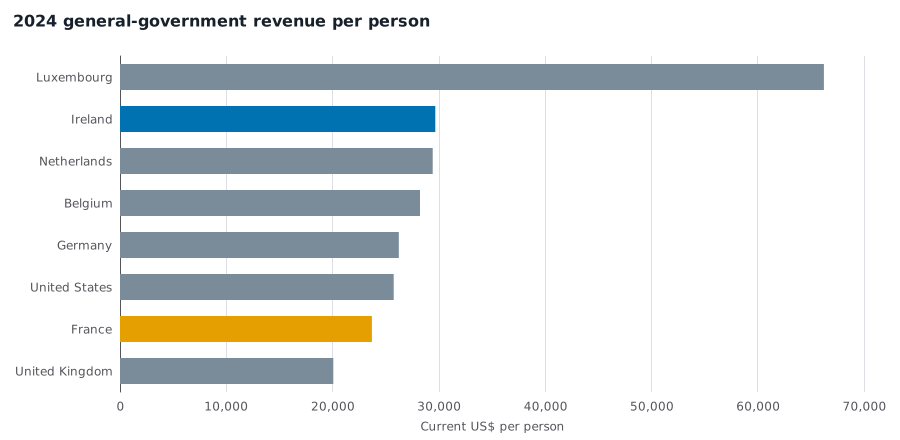
Derived 2024 general-government revenue per person in current US dollars. Ireland is close to the Netherlands and above France, Germany, the United States and the United Kingdom. Luxembourg is far higher. Same IMF vintage as the charts above.
None of this proves how much of Ireland’s $160.8 billion came from Apple, Google or Microsoft. The IMF series is general-government revenue: income tax, social contributions, VAT, corporation tax and the rest, bundled together. De Standaard’s “tens of billions of euros” from named technology firms is a reporting claim, not a line in these accounts. A $27 billion one-year increase in Ireland’s total take is large enough to make a corporate-tax windfall plausible. It is not a corporate-tax ledger.
The IMF’s own 2025–26 projections in this vintage put Ireland’s revenue ratio back near 23 percent as measured GDP continues to swell in current dollars. Those are forecasts, not 2024 outcomes. They do not settle who should tax which profits. They do show why a 26 percent Irish tax state can look stingy in a table of ratios and flush in a table of cash.
Methods and sources
This is retrospective research. The reporting is from 20 September 2026; the calculations use an IMF World Economic Outlook snapshot pinned on 24 August 2026 (research date 21 September 2026). Figures for 2025 and 2026 are IMF projections in that vintage. Revenue per person is government revenue as a percent of GDP multiplied by GDP in current US dollars, then divided by population. Ireland and France share the euro, so their dollar comparison is a common exchange-rate conversion; comparisons with the United States and the United Kingdom mix currencies. Linked IMF series pages are multi-country; choose Ireland or France in the chart selector. Browser layout of the charts was not separately tested.
Research Date
The displayed date matches the related news edition. Research was completed 2026-09-21.
Related news: Daily · 2026-09-20
More Research
Spain Left Its COVID Debt Peak. France Is About To Break It.
France’s coming 120% debt ratio is a national record because the COVID spike barely receded, unlike Spain’s.
Haiti Is Two-Fifths Poorer Than In 1980. Next Door Is Ten Times Richer.
IMF accounts show Haiti’s real economy contracting every year since 2019, with income per person two-fifths below 1980 and about one-tenth of the Dominican Republic’s.
Oil Shocks Alone Rarely Wreck The World Economy. 2026 Starts From A Worse Place.
What 45 years of IMF data say about oil shocks, growth and inflation — and why the September 2026 configuration of a $108 spot price, already-rising world inflation and a resuming Fed resemb