LunarWeave
Saudi Arabia Still Generates Two-Fifths Of Its Electricity From Oil
When Brent crude was reported back above $100 a barrel in July 2026, after Houthi strikes on Saudi tankers, Washington and Riyadh were also announcing a civilian nuclear cooperation pact. The public argument is about enrichment rules and whether the kingdom will normalise with Israel. The quieter fact is on the grid.
As of 2023, the latest year in the International Renewable Energy Agency’s generation statistics, oil still produced 39.1 percent of Saudi electricity. Natural gas produced 59.4 percent. All renewables together produced 1.5 percent, and there is no nuclear generation in the IRENA record. A nuclear communiqué is not the same thing as nuclear kilowatt-hours.
The oil did not leave when the gas arrived
Saudi power demand has grown fast. Total generation rose from 126 terawatt-hours (TWh) in 2000 to 441 TWh in 2023. Gas did much of the new work: 58 TWh in 2000, 262 TWh in 2023. Oil’s share fell from a peak of 62.6 percent in 2015 to 39.1 percent in 2023. That is a real shift toward gas. It is not an exit from oil.
Oil-fired generation itself was 68 TWh in 2000, peaked at 225 TWh in 2015, and was still 172 TWh in 2023 — two and a half times the 2000 volume. IRENA records the same 172.378 TWh of oil generation in 2022 and 2023; gas and renewables kept rising, so oil’s share edged down. In every year from 2000 through 2023, oil plus gas equals all non-renewable generation. There is no coal residual and no nuclear residual. The system is a two-fuel thermal grid with a thin green edge.
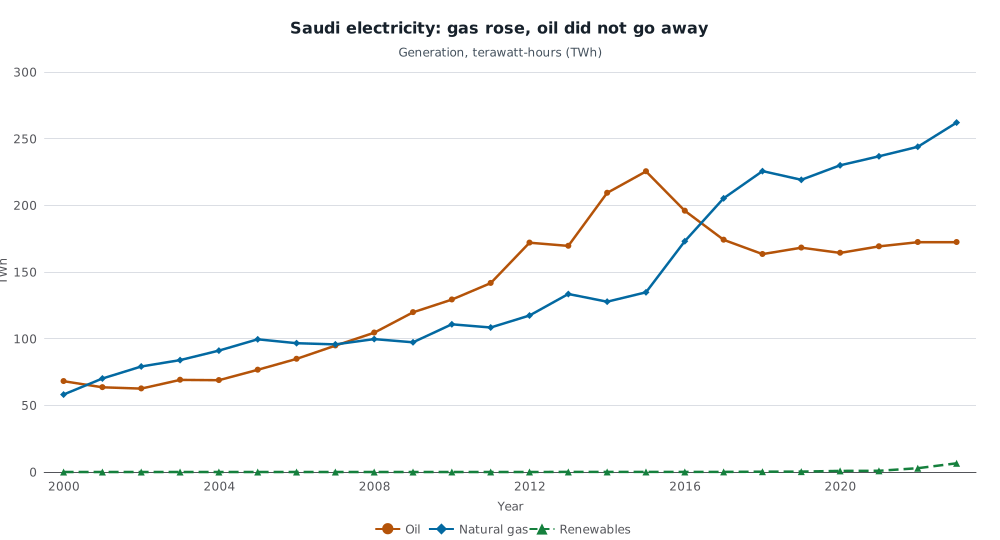
Saudi Arabian electricity generation from oil, natural gas and renewables, 2000–2023, in terawatt-hours. Oil generation in 2022 and 2023 is recorded as the same 172.4 TWh. Oil plus gas equals all non-renewable generation in every year. Source: IRENA electricity generation statistics (all grids). Latest generation year in this snapshot is 2023.
Solar photovoltaic output jumped from 1.1 TWh in 2022 to 4.8 TWh in 2023 — about 1.1 percent of generation. That is rapid growth from a tiny base. It is not yet a substitute for 172 TWh of oil.
On-grid oil capacity tells the same story in steel rather than electrons: 10.2 gigawatts in 2000 and 44.9 gigawatts in 2023. IRENA still shows about 42 gigawatts in 2024.
Next door, the reactors already run
The contrast is not with Japan or the United States, where oil is a backup fuel on the grid. It is with the United Arab Emirates.
In 2023, UAE non-renewable generation was exactly equal to natural gas plus nuclear. The oil residual is zero, and IRENA has no oil-generation observations for the UAE at all. Nuclear supplied 33.1 TWh, or 19.6 percent of UAE electricity. Renewables supplied 8.7 percent, including 13.3 TWh of solar photovoltaics — more solar than Saudi Arabia produced, on a much smaller system.
Kuwait, by contrast, still looks like Saudi Arabia. Oil produced 41.7 percent of Kuwaiti electricity in 2023; gas produced the rest of the thermal mix; renewables were 0.2 percent. Two Gulf oil exporters still burn oil for power. One already runs reactors.
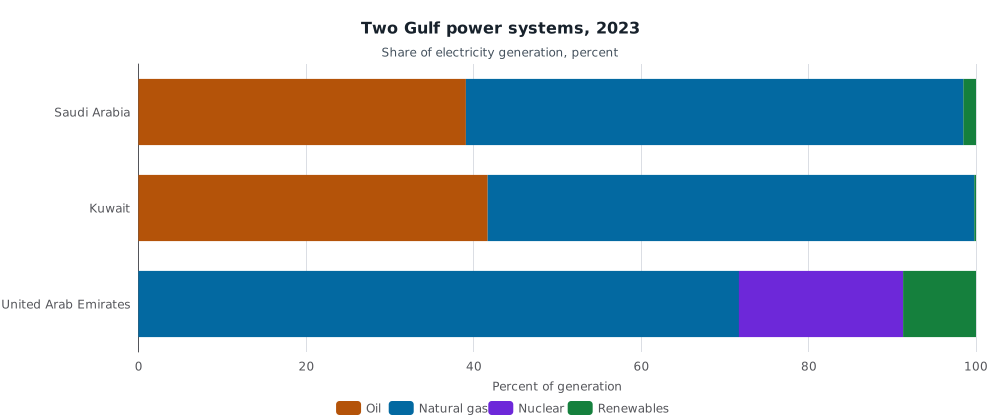
Share of 2023 electricity generation. Saudi Arabia and Kuwait still get about two-fifths of their power from oil and have no recorded nuclear generation. The UAE mix is gas, nuclear (19.6 percent) and renewables (8.7 percent); the oil residual is zero. Source: IRENA. Rounded to one decimal place.
Absolute scale matters as much as shares. Saudi oil-fired generation in 2023 was larger than the UAE’s entire electricity system (169 TWh), about twice Kuwait’s entire system, and more than five times Japan’s oil-fired output. Japan still burned 30 TWh of oil, 3.0 percent of its generation; the United States burned 33 TWh, 0.7 percent. Those are rounding errors on rich-country grids. They are the core of the Saudi one.
| Place, 2023 | Oil share of generation | Oil generation (TWh) |
|---|---|---|
| Kuwait | 41.7% | 36.7 |
| Saudi Arabia | 39.1% | 172.4 |
| Japan | 3.0% | 30.2 |
| United States | 0.7% | 33.1 |
| United Arab Emirates | 0% (residual) | 0 |
Oil generation divided by IRENA total non-renewable plus renewable generation. UAE oil is the residual after gas and nuclear, which is zero. Figures rounded.
Why $100 oil makes the old habit expensive
A barrel burned in a power plant is a barrel not exported. That opportunity cost is always there; it is more visible when crude is reported above $100 and when the kingdom’s external accounts are no longer flush.
The IMF’s World Economic Outlook, in the snapshot used here, puts the annual-average Brent price at $99.00 in 2022, $82.32 in 2023 and $79.91 in 2024. Its 2026 figure is $80.19 a barrel — an IMF projection, not a spot quote, and well below the July 2026 wartime print. Even at that calmer annual path, the Fund already has Saudi Arabia’s current-account balance swinging from a surplus of 11.7 percent of GDP in 2022 to a 1.3 percent deficit in 2024, and a 1.6 percent deficit in the 2026 projection. General-government net lending follows the same arc: a 2.2 percent of GDP surplus in 2022, then deficits of 1.8 percent in 2023 and 2.5 percent in 2024.
Those balances are not a meter on oil-fired megawatt-hours. They are the backdrop against which burning 172 TWh of oil at home has to be judged. The nuclear deal, if it is built rather than announced, is one proposed way to free crude for export. IRENA’s 2023 record says that substitution has not started.
What the figures cannot settle
IRENA generation ends in 2023, so this is not a 2026 operations log. Identical 2022 and 2023 oil-generation totals for Saudi Arabia should be read with care, even though gas, renewables and the national total all moved. Capacity for 2024–25 looks preliminary (the two years are identical). Empty nuclear and UAE oil series are not invented zeros; the accounting identities above are what justify treating those residuals as zero.
The July 2026 nuclear text was not published with the announcement. Reporting that the pact “could” allow enrichment, or that it hinges on the Abraham Accords, is reporting, not a finding from these data. Nothing here measures how many reactors will be built, what they will cost, or whether they will actually displace oil rather than meet new demand. The data answer a narrower question: on the latest complete generation year, Saudi Arabia still runs an oil power system. The UAE does not.
Sources and methods
This article is retrospective. It was researched on 10 September 2026 about events reported on 23 July 2026, using catalogue snapshots that include later statistical releases than were available that July. IRENA generation is annual, all-grid electricity in gigawatt-hours, converted here to terawatt-hours by dividing by 1,000. Shares use non-renewable plus renewable generation as the denominator. IMF series are annual World Economic Outlook values; 2025–31 are treated as estimates or projections. Brent is the WEO annual average (POILBRE), not a daily spot price. MacroVedia pages linked above are the same IMF measures; choose Saudi Arabia in the chart selector. Official sources: IRENA statistics, IMF World Economic Outlook.
Research Date
The displayed date matches the related news edition. Research was completed 2026-09-10.
Related news: Daily · 2026-07-23
More Research
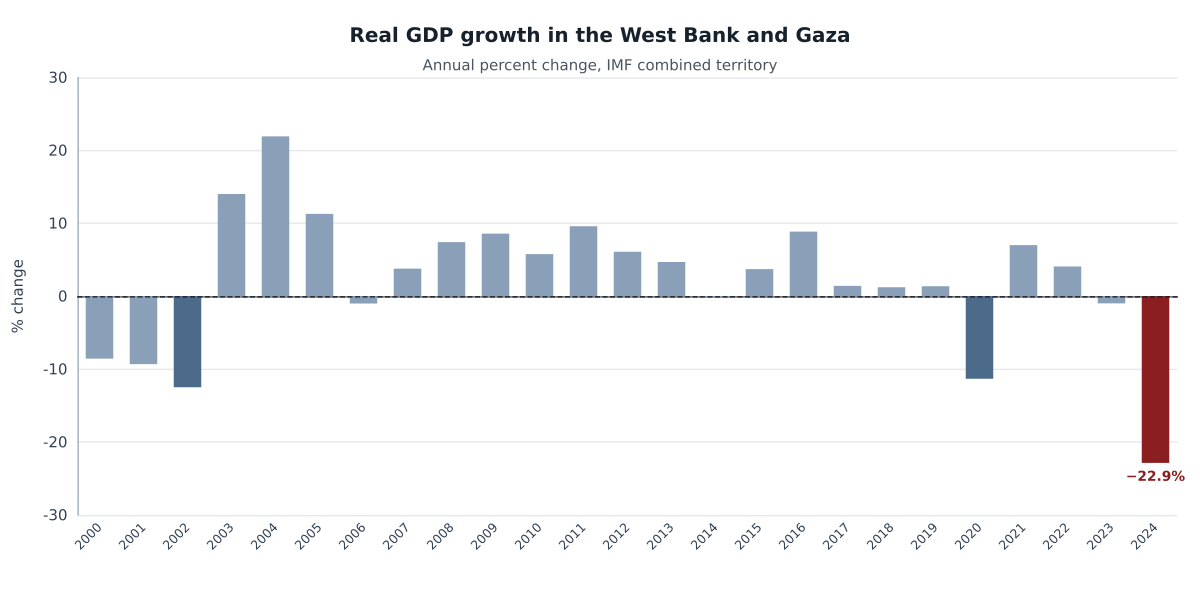
The War Year Cut Palestinian Output By Nearly A Quarter
IMF accounts for the combined West Bank and Gaza show a 22.9 percent real-GDP drop in 2024, the worst year in the series, with no published 2025 output path.
The US Medicine Bill Grew. The Pill Factories Barely Did.
US pharmaceutical-products spending reached $669 billion in 2024, while finished-medicine factory payrolls remain near their early-2000s level.
Groceries Cost More. They Still Take A Smaller Slice Of Spending.
BEA spending accounts through 2024 show food at home taking a smaller slice of U.S. consumption after the post-2019 grocery-price jump, with a much larger gap between states than between yea