LunarWeave
The War Year Cut Palestinian Output By Nearly A Quarter
Nine months after a ceasefire between Israel and Hamas, a UN assessment reported by France 24 still put two-thirds of Gaza’s population at crisis-level food insecurity. Residents described food and medicine spoiling in summer heat without refrigeration. Those are humanitarian observations, not national accounts. They do raise a measurable question: in the IMF’s books, how large was the 2023–24 collapse in the Palestinian economy, and is any recovery on the page?
The answer is blunt. For the Fund’s combined West Bank and Gaza series — Gaza is not published on its own — real GDP is estimated to have contracted 22.9 percent in 2024, after a 1.0 percent decline in 2023. That is the steepest annual drop in the series, which begins in 1995. It is almost twice the 12.5 percent contraction of 2002, at the depth of the Second Intifada, and twice the 11.3 percent pandemic decline of 2020. Compounded, real output in 2024 was 23.6 percent below 2022. These 2024 figures are IMF estimates in a later snapshot; they are not Gaza-only GDP, and they do not measure meals.
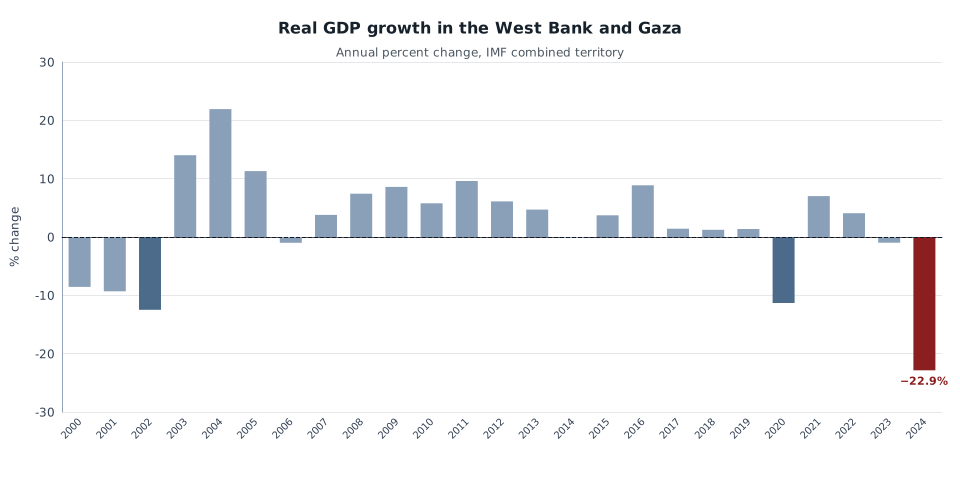
Annual percent change in real GDP for the IMF’s combined West Bank and Gaza series, 2000–2024. The 2024 estimate (−22.9%) is the steepest contraction in the series. Source: IMF World Economic Outlook, NGDP_RPCH. Choose West Bank and Gaza in the chart selector on the linked series page. This is not a food-security measure.
Income per person fell back to the 1990s
A collapse in total output is not the same as a collapse in living standards, because population also changes. On that score the accounts are darker, not milder. PPP GDP per person fell from about $5,419 in 2022 to $3,949 in 2024, a 27 percent drop, and sat 2.5 percent below 1995. The series peaked in 2016 near $6,094; 2024 is 35 percent below that high. Total real GDP in 2024 was still more than double its 1995 level — the per-person figure is the one that has gone into reverse.
In current US dollars, output shrank from $19.2 billion in 2022 to $16.0 billion in 2024, and dollar GDP per person from $3,579 to $2,853. Those dollar levels mix volume, inflation and exchange rates; the real-growth and PPP series are the cleaner comparisons.
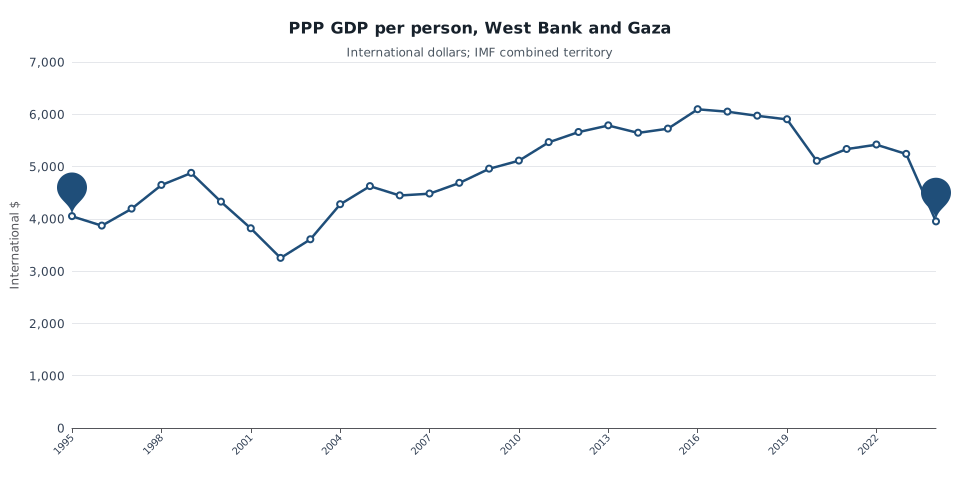
GDP per capita in PPP international dollars, IMF combined West Bank and Gaza, 1995–2024 (NGDPRPPPPC). 2024 is an estimate. Population growth means total real output can exceed 1995 even when income per person does not. Source: IMF World Economic Outlook.
The same war year did not show up as a regional recession in Israel’s real-GDP series: the Fund has Israel growing 1.0 percent in 2024. That is a same-source contrast of two different economies, not a welfare ranking and not a statement about food access inside Gaza.
Prices exploded; goods inflows shrank
If output collapsed, prices did the opposite. Average consumer-price inflation in the combined territory jumped to 53.7 percent in 2024, after 5.9 percent in 2023. The previous high in the 1997–2023 record was 9.9 percent in 2008. Inflation is not the same thing as missing calories, but a 50-percent-plus rise in the consumer basket is what a wartime shortage looks like in a price index.
The IMF file does contain a 2025 inflation estimate of 10.5 percent — still high, but far below 2024. It does not contain 2025 or 2026 real GDP for West Bank and Gaza. The Fund has a price path. It has not published an output recovery.
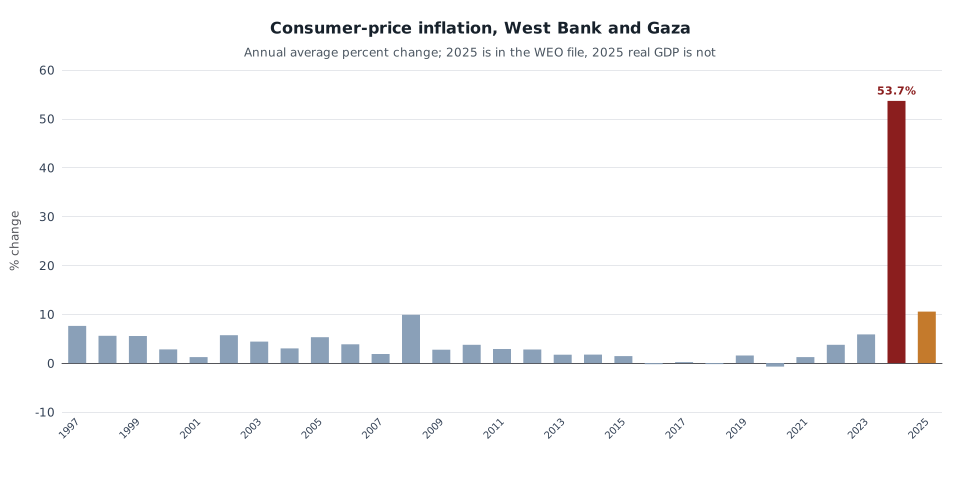
Annual average consumer-price inflation, IMF combined West Bank and Gaza, 1997–2025. 2024 is 53.7 percent; 2025 is 10.5 percent in this WEO extract. 2025 real GDP is not published. The live MacroVedia inflation page currently ends in 2024. Source: IMF World Economic Outlook, PCPIPCH.
Trade volumes tell a parallel story. Real import volumes fell 4.2 percent in 2023 and 30.5 percent in 2024. That is consistent with blocked goods, destroyed capacity and a smaller economy; it is not a count of aid trucks, and it still mixes the West Bank with Gaza. The current-account deficit widened to 18.1 percent of GDP in 2024, from 10.6 percent in 2022. Government gross debt rose from 46.5 percent of GDP in 2023 to 56.1 percent in 2024.
Unemployment cannot be brought up to date. The IMF series ends in 2022 at 24.4 percent — already extreme — and then stops. Treating that last observation as the wartime rate would be an invention.
| Measure | 2022 | 2024 |
|---|---|---|
| Real GDP growth | +4.1% | −22.9% |
| PPP GDP per person | $5,419 | $3,949 |
| Average CPI inflation | +3.7% | +53.7% |
| Import volume | +19.7% | −30.5% |
| Current account | −10.6% of GDP | −18.1% of GDP |
IMF World Economic Outlook, combined West Bank and Gaza. 2024 values are estimates in the 24 August 2026 snapshot. Inflation and import volume are percent changes; PPP GDP per person is in international dollars.
What this does not show
The IMF cannot split Gaza from the West Bank in this dataset. Gaza’s destruction is almost certainly worse than the combined average; West Bank disruption from raids, closures and lost Gaza-linked demand is folded into the same number. Using 22.9 percent as “Gaza’s GDP” would overstate what the series is.
The accounts also cannot confirm or refute the UN’s food-insecurity headcount. GDP, inflation and import volumes are consistent with a collapse in supply and purchasing power. They are not a nutrition survey.
And a missing 2025 GDP figure is not proof that output failed to recover. It is proof that, in this vintage of the World Economic Outlook, the Fund did not publish one. Anyone claiming a rebound — or a further collapse — in 2025 is using some other source.
What the published numbers do establish is narrower, and hard enough. In the IMF’s combined Palestinian accounts, 2024 was not a bad year in a volatile series. It was the worst year on the books, it wiped out the per-person income gains of a generation, and it left no official real-GDP path for the year that followed. A ceasefire can stop a war from deepening. It does not, by itself, put the economy back.
Sources and methods
Figures are from the IMF World Economic Outlook extract pinned for this research (snapshot created 24 August 2026). Real GDP growth is NGDP_RPCH; constant-price GDP levels (NGDP_R) are used only to compound 2022–24; PPP GDP per capita is NGDPRPPPPC, in international dollars; inflation is PCPIPCH (annual average); import volumes are TM_RPCH; the current account is BCA_NGDPD; government debt is GGXWDG_NGDP. Geography code WBG is the Fund’s combined West Bank and Gaza series. Israel’s 2024 growth uses the same NGDP_RPCH concept.
This is a retrospective analysis. The news day is 24 July 2026; the calculations use a later pinned snapshot and should not be read as what was knowable that day. 2024–25 observations are IMF estimates; later WEO vintages can revise them. Browser layout of the charts was not separately tested beyond SVG rendering. MacroVedia series pages are multi-country views: select West Bank and Gaza. The live inflation page ends in 2024 and therefore does not display the 2025 estimate used here.
Research Date
The displayed date matches the related news edition. Research was completed 2026-09-10.
Related news: Daily · 2026-07-24
More Research
Groceries Cost More. They Still Take A Smaller Slice Of Spending.
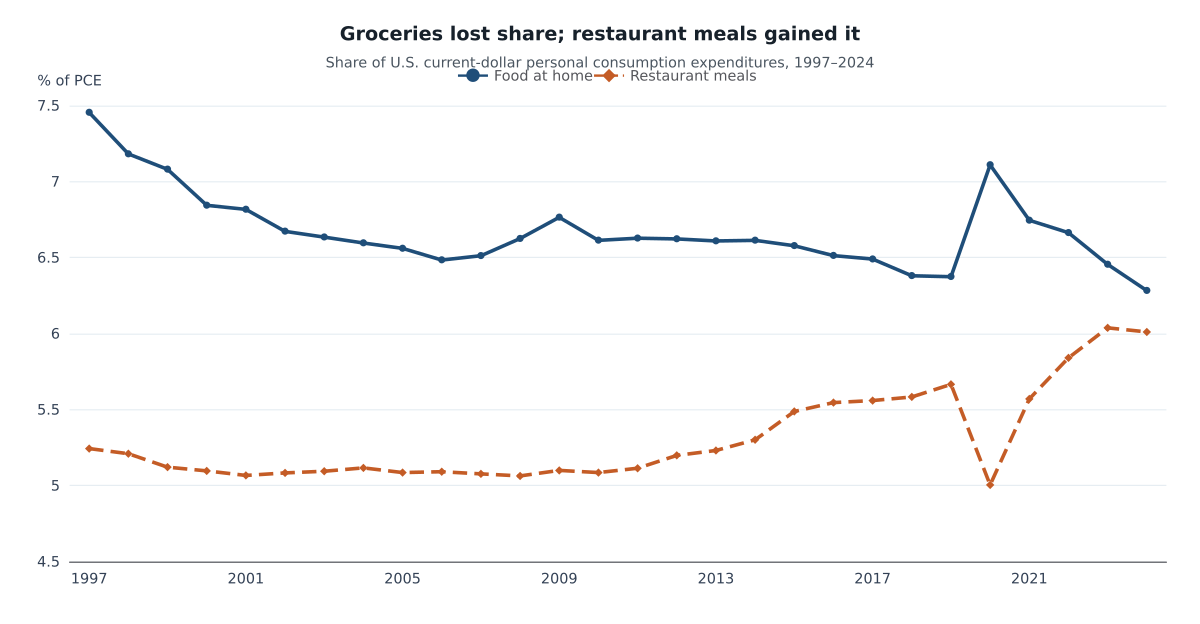
BEA spending accounts through 2024 show food at home taking a smaller slice of U.S. consumption after the post-2019 grocery-price jump, with a much larger gap between states than between yea
Saudi Arabia Still Generates Two-Fifths Of Its Electricity From Oil
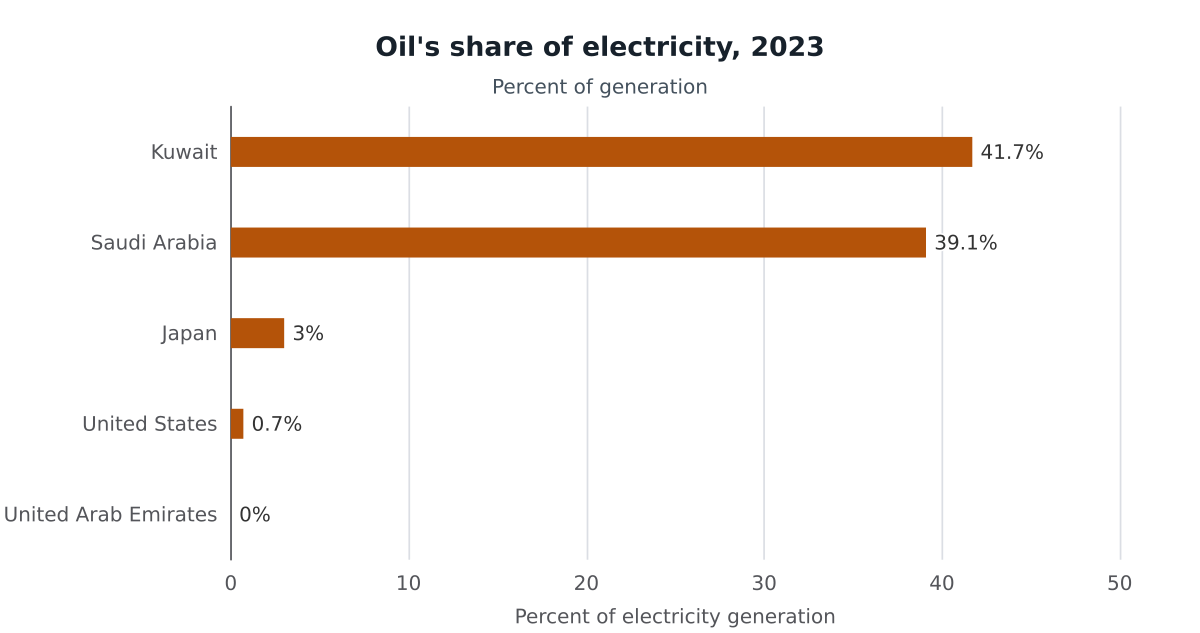
In 2023 Saudi Arabia still generated 39 percent of its electricity from oil. The UAE already runs nuclear plants and has no oil residual on the grid.
Africa’s First Battery Factory Is Plugging Into A Coal Grid
Africa’s first EV battery gigafactory is planned for Morocco, but IRENA data show coal still supplied two-thirds of Moroccan electricity in 2023.