LunarWeave
Nepal’s Power System Is Hydropower — And It Was Still Being Built
When ice, rock and mud tore down the Nepal–Tibet border in late August, rescuers did not only search villages. They dug at tunnel mouths. Dawn, citing Nepal’s disaster authority, reported 903 people dead and 4,247 missing in Nepal, including 933 missing from hydropower projects, with workers believed trapped in about half a dozen blocked tunnels. France 24 described the same race to free hundreds of workers at buried hydropower sites. Those figures are the authorities’ count, not a census this article can check. What the electricity accounts can show is why so many people were underground in the first place.
Nepal does not sprinkle a few dams onto a coal or gas grid. In the International Renewable Energy Agency’s IRENASTAT series, hydropower already supplies almost every kilowatt-hour the country generates — and the fleet that produces it has been expanding faster than at any other point in the 2000–2025 record. The tunnels were not a side project. They sat on the system that keeps the lights on.
A quiet grid, then a construction surge
On-grid renewable hydropower capacity in Nepal was 259 megawatts in 2000 and 1,248 MW in 2020. That twenty-year rise, 989 MW, looks almost flat beside what came next. By 2025 the same series stands at 3,772 MW — just over three times the 2020 level. The country added 2,525 MW in five years, more than two and a half times as much as it had added in the previous twenty.
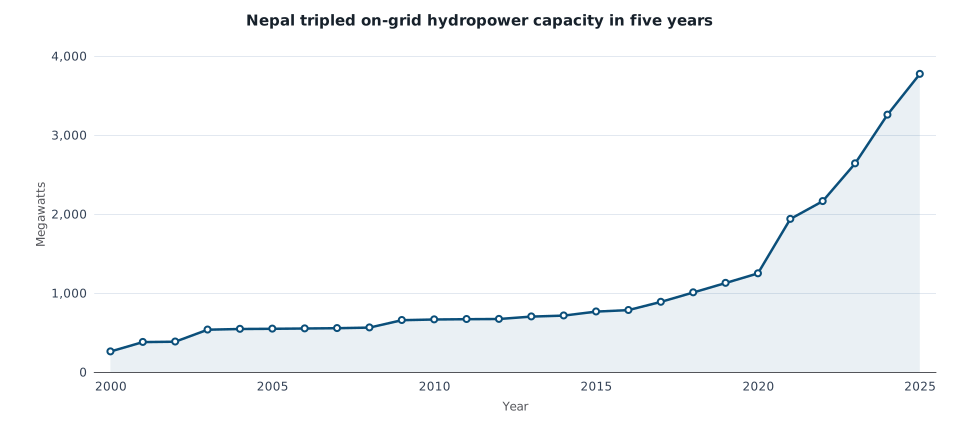
On-grid renewable hydropower electricity capacity in Nepal, megawatts, 2000–2025. IRENASTAT installed-capacity series. The 2020–2025 rise is 2,525 MW. Capacity is not a headcount of tunnel workers, and it does not identify the specific sites hit in August 2026.
The jump is visible in a single year. Capacity rose from 1,248 MW in 2020 to 1,937 MW in 2021, then kept climbing through 2,639 MW in 2023 and 3,256 MW in 2024. Output followed with a lag. Hydropower generation — IRENA’s “all grid connections” series, which includes small off-grid plants — went from 6,182 gigawatt-hours in 2020 to 11,422 GWh in 2023, an 85 percent increase in three years. IRENA has not yet published generation for 2024–2025, so those last two capacity years are still untested as electricity.
The rest of the grid is a rounding error
That new steel is not diversifying Nepal off the rivers. It is piling onto them.
In 2023, hydropower produced 11,422 GWh out of 11,550 GWh of electricity IRENA records for Nepal: 98.9 percent. Other renewables contributed 128 GWh. Non-renewable generation was 0.01 GWh, indistinguishable from zero. IRENA’s own renewable share of electricity generation has printed 100 percent every year since 2016.
Capacity in 2025 tells the same story on the plants that feed the grid. Of 3,987 MW of on-grid capacity, hydropower is 3,772 MW (94.6 percent). On-grid solar photovoltaics are 156 MW. Other on-grid renewables are 6 MW. Fossil-fuel capacity is 53 MW — the same figure IRENA has carried, unchanged, every year since 2000. Off-grid solar (57 MW) and off-grid hydro (38 MW) exist, and they are why IRENA’s renewable share of all capacity is 98.7 percent rather than 94.6. They do not change the fact that the large plants, and the tunnels that serve them, are the power system.
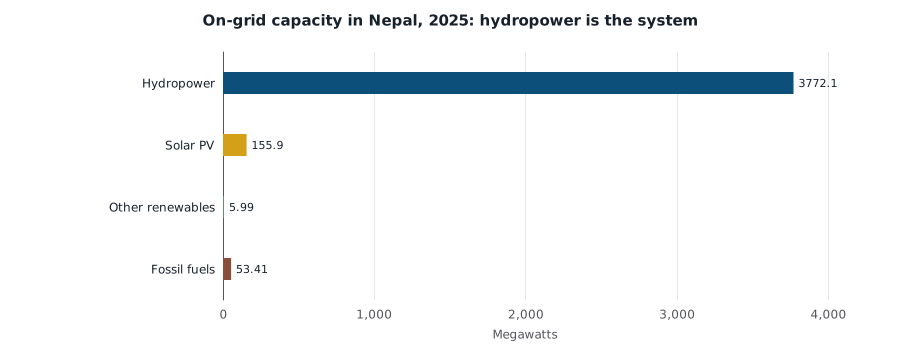
Nepal on-grid electricity capacity by technology, megawatts, 2025. IRENASTAT: hydropower 3,772.1 MW, solar PV 155.9 MW, other renewables 5.99 MW, fossil fuels 53.41 MW. Off-grid plants are excluded. Shares are of capacity, not of 2023 generation, which was even more hydro-heavy.
| Year | On-grid hydro (MW) | On-grid solar PV (MW) | On-grid fossil (MW) | Hydro generation (GWh) |
|---|---|---|---|---|
| 2015 | 764.48 | 0.68 | 53.41 | 3,587.73 |
| 2020 | 1,247.51 | 11.64 | 53.41 | 6,182.29 |
| 2023 | 2,639.49 | 61.51 | 53.41 | 11,422.11 |
| 2025 | 3,772.10 | 155.90 | 53.41 | — |
Generation is IRENA’s hydropower series for all grid connections and is not yet published for 2024–2025. Solar PV on-grid begins in 2011 in this extract.
A flood that buries hydropower tunnels is therefore not only a construction disaster. It hits the plants Nepal has been betting the grid on, at the moment those plants were still being built.
Neighbours show the pace, not a template
Himalayan hydropower is not new, and Bhutan is the usual comparison: another landlocked hydro state that sells power abroad. Bhutan’s on-grid hydro capacity sat at 2,326 MW from 2019 through 2023. Nepal passed it in 2023 (2,639 MW) and remained ahead in 2025 (3,772 MW against Bhutan’s 3,482 MW, after Bhutan’s own 2025 step-up). In 2023 Nepal also generated more hydropower electricity than Bhutan — 11,422 GWh against 10,535 GWh — before Nepal’s 2024–2025 capacity had a chance to show up in the generation file.
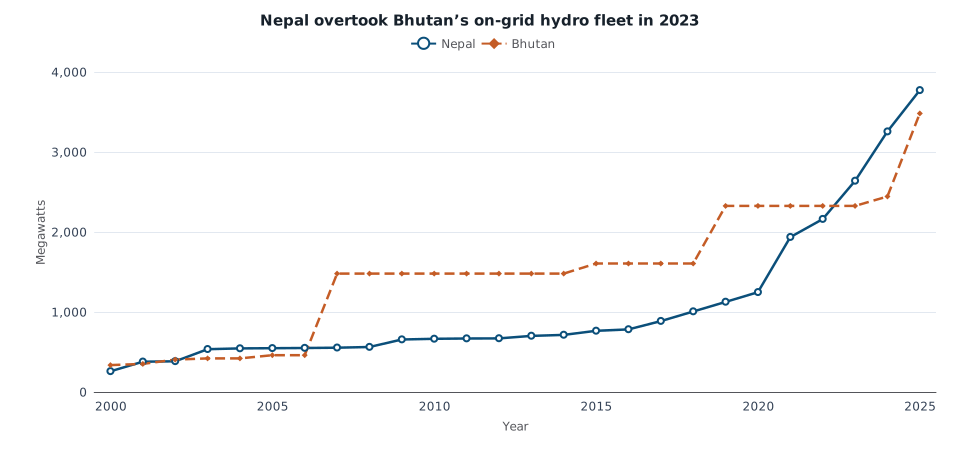
On-grid renewable hydropower electricity capacity, megawatts, Nepal and Bhutan, 2000–2025. IRENASTAT. Bhutan’s series moves in steps as large plants come online; it was flat while Nepal’s post-2020 build-out ran. This is fleet size, not output per person or export revenue.
India’s on-grid hydro fleet is in another league — 45,893 MW in 2020, about 37 times Nepal’s — and it added 3,145 MW by 2025. Nepal added 2,525 MW in those same years: four-fifths as many megawatts from a grid 37 times smaller. That is a statement about construction intensity in Nepal, not a claim that India should have been building more dams. Hydropower is not India’s grid: IRENA’s renewable share of Indian electricity generation was still 19.9 percent in 2023.
None of this identifies the Chilime plant in Rasuwa, named in the Dawn dispatch, inside IRENA’s national totals. National megawatts cannot say which tunnels flooded, how many workers were on each site, or whether a given 2021–2025 addition was the project now under the mud. They also say nothing about the Tibetan side of the same flood. Chinese authorities, as reported by the Guardian, put that toll at 16 dead and 546 missing; advocacy groups dispute the scale. IRENA’s China series is national and cannot isolate Tibet.
The electricity record does not attribute the flood’s trigger — reported as a glacier collapse — to hydropower construction or to climate change. It answers a narrower question. If hundreds of people were in hydropower tunnels when the mountain failed, that is because Nepal had spent five years installing the plants that already make almost all of its electricity. Rebuilding those plants is not a boutique energy option. In these accounts, it is the grid.
Sources and methods
This is retrospective research written on 10 September 2026 about events reported on 31 August 2026. It uses a pinned IRENA Renewable Energy Statistics extract (snapshot created 24 August 2026). Capacity runs through 2025; generation and the renewable share of generation run through 2023. Observation years are IRENA’s series dates, not proof of what was publicly released on any given day.
On-grid hydropower, solar PV, fossil and total renewable/non-renewable capacity are separate IRENASTAT series. The 94.6 percent hydro share is on-grid hydro divided by on-grid renewable plus on-grid non-renewable capacity in 2025. The 98.9 percent generation share is hydropower generation divided by renewable plus non-renewable generation in 2023. Off-grid plants are excluded from the on-grid mix and included in generation. IRENA does not flag individual years as estimates in this extract; later revisions remain possible. Death, missing and tunnel counts are taken from contemporaneous reporting and are not independently verified.
Research Date
The displayed date matches the related news edition. Research was completed 2026-09-10.
Related news: Daily · 2026-08-31
More Research
Japan’s 3% Yield Is A Cheap-Debt Problem, Not A 2025 Blowout
Japan’s 10-year yield at 3 percent is a break with cheap borrowing, not a 2025 IMF budget blowout: the COVID deficit had already narrowed, and residual interest remained tiny beside the Unit
Iceland Voted No Already Richer Than Germany — With Inflation Still The Outlier
Iceland’s 2026 EU-talks referendum was not a poor-applicant vote: IMF accounts put 2024 GDP per capita above Germany, while inflation remained the highest among European peers.
Japan’s 30-Year-High Yield Is Not This Year’s Interest Bill
Japan’s 3% 10-year yield is a 30-year high, but IMF accounts still show Tokyo paying almost no net interest. Britain’s 2008-level gilt yield is already an interest bill, because the debt sto