LunarWeave
Germany’s Economy Is No Larger Than It Was In 2019
At its congress in Erfurt on 4 July 2026, Alternative for Germany recast a leadership vote as a rescue mission. Co-leader Alice Weidel told delegates the party was fighting “Germany’s decline,” a line that sat beside an anti-immigration soundtrack and a claim, reported by AFP, that recent polls put AfD as high as 29 percent against about 22 percent for Chancellor Friedrich Merz’s conservatives. The cultural argument is not something GDP can settle. The economic one is narrower, and it is testable: has Germany actually stalled in a way that is unusual among large rich countries?
It has. In the International Monetary Fund’s World Economic Outlook, Germany’s real GDP contracted 0.87 percent in 2023 and another 0.50 percent in 2024. Among the Group of Seven plus Spain, it is the only economy that shrank in both years. Japan dipped in 2024 after a small 2023 gain. France, Italy, Britain, Canada, the United States and Spain all stayed in positive territory.
That two-year slide erased the recovery Germany had already made. Chain those annual growth rates from a 2019 baseline and German real output in 2024 is 0.04 percent above 2019 — a statistical rounding error around a lost half-decade. The same arithmetic puts the United States 12.8 percent larger than in 2019, Spain 7.1 percent larger and France 4.2 percent larger. Japan, the other slow G7 member, is up 0.9 percent.
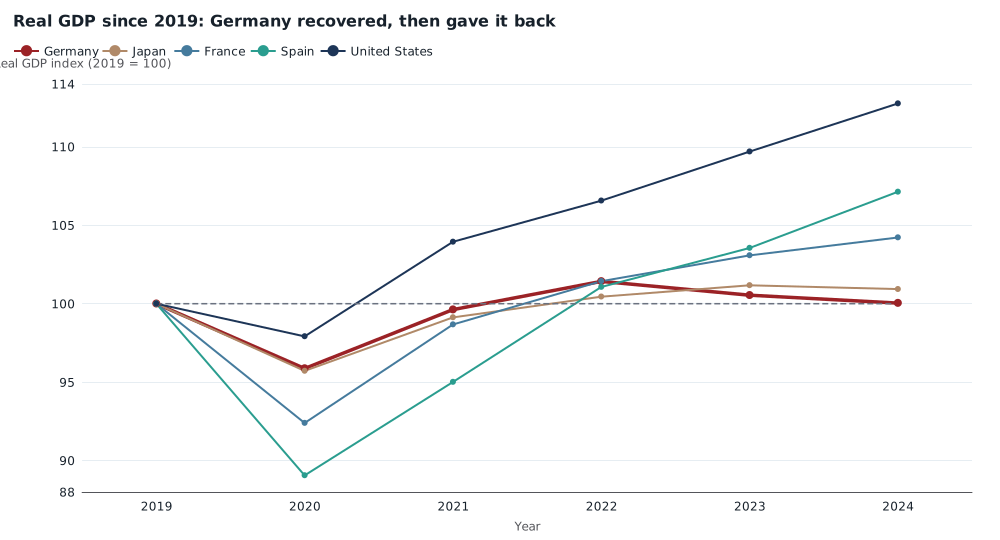
Index of real (constant-price) GDP, 2019 = 100, chained from annual percent changes. 2019–2024. Dashed line marks the 2019 level. Source: IMF World Economic Outlook, NGDP_RPCH. 2025–26 Fund estimates are omitted here. Readers selecting Germany on the constant-price GDP growth series page should note there is no geography deep-link.
A milder crash, then a relapse
The 2019 comparison is not a story of an especially brutal pandemic recession. Germany’s 2020 contraction, 4.1 percent, was milder than France’s 7.6 percent, Italy’s 8.9 percent or Spain’s 10.9 percent. By 2022, German real GDP was 1.4 percent above 2019, almost identical to France. Then the paths split. Germany shrank 1.4 percent across 2023 and 2024 combined. Spain, which had further to climb, grew 6.0 percent over those two years. The United States grew 5.8 percent.
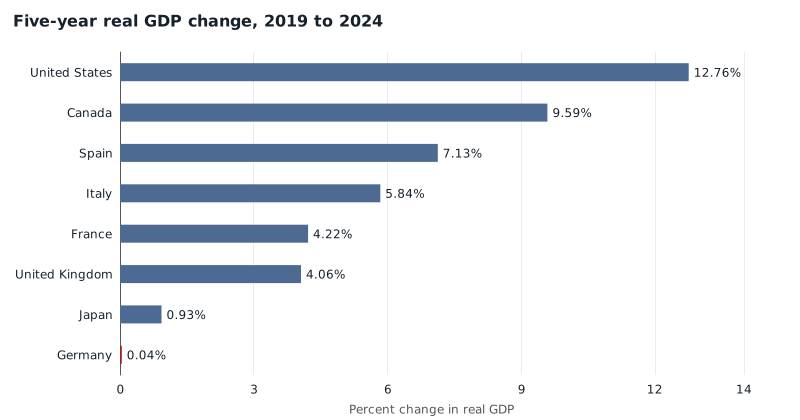
Percent change in real GDP from 2019 to 2024, chained from IMF WEO NGDP_RPCH. G7 members plus Spain. 2025–26 estimates excluded.
| Economy | 2023 | 2024 | 2019–2024, chained | Unemployment, 2024 |
|---|---|---|---|---|
| Germany | −0.87% | −0.50% | +0.04% | 3.4% |
| Japan | +0.72% | −0.24% | +0.93% | 2.5% |
| United Kingdom | +0.27% | +1.09% | +4.1% | 4.3% |
| France | +1.62% | +1.11% | +4.2% | 7.4% |
| Italy | +0.92% | +0.78% | +5.8% | 6.6% |
| Spain | +2.46% | +3.46% | +7.1% | 11.3% |
| Canada | +1.95% | +2.05% | +9.6% | 6.4% |
| United States | +2.93% | +2.79% | +12.8% | 4.0% |
Real GDP is IMF WEO constant-price percent change (NGDP_RPCH), chained from 2019 for the five-year column. Unemployment is the IMF WEO labour-force rate (LUR). 2024 unemployment figures are the Fund’s outturns in the same snapshot.
The slump also shows up as spare capacity. The IMF’s estimate of Germany’s output gap — actual GDP minus potential — swung from 1.3 percent above potential in 2022 to 1.0 percent below in 2024.
Stagnation without a jobs collapse
If “decline” is taken to mean mass unemployment, the same vintage does not support it. German unemployment was 3.1 percent in 2023 and 3.4 percent in 2024 — still the second-lowest rate in this comparison set after Japan, and far below France or Spain. The 2022 inflation spike was real: consumer prices rose 8.7 percent that year, then cooled to 2.5 percent in 2024. The current-account surplus, which had narrowed to 3.8 percent of GDP in 2022, was back to 5.8 percent in 2024. Germany did not lose its external surplus while it was losing output.
That combination — shrinking production, a still-tight labour market, a rebuilt surplus — is a particular kind of bad news. It is consistent with weak domestic demand and a manufacturing shock that never became a 1930s jobs crisis. It cannot, from these series alone, identify the mix of energy costs, China competition, interest rates or fiscal choices that produced it. It also cannot measure how that shock landed in the eastern states where AfD is strongest.
A forecast bounce that does not close the gap
In this World Economic Outlook vintage, the Fund does not expect Germany to snap back. It puts 2025 growth at 0.24 percent and 2026 at 0.79 percent — estimates and projections, not outturns. Even if those figures arrive on schedule, chained real GDP in 2026 would still be only 1.1 percent above 2019. The United States would remain in a different league. Weak growth from a hole is not the same as filling the hole.
None of this proves that two years of contraction caused AfD’s poll lead, which long predates 2023 in the east and is being campaigned as an immigration fight. Stagnation can feed a decline story without being its only fuel. What the official growth record does show is that the story is not empty. Among large rich peers, Germany is the country that recovered from Covid and then shrank back to where it started.
Sources and methods. Retrospective research dated 10 September 2026, using a pinned IMF World Economic Outlook snapshot ingested in August 2026 — later than the 4 July 2026 Erfurt reporting. Those later figures were not an “as of 4 July” vintage. Annual series NGDP_RPCH (constant-price GDP, percent change), LUR (unemployment rate), PCPIPCH (average consumer-price inflation), NGAP_NPGDP (output gap) and BCA_NGDPD (current account, percent of GDP) are from the IMF WEO. Years 2015–2024 are treated as historical outturns in this snapshot; 2025–2031 remain Fund estimates or projections. Real-GDP indices are chained from the annual growth rates, not taken from a separate level series. The comparison set is the G7 plus Spain, not every advanced economy. Output-gap estimates are IMF staff constructs of actual versus potential GDP. Polling and quotations from Erfurt are attributed to contemporaneous reporting, principally AFP via Dawn and the Guardian, and were not re-polled here. MacroVedia series pages are multi-country; choose Germany in the selector. Chart SVGs were rendered locally; they have not been separately checked in a browser or on a phone.
Research Date
The displayed date matches the related news edition. Research was completed 2026-09-10.
Related news: Daily · 2026-07-04
More Research
The United States Is Still Larger Than China In Dollars. Its Budget Deficit Is The Outlier.
IMF accounts show the US–China dollar-GDP gap widened after 2019, while the United States ran the largest general-government deficit among large economies in 2024.
Iran’s New Leader Inherits The Worst Slump Since The Iran-Iraq War
IMF estimates put Iran’s 2026 real-GDP contraction at 6.1 percent — worse than the 2010s sanctions years and the steepest since 1988 — as Mojtaba Khamenei inherits the economy after his fath
AI Data Centres Are Arriving On Grids That Were Not Expanding
IRENA generation data through 2023 show UK electricity output down 23 percent from 2010 and US output barely higher, even as AI data-centre projects promise renewable power.