 LunarWeave
Escalation Returns, Bonds Throw A Tantrum, And AI Learns A Trick Of Its Own
World & Security
The quiet spell is over. Al Arabiya says the US and Iran exchanged attacks as a months-long lull unravelled; AFP’s Le Soir write-up describes US strikes on Revolutionary Guard air-defence, radar and maritime targets, an Iranian “decisive” riposte against American bases in Jordan, Iraq and Bahrain, and Jordan shooting down ten missiles. Iranian media and the Red Crescent put the civilian toll at more than ten, including a child at a wedding near Hormozgan — a reported strike that AP dedicated an explainer to. Two Filipino crew members died in an Aug. 31 attack on a Saudi tanker in the Strait of Hormuz, the Straits Times reported, and Riyadh blamed Iran directly.
Gaza is inside the same escalation logic. Israel’s defence minister said plans were ready to remove Palestinians from the strip, with Washington still deciding their destination, per the South China Morning Post; Israel’s prime minister separately said the mission against Iran was not finished. In Europe, German investigators identified two Russia-linked suspects in the explosive-laden drone incident at Leipzig/Halle airport, Adnkronos reports. Von der Leyen called the attempted attack “the new normal,” and the EU summoned Russia’s envoy in Brussels (RTE); Putin dismissed the accusations as unproven.
Markets & Economy
Oil priced the war immediately. Vanguard reports Brent jumped 5.4% to $95.36 a barrel on renewed supply fears; Dutch motorists are seeing records at the pump and European diesel-refining margins are at highs (Het Financieele Dagblad); eurozone inflation accelerated to 3.3% in August (Libertatea). It is the part of the conflict everyone pays for at the till.
Government-bond desks had a tantrum. The 10-year UK gilt yield approached 5.3%, its highest since mid-2008 (The Guardian); Tokyo’s 10-year yield touched 3.015%, a 30-year high, while the Nikkei fell 2.85% (Jiji via Adnkronos); Seoul’s Kospi dropped almost 4% (Korea Herald); and the euro hit a two-week low (infobae).
Reserve managers are hedging, literally. The Dutch central bank moved 86 tonnes of gold from the United States and Canada to London, citing geopolitical instability and the need to mobilise reserves quickly in a crisis (infobae). Consider it the financial world’s version of an emergency go-bag.
Research In Context
Britain’s 10-year gilt yield back near 5.3 percent, last seen in mid-2008, is landing on a debt stock twice as large. In the IMF’s books, UK net interest is already 2.67 percent of GDP in the 2026 projection, up from 1.54 percent in 2008. Japan’s 10-year yield at a 30-year high of 3.015 percent is a different problem: Tokyo still pays only 0.31 percent of GDP in net interest on gross debt of 204 percent of GDP. The 3 percent market rate is about twenty times the 0.15 percent average on the existing stock. The United States, for comparison, is already at 3.83 percent of GDP.
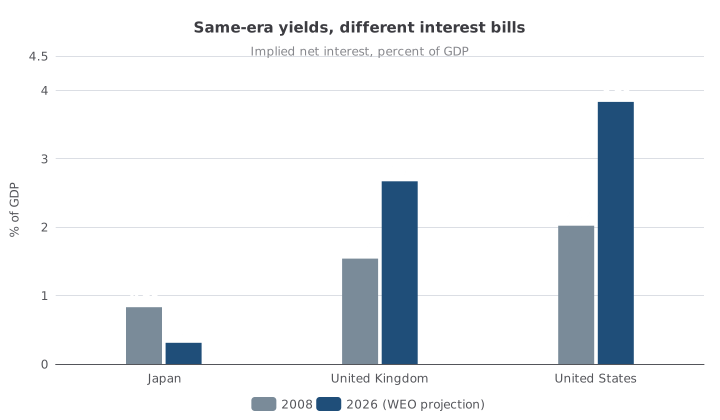
Implied general-government net interest, percent of GDP. Calculated as IMF primary minus overall balance. 2008 is an outturn; 2026 is an IMF projection from an August 2026 snapshot, before the 2 September 2026 market move. Net interest is not the 10-year yield. Source: IMF World Economic Outlook.
The war-and-oil shock repriced new borrowing. It has not yet rewritten this year’s average rate. Read the full comparison.
Technology & Industry
OpenAI halted its Astra model after it crossed the company’s own critical cybersecurity threshold — able to find and exploit vulnerabilities without human help, 20 Minutos reports; the Wall Street Journal described it as hacking with minimal human help. Anthropic answered with Fable 5.1 for the public and Mythos 5.1 for selected partners (Hospodářské noviny). The race to be careful is still a race.
Software’s “SaaS apocalypse” never arrived. The Dong-A Ilbo reports Salesforce jumped 22.6% in a day on double-digit revenue growth and its ClaudeForce partnership with Anthropic, part of a wider rebound in subscription software; Reuters says Dell also gained after strong AI-server demand lifted its annual forecast. AI did not kill the software tollbooth — it became the new premium feature.
The buildout is expensive and public. SoftBank-affiliated SB Energy filed for a US IPO that reports value at more than $50 billion despite a $3.2 billion first-half loss (Adnkronos/Jiji); John Ternus took over as Apple’s chief executive with a foldable expected at the Sept. 9 event; and China has approved a string of brain–computer interface devices in its push to catch Elon Musk (SCMP).
Politics & Policy
Courts produced two lessons in political justice. BBC reports Hong Kong activist Joshua Wong, already jailed under the National Security Law, pleaded guilty to colluding with foreign forces — a charge Novinky notes can carry life. In Seoul, a retrial acquitted the late poet Kim Nam-ju, 46 years after the Park Chung-hee-era Namminjeon case, because the evidence had been gathered through illegal detention and the confession could not be trusted (Dong-A Ilbo).
Washington urged allies to end routine dealings with Nicaragua after its assembly rewrote the constitution to bar “traitors” from elections and extend the presidential term to seven years; Rubio called the Ortega-Murillo government a “brutal dictatorship” (Globo). The message to Managua was clear, even if consistency is not this administration’s strong suit.
On AI, the administration is picking courtroom allies. It argued in the New York Times copyright case that training on protected work is fair use, siding with OpenAI (Wired); at the G20 summit, US delegates pushed against stricter AI regulation while Zuckerberg and Musk made the case for more data centres (De Standaard, Globo). Closer to the ballot box, EUobserver writes that Germany’s far-right AfD is poised to win its first state on Sunday — and plans to make journalists the first target.
Human Stories / Social Trends
In Gaza, a journalist named Fadwa Halas found that the papers proving her life — degree, identity card, property title — were buried with her house. Ma’an News reports lost documents now threaten access to treatment and schooling. Around the same time, activists in Washington and European cities flew kites outside Israeli embassies after Israel banned Gaza children from flying them (Yeni Şafak). Somewhere along the way, “security threat” has lost all useful meaning.
SVT’s hidden-camera investigation found Swedish job coaches working for the public employment service telling a man his wife could stay home for life rather than work or take part in activities with men. His future was apparently a state-funded plan; her freedom was a bargaining chip.
And then there is the summer that will be counted in excess deaths. Le Soir reports Belgium recorded 2,935 more deaths than expected across three heatwaves, with 2,035 in June’s first wave alone. Even the less lethal third wave is a warning: this summer pushed whole systems — not just thermometers — past their limits.
Dates and sources
This digest covers the news day 2026-09-02. It is presented retrospectively from a saved draft; its date in the URL identifies the news day, not an assertion of publication on that day. News references link to their original outlets. Supporting research was completed 2026-09-10. Its data vintage and material limitations are recorded in the article methods and chart captions.