 LunarWeave
Drone Blame Games, Hormuz Fever And A School Bell That Saved 900
World & Security
Germany formally pinned the failed August 4 drone attack at Leipzig/Halle airport on Russia, saying the Russian state supplied the know-how and equipment and recruited “low-level agents” to carry it out (The Guardian). Berlin then moved from words to consequences, announcing the closure of Russia’s last consulate, in Bonn, and of the Russian cultural center in Berlin (Adnkronos). Hours later came a fresh scare: explosive devices were found near one of Germany’s biggest power plants in Brandenburg, which a regional minister called a terrorist act (UNIAN). Brussels says “hybrid attacks” of this kind will not go unanswered (infobae).
The Strait of Hormuz stopped being quiet again. A tanker was hit by three missiles off Oman as it left the strait, per the British maritime watchdog (Glas Srpske). U.S. Central Command then announced strikes on Revolutionary Guard targets, citing attempts against commercial shipping and American forces (Reuters); Iranian media reported explosions on Qeshm (iDNES); and the Guard claimed a ballistic-missile strike on a U.S. drone base at Jordan’s Prince Hassan airfield (Mehr). Even by this conflict’s standards, the choreography was odd: Trump publicly asked Tehran not to respond, minutes before fresh strikes (Hamshahri). Iran promised a crushing reply anyway (IRNA).
Ukraine kept two air wars running at once. Russia hit the Kyiv region for a sixth straight night, killing at least a dozen people (Los Angeles Times). In the other direction, Ukraine’s military intelligence said it caused a fire at the Novatek-Ust-Luga complex near St Petersburg (Ukrainska Pravda); Moscow claimed 516 drones were destroyed nationwide, while Estonia scrambled NATO jets after several drones crossed its airspace (Kyiv Post). Which side is winning the air war depends mostly on which airspace you’re standing in.
Markets & Economy
The Middle East escalation is now visible in the inflation basket. Eurostat put euro-area August inflation at 3.3 percent, the highest in almost three years, with energy prices up more than 14 percent (Le Soir). In Tokyo, the 10-year government bond yield touched 3 percent for the first time in 30 years, with fiscal 2027 budget requests reportedly above ¥143 trillion (Adnkronos). U.S. Treasury Secretary Scott Bessent has called time on Japan’s big-stimulus era (Reuters) — a message Tokyo’s spending machine does not appear to have received.
Oil traders raised their premiums accordingly: Brent moved above $95 a barrel and WTI to $90.77 (Akşam), while European benchmark gas crossed €70 per megawatt-hour with storage refills still hostage to the fighting (Le Soir). Wall Street opened in the red, with the Dow down 0.44 percent and 10-year Treasury yields at levels not seen since January 2025 (El Comercio). Bessent’s sales pitch is that pipelines can make Hormuz a “worthless piece of water” (Yonhap); the charts have not yet bought it.
Washington is also drafting an oil-country takeover plan: the White House detailed a deal giving the U.S. a first right to buy roughly 80 percent of North American Blue Energy Partners’ Venezuelan production at cost, an assured 20 percent, board veto power and a Pentagon-linked warrant stake (Globo). Trump framed it as taking “all” of Venezuela’s oil (Euronews); Bloomberg’s verdict is that the whole thing is “built on quicksand” (Bloomberg). For contrast, Russia’s government now forecasts 2026 oil output at a 17-year low, blaming embargoes, export bottlenecks and drone strikes on refineries (Nexta).
Research In Context
Japan’s 10-year yield touching 3 percent on 1 September is a break with 30 years of cheap borrowing, not a 2025 IMF budget blowout. In the Fund’s books, gross debt had fallen to 206.5 percent of GDP in 2025 from a 228.8 percent peak in 2020, and the overall deficit had narrowed to 1.05 percent of GDP. Residual net interest — the gap between the primary and overall balances — was still 0.20 percent of GDP, against 3.65 percent in the United States. A 3 percent coupon on the whole stock would be 6.2 percent of GDP; existing bonds do not reprice that fast. The live risk is new issuance, not last year’s deficit.
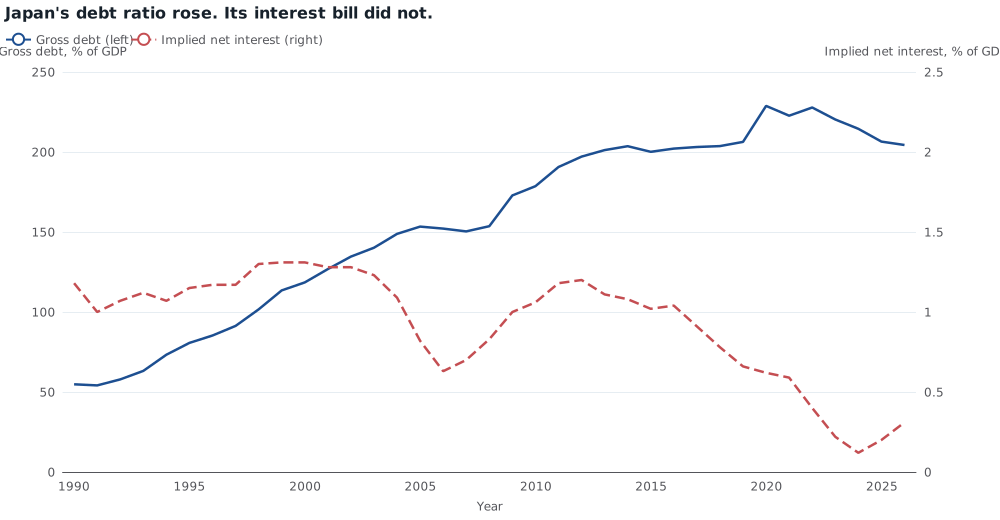
Japan general-government gross debt (left axis) and implied net interest (right axis), percent of GDP, 1990–2026. Implied net interest is the IMF primary minus overall balance, not the 10-year market yield. 2025–26 are estimates/projections in the 24 August 2026 WEO snapshot. Source: IMF World Economic Outlook.
How Japan’s 3% yield compares with the actual interest bill
Retrospective note, 10 September 2026: 24 August 2026 IMF WEO snapshot; 2025–26 are estimates/projections, not the 1 September market yield.
Technology & Industry
Apple turned a page on September 1: John Ternus took over from Tim Cook after 15 years, taking charge of a company that is, in Reuters’ words, bigger and richer but catching up in the AI race (Reuters). Cook’s farewell was pure fondness — “my love for the Apple community will remain unchanged” (Bakinski Rabochi). The courtroom side of Silicon Valley stayed less warm: Apple alleges an OpenAI employee accessed circuit plans after joining the startup (The Star), while OpenAI rejects the claims (infobae).
Brussels made ChatGPT the first AI chatbot subject to the EU’s toughest online-content rules, adding Reddit and Roblox to the “very large platform” list with four months to comply (Malay Mail). Capability and caution are racing each other: OpenAI is giving select partners early access to Astra, its first model with “critical” cyber abilities (Wired), while rival Anthropic signed a reported $35 billion cloud deal with Nvidia-backed Lambda (Reuters) and says it has hardened alignment and sandbox security after Claude cyber-evaluation incidents (ANI).
The U.S. government also picked a fight with Amazon’s ad machine: the FTC and 22 states allege the company secretly inflated advertising prices, and Amazon denies the charges (The Washington Post, Rzeczpospolita). Meanwhile, Samsung Electro-Mechanics announced its largest-ever AI-server capacitor supply contract, a sign that the hardware boom is undimmed (The Dong-a Ilbo). And if you want a measure of how coherent the AI conversation has become: Time’s influential-AI list omitted Nvidia’s Jensen Huang while finding room for Ben Affleck and Paris Hilton (Adevărul).
Politics & Policy
Mark Carney’s Liberals won all three special elections on Tuesday, keeping their majority while Canada stares down a trade war with the United States (Reuters). The headline came from Quebec, where a Liberal ousted a Conservative for the first time since 2018 (The Independent). Carney’s message to Washington was blunt: “stop trying to be tough” (Arab News) and start being serious before trade talks resume (Reuters).
The G20 meeting in Asheville was its own diplomatic mood ring. Washington re-invited Russia and barred journalists from parts of the event, irritating European ministers (The Jakarta Post). On the sidelines, U.S. Treasury Secretary Scott Bessent reportedly told Russia’s finance minister there would be no economic relief while the war in Ukraine continues (Novinky); the Russian delegation, which arrived expecting business, left without concessions (Meduza). Separately, eleven EU countries revived the perennial idea of scrapping unanimity in EU foreign policy (Bakinski Rabochi), which is Brussels-speak for “please stop giving us vetoes.”
The Pentagon’s leadership churn continued as Army Secretary Dan Driscoll resigned after months of reported tensions with Defense Secretary Pete Hegseth (Al Jazeera). And while Washington lectures others about foreign interference, Reuters-sourced reporting says the administration plans to spend about $4 million strengthening right-wing media in Europe as part of a conservative civil-society package of at least $25 million (Jutarnji list). Foreign influence, it seems, is in the eye of the check-writer.
Human Stories / Social Trends
In Nepal’s Trishuli Valley, school principal Rajendra Dawadi heard a colleague’s warning about floodwaters, rang the school bell and moved staff and students to higher ground — saving 900 people just before the disaster hit (South China Morning Post). His quick bell was rare good news in a catastrophe that has killed more than 1,000 people and left thousands missing (Deccan Herald); with mortuaries overflowing, bodies are being numbered and buried en masse (Yeni Şafak).
In England, a 10-year-old autistic boy won his fight against permanent exclusion after bringing a replica butterfly knife to school; the High Court ruled that exclusion should be “a tool of last resort,” and his mother hopes the case helps other children (The Guardian). The wider picture is grimmer: researchers say the number of young people in England with no close friends has risen fivefold since 2014, a change they blame on austerity, the pandemic and social media (The Guardian). Childhood, apparently, is not on the syllabus.
In Damascus, a young Syrian woman named Lama Awad found her detained brother’s name carved into a cell door in the old Interior Ministry pavilion and asked whether she could take the door as a last memory of him (Al Jazeera). In Berlin, someone destroyed the rainbow bench installed in Tiergarten to remember the victims of July’s terror attack (iDNES). Some memorials are kept; others need to be defended from the living.
Dates and sources
This digest covers the news day 2026-09-01. It is presented retrospectively from a saved draft; its date in the URL identifies the news day, not an assertion of publication on that day. News references link to their original outlets. Supporting research was completed 2026-09-10. Its data vintage and material limitations are recorded in the article methods and chart captions.