 LunarWeave
Gold On The Move, AI Talking Big, Football In A Huff
World & Security
The cultural-diplomacy fight has become a front in Europe's hybrid war. After a drone laden with explosives was found near a Ukrainian plane at Leipzig/Halle airport, Moscow said it would close branches of Germany's Goethe-Institut across Russia—Lavrov called it payback for Berlin's planned closure of the Russian House. The European Commission says it cannot close Russian Houses itself; that is up to member states. Danish counterintelligence told Berlingske it had uncovered concrete Russian sabotage plans against defense companies, and Munich police reported incendiary devices thrown near arms firms, with two Bulgarian suspects arrested.
The US-Iran war grinds on. US forces struck Iran as Tehran targeted Gulf allies; Iran answered with missile and drone attacks on US bases in Jordan and the UAE, part of an escalation touching five countries, and Kuwait said it had intercepted incoming projectiles. Israel says it is prepared to 'respond with great force', and Netanyahu called toppling Iran's regime Israel's 'central mission'—and 'within reach'.
On Ukraine, Putin said chances for peace 'exist', while blaming attacks on civilian vessels and threats to aviation. Estonia's defense minister resigned after a €70 million EU-funded contract produced defective shells that never reached the front, and Zelensky dismissed the deputy heads of the SBU and HUR after their officers shot at each other. Germany has begun producing more than 5,000 AI-equipped combat drones for Ukraine.
Markets & Economy
Central banks are doing the financial equivalent of moving cash under the mattress. The Dutch central bank shifted 86 tons of gold—roughly $12 billion—from New York and Ottawa to London between March and August, citing 'crisis preparedness' and rising geopolitical risk; London makes the metal easier to trade in a hurry. The move cut the share of Dutch gold stored in North America from 51% to 37%. Nothing reassures markets like quietly relocating the family silver.
Energy markets keep reminding everyone that infrastructure is a target. Treasury Secretary Bessent says Ukraine's strikes on Russian oil infrastructure helped cause a global energy price shock; Russian oil companies have reportedly left about 60% of exchange gasoline contracts unclosed as refineries keep getting hit, and Putin told Russians to be 'ready for everything' in case of a lasting fuel shortage. Six months of the Iran war have also pushed oil prices up and accelerated clean-energy investment. Norway immobilized a Russian ship in Svalbard to help Naftogaz collect on a $4.22 billion arbitration award over Crimean assets.
The AI trade is getting nervous. Ten-year US Treasury yields climbed above 4.81%, raising financing costs just as Vinod Khosla warns most AI investments will lose money in the 'greed' cycle and Goldman traders note stocks keep rising while recession risks are ignored. The US Senate wants UBS to explain its Nazi-linked accounts—history has a long half-life.
Technology & Industry
Nvidia bought Hugging Face for about $13 billion, a deal the BBC says gives the chip giant control of a leading open-source AI platform and developer community. The Financial Times adds a twist: Hugging Face reportedly turned down investment from Jensen Huang's company last year to preserve its independence. Nvidia says the platform will remain open to all. As corporate promises go, that one is doing some heavy lifting.
OpenAI has begun rolling out GPT-6 Astra while declaring, per Blick, 'Welcome to the AGI era'. The Verge reports that researchers fear a safety disaster ahead of the release, and OpenAI has told lawmakers it is building 'automated shutdown' capabilities for its AI tools. The order of operations—announce first, reassure later—is doing nothing to calm the skeptics.
The copyright front moved in OpenAI's favor: the US government sided with the company in the New York Times lawsuit, with the Justice Department arguing that the 'creative possibilities and public benefits' of training language models on copyrighted content outweigh competitive harm. New York City's mayor, meanwhile, announced a one-year moratorium on generative AI in schools through eighth grade, saying the purpose of public schools is students, not profit. Washington and New York are clearly reading from different scripts.
Politics & Policy
In Washington, the courts keep clipping the administration's wings. A federal judge blocked Trump's latest attempt to limit birthright citizenship—an executive order aimed at 'maternity tourism'—citing a June Supreme Court ruling that protects the right. Immigration enforcement is also under scrutiny: an ICE officer was indicted for allegedly lying about the shooting of a Venezuelan man during Operation Metro Surge, and US asylum judges rejected 94% of applications in June, granting asylum to just 771 people.
Israel's national security minister presented a plan to move Palestinians out of Gaza—250,000 in the first year, the rest over six years. Ben-Gvir calls it 'realistic' and insists it is not forced; its timing, ahead of Israel's October 27 election, is hard to separate from electoral politics. In the West Bank, two teenagers were shot dead and a village razed, and a Palestinian leader called the attacks 'totally unprecedented' and aimed at ethnic cleansing. The EU remains divided over settlement sanctions.
In the governance-of-football file, FIFA called UEFA's request for documents on the failed World Cup investor plan a 'smear campaign', dismissing the US filings as 'little more than press releases'. UEFA had called the plan a 'shady, opaque backroom deal'. Two bodies, one shared vocabulary: each accuses the other of exactly what it did.
Research In Context
Immigration judges were reported to have denied 94 percent of U.S. asylum cases in June 2026, granting protection to 771 people. That was not a month of overflow at the line. Title 8 southwest-border encounters that month were 12,907 — 96 percent below the December 2023 peak of 301,981, and inside an 18-month plateau near 11,000 that began with an 81 percent drop in February 2025.
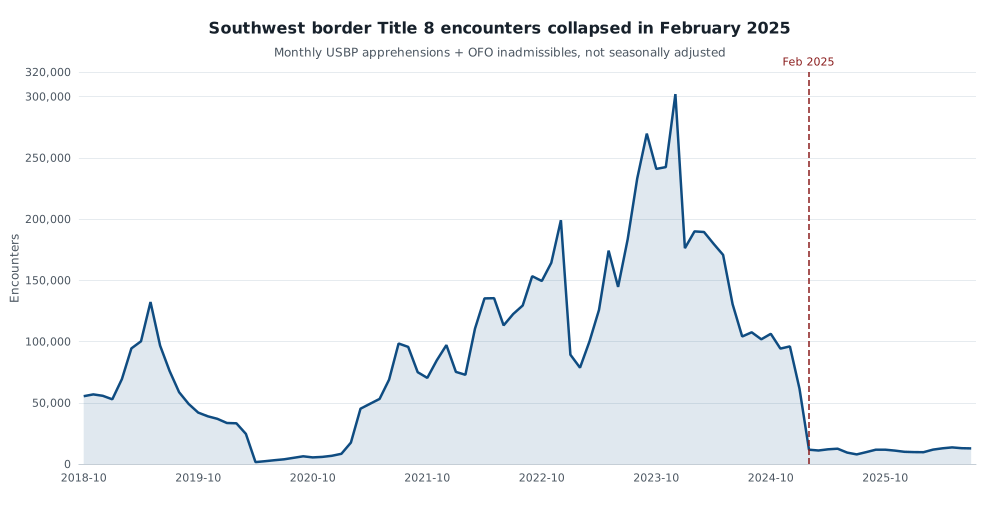
Monthly Title 8 southwest land-border encounters (Border Patrol apprehensions plus Office of Field Operations inadmissibles), October 2018–July 2026, not seasonally adjusted. Title 42 expulsions are excluded. Encounters are events, not unique people or asylum cases. Source: U.S. Customs and Border Protection extract through July 2026.
The remaining flow is mostly Mexican single adults. Extra-regional and family arrivals, which dominated the 2023 peak, are almost gone. The court numbers are a reported news claim, not CBP data. The sequencing is the point: the denial-rate story arrived long after the surge had already ended.
Human Stories / Social Trends
Gloria Steinem, the journalist, activist and face of second-wave feminism, has died at her home in New York. CNN put her age at 92; some European outlets said 93. Steinem co-founded Ms., received the Presidential Medal of Freedom, and spent decades making the personal political—while reminding everyone that the personal is not the same as the trivial.
Nepal is still counting the cost of last week's Himalayan flash floods: at least 1,252 dead, more than 4,200 missing, and about 20,000 homes that must be rebuilt in safer places. Relatives have held symbolic funerals for the thousands who may never be found, and authorities are trying to get children back into makeshift schools. Nepal's foreign minister noted that a country with negligible emissions is bearing a disproportionate burden of a warming Himalaya.
On the lighter side of science, researchers won Ig Nobel prizes for studying cockroach milk and using underwear to analyze soil health, with the ceremony held outside the US for the first time in 35 years over travel concerns. And a study warns that climbers are melting Everest's glacier with their urine—more than 6,000 litres a day. The world's highest peak now has a new kind of summit record.
Dates and sources
This digest covers the news day 2026-09-03. It is presented retrospectively from a saved draft; its date in the URL identifies the news day, not an assertion of publication on that day. News references link to their original outlets. Supporting research was completed 2026-09-10. Its data vintage and material limitations are recorded in the article methods and chart captions.