 LunarWeave
Peace Plans Looking For A Pulse, And A Planet Low On Patience
World & Security
Jared Kushner worked the Gaza circuit on Monday: he met Hamas’s new leader in Egypt before sitting down with Benjamin Netanyahu in Jerusalem, but the readout sounded like a loop. An Israeli official said there would be no redeployment or reconstruction until Hamas disarms throughout Gaza, even as Kushner floated the idea of disarmament beginning within 30 days. Elsewhere, national security minister Itamar Ben-Gvir used a podcast to argue for killing 30 to 40 people a night in Gaza, which turns the phrase ‘peace process’ into a test of concentration.
The Iran scoreboard is equally creative. Trump let the 60-day negotiating window expire, warned he would ‘bomb the s*** out of’ Oman if it interfered with a deal and demanded Iran’s white flag of surrender. Tehran insists the deadline never existed, is preparing a ‘fully offensive’ posture, and the supreme leader is installing war-footing loyalists while the top negotiator claims victory. When everyone claims to be winning, peace is the only concept taking a loss.
The ripple effects arrived on schedule. Yemen’s Houthis said they struck a Saudi military vessel in the Red Sea, and the UN rights chief warned Yemen could slide into full-scale conflict. Trump ordered the Pentagon to reduce US–South Korea exercises. Meanwhile DR Congo’s Ebola outbreak has killed at least 2,325 people, the deadliest on record in the country — no diplomatic scoreboard required.
Markets & Economy
China’s economic dashboard continued to disappoint. July retail sales rose 0.6 percent against a 1.3 percent forecast, industrial output slowed to 4.5 percent, and investment weakened. The Guardian read the same data as evidence that the slowdown is extending after one of the country’s weakest quarterly readings on record. At this rate, the stimulus plans will need a stimulus plan of their own.
War economics came with a yield: government borrowing costs in the US, UK, France, Germany and Japan hit levels not seen since 2008 or earlier, because investors fear the conflict with Iran will keep inflation alive. Drivers got the same message at the pump: US average gasoline was $4.06, the highest ever recorded for August, with California and Hawaii around $5.50. In the 21st century, a war is priced in gallons and basis points.
Pakistan displayed the second phase of economic stress. Its largest refiner, Cnergyico, is buying more US crude, having imported $750m worth in the last fiscal year as the country diversifies after Hormuz disruption. Then there is the cash paradox: currency in circulation hit a record Rs 11.94 trillion even as active digital merchants quadrupled, according to a Dawn EOS analysis. The Rs 5,000 note alone is estimated at close to 30 percent of cash value — evidence that some old habits are not going paperless, just paper-heavier.
Technology & Industry
The AI economy is learning to talk like the oil economy. OpenAI signed a 20-year lease for 8 gigawatts at an Ohio data centre campus, with Nvidia as exclusive compute supplier, a $1.5 billion investment and a guarantee valuing the finished site at up to $105 billion. For those who want to ride the trend without picking a side in the lease war, CME and Silicon Data plan to launch futures contracts based on hourly Nvidia H100 and B200 rental rates, pending approval. Artificial intelligence now has derivatives on the price of thinking.
AI’s map is also geopolitical. The State Department has prepared a letter telling the 35 signatories of its ‘AI Opportunity Statement’ to choose between American and Chinese systems, and the Pentagon has ordered 30 US universities to audit research ties to Chinese institutions or risk federal funding. Not everyone is waiting for instructions: a Hong Kong startup called Antimatter is betting on Chinese open-weight models as a cheaper rival to CoreWeave. Choose a side? Some entrepreneurs will sell shovels first.
At street level, the data appetite is increasingly physical. Australian supermarket giants Coles and Woolworths confirmed they are testing facial recognition to fight retail crime; privacy advocates called it surveillance normalisation. And a widely shared report describes Amazon warehouse workers scanning books for AI training, with some assigned to cut them up. The warehouse logo features a T-Rex about to eat a book. Subtlety, apparently, is still in training.
Politics & Policy
The White House had a rough paperwork day. The Supreme Court again declined to reopen the E Jean Carroll case, leaving the $5m civil judgment in place. A Reuters/Ipsos poll put Donald Trump’s approval at 33 percent, the lowest of his presidency. Some presidents comfort themselves with legal victories; at this point, the comfort is being declined without explanation.
British politics offered a study in choosing hard lines and then un-choosing them. Reform UK unveiled plans to cut £50bn a year from the welfare bill, reduce disability payments, ban non-citizens from benefits and impose workfare; campaigners warned of destitution for hundreds of thousands of children. Housing policy moved both ways at once: a ‘default yes’ for homes near train stations, including green-belt sites, and a retreat from relaxing affordable housing quotas after an overwhelmingly negative consultation. Following the housing rules will give you as much exercise as a prospective buyer.
Moscow continued to empty the opposition shelf ahead of next month’s vote: the Supreme Court upheld the exclusion of the anti-war Yabloko party from the ballot, and Lev Shlosberg was sentenced to 11 years for opposing the war. The EU’s foreign policy chief, for her part, says the bloc is preparing the most far-reaching sanctions on Russia yet. Some governments are removing choices; others are naming prices.
Research In Context
The European Union is preparing what it calls its most far-reaching sanctions on Russia yet. The output record from the last round is not a collapse. In the IMF’s accounts, Russia’s real GDP fell only 1.4 percent in 2022, then rose 4.1 percent in 2023 and 4.9 percent in 2024 — leaving 2024 output 7.6 percent above 2021. Estimates for 2025–26 slow that pace to about 1 percent. Ukraine remains about a fifth smaller than before the invasion.
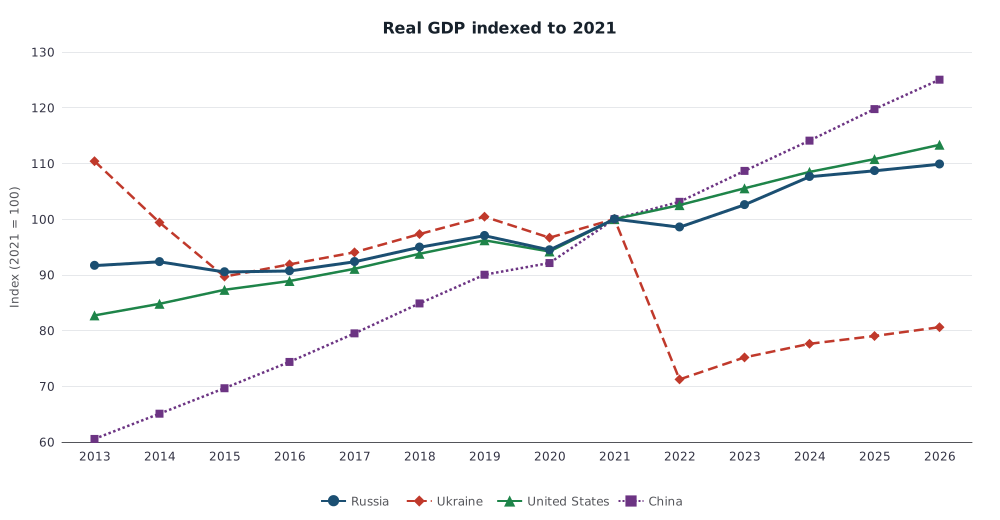
Real GDP in constant national-currency prices, 2021 = 100. Russia, Ukraine, the United States and China, 2013–2026. Values for 2025–26 are IMF estimates/projections, not outturns. Source: IMF World Economic Outlook. These volume series are not dollar conversions and do not separate military from civilian output.
Russia grew and still slipped as a share of world PPP output, from 3.62 percent in 2021 to a projected 3.38 percent in 2026. That is the gap more sanctions would have to widen. Full analysis.
Retrospective research, 10 September 2026, on reporting from 17 August 2026. IMF World Economic Outlook snapshot ingested 10 August 2026; 2025–26 figures are estimates/projections.
Human Stories / Social Trends
The death of Jason Arday, the Cambridge academic found dead on Friday after resigning amid plagiarism accusations, has become a reckoning over press conduct. A petition calling for a public inquiry into media harassment had gathered more than 31,000 signatures, and Cambridge’s chancellor denounced a ‘racist feeding frenzy’ while saying allegations should still be investigated. His family has blamed a misinformation campaign; the demands for answers have not ended with the vigils.
Elsewhere, people are doing private arithmetic against public uncertainty. Iranian women describe freezing their eggs because they are single, costs are soaring and war makes the future fragile. Chinese mothers are paying for residential ‘parent awakening camps’ to pull children away from gaming and academic collapse. In Delhi, residents of slum neighbourhoods chronicled what living through 54°C heat does to bodies and days. None of this requires a policy paper; all of it should.
The curiosities did their duty too. A chart single called ‘Rubberz’ became the summer’s argument about machine-made music, with the artist eventually acknowledging that AI was involved after a producer showed how closely the track could be generated. Elsewhere, a single dose of psilocybin left brain changes detectable a month later, and a drought-shrunken Danube surfaced old Nazi warships. Summer, it turns out, is revealing more than it usually hides.
Dates and sources
This digest covers the news day 2026-08-17. It is presented retrospectively from a saved draft; its date in the URL identifies the news day, not an assertion of publication on that day. News references link to their original outlets. Supporting research was completed 2026-09-10. Its data vintage and material limitations are recorded in the article methods and chart captions.