 LunarWeave
Hormuz On The Map, Meta On Trial, Marmots In Crypto
World & Security
Washington’s latest map says the Strait of Hormuz is “NEW U.S. Territory,” South China Morning Post reports, with no talks with Iran planned. Tehran’s speaker says the strait stays shut until the blockade lifts and assets are unfrozen (TASS), while a ship hit by an “unknown projectile” reported one casualty and engine damage (Euronews). The UAE said Iran fired two ballistic missiles toward it and then suspended trade with Tehran (SCMP, TASS); Trump had already threatened to bomb Oman if it “gets in the way” (BBC). If only maps came with legal opinions.
Ukraine was also writing messages in hardware: The Guardian puts the overnight drone wave at more than 600 aimed at Moscow and surrounding areas, and The Hindu says a Russian strike killed ten people in a Kharkiv village. Moscow warned London of “consequences” after reports British-made drones were used inside Russia; the UK says it will keep supplying Ukraine (The Guardian). The BBC notes anti-war politician Lev Schlosberg got 11 years for “discrediting” the army. In the West Bank, Dawn describes Israeli troops failing to end a settler siege on a Palestinian-American home, while The New York Times reports Israeli strikes on a Syrian base drew a U.S. rebuke. Plus ça change, plus c’est la même guerre.
Markets & Economy
Oil didn’t need a status update to notice: The Guardian reports Brent crude topped $90 a barrel after the US-Iran ceasefire window lapsed and Trump demanded that Tehran “put up the white flag of surrender.” Government borrowing costs in the US, UK, Germany, France and Japan hit multi-decade highs as peace hopes faded, The Guardian says. China, meanwhile, trimmed Treasury holdings to their lowest since September 2008, South China Morning Post reports. Sovereign yields and crude prices rarely agree on much, but both read the Hormuz headlines.
Trade policy stayed in the final-five-minutes phase. Canada is scrambling to avoid 50 percent US tariffs (Al Jazeera, The New York Times); Mexico is weighing new anti-dumping measures on Chinese goods (SCMP); and Southeast Asian exporters are bracing after Washington named nine countries in a “Shadow Transshipment Network” (SCMP). On the home front, DW says Germany’s farmers’ association is warning of a below-average harvest after drought — which is how the economy tells you your grocery bill is also a geopolitical briefing.
Research In Context
Brent’s jump above $90 after the US-Iran ceasefire lapsed is a break with last year’s $68 average, not a return to 2022. In IMF World Economic Outlook annual averages, only six years since 1980 have averaged at least $90, and 2022 itself averaged $99. The Fund’s 2026 assumption is still $80, then a fade toward $70. Average consumer-price inflation in the United States, Britain, Germany and France had already cooled from 2022; Japan is the exception. Those governments, Germany aside, now carry heavier public debt than in 2019 — which is why a yield backup and an oil scare arrive together.
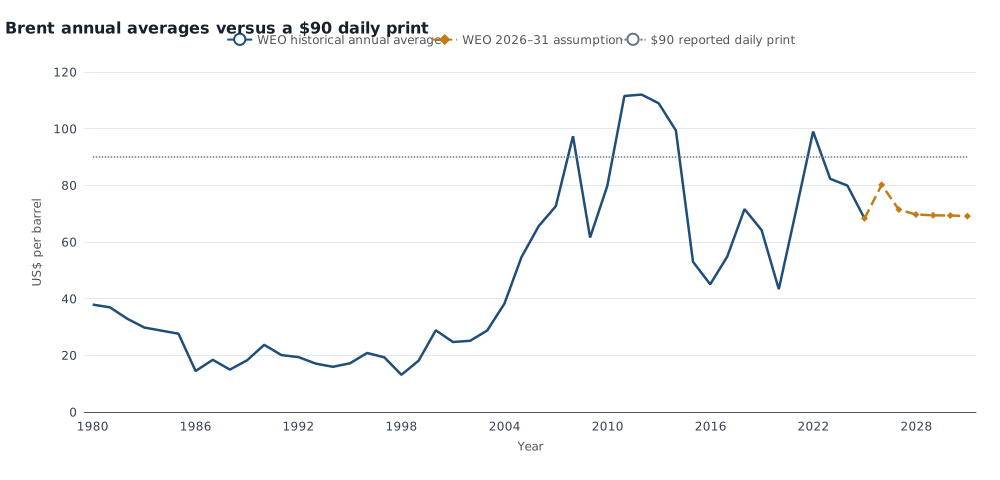
IMF WEO Brent crude, US$ per barrel, annual average, world aggregate, 1980–2031. Solid line: historical averages through 2025. Dashed line: 2026–31 assumptions. Dotted line: $90 reported daily print on 18 August 2026, not an annual average. Snapshot packaged August 2026.
Retrospective note, 10 September 2026: later WEO revisions can differ from what was published on the news day. Full comparison of $90 with the annual record.
Technology & Industry
The court system finally got to ask whether Meta’s business model is an allegation or a feature. The Guardian reports 29 US states opened a trial accusing Meta of designing addictive products that harm children; SCMP cites a California lawyer saying Meta intentionally sought to addict young users. Damages could reach $200 billion — about what Meta earned in 2025 — if the states win (The Guardian). Meta calls the claims “unsubstantiated” and says social-media addiction doesn’t exist (The Guardian, BBC). Advertisers, presumably, are taking notes.
In less legal AI news, a rare book with an AirTag allegedly ended up at an Amazon warehouse where employees cut bindings off and scan books for training data, Times of India reports from an investigation; Amazon says it buys books commercially to improve services. Google will move Pixel production out of China to Vietnam and India beginning next year (Times of India), while Alibaba’s 27-billion-parameter Qwen model performed on par with much larger rivals in benchmarks, per SCMP. One trend binds them: everything, including the bookshelf, is becoming training data.
Politics & Policy
Data policy now looks like controlled demolition. The Guardian says a tracker logged 28 federal datasets deleted and 338 modified, with health data among the most affected; the administration also moved to scrap the roadless rule protecting almost 45 million acres of national forest (The Guardian). Disney sued the FCC on Tuesday, arguing that forcing ABC into early licence renewals is retaliation for its coverage (The Guardian, Al Jazeera). And the man who signed an order restricting mail-in voting cast a mail-in ballot in Florida’s Republican primary (The Guardian).
Courts and court-adjacent bodies had a busy day too. The Supreme Court again declined to revisit the $5 million E Jean Carroll verdict, while the US sanctioned the ICC’s president and a senior trial lawyer; the court retorted that such moves undermine the rule of law (The Guardian, Euronews). Minnesota’s attorney general, meanwhile, sued Texas to extradite the ICE agent charged over a Minneapolis shooting (The Guardian). The separation of powers is apparently still open for business, even when the executive isn’t thrilled about it.
Human Stories / Social Trends
Extreme heat has a habit of turning history into warning labels. The Guardian says England’s ancient oaks are dying from drought stress and entering “early autumn,” while Dawn reports firefighters in Belgium’s High Fens trying to encircle the country’s largest wildfire in a century with help from farmers hauling water by tractor. There is better news in the same weather system: The Guardian found children’s lungs grew after London introduced the ultra-low emission zone, and scientists behind a 60-year marmot study raised more than $100,000 with an OnlyFans page and a marmot-themed cryptocurrency after funding cuts (The Guardian). If wildlife could vote, this would be the feel-good paragraph.
Not every story offers that comfort. Deutsche Welle reports thousands of unaccompanied minors are living on the streets of Ceuta, with disease and abuse widespread; Al Jazeera says Spain is now building four temporary sites with 1,500 places as an estimated 5,000 migrants remain in the enclave. Authorities admit they are overwhelmed; the tents are acknowledgement rather than a solution.
Dates and sources
This digest covers the news day 2026-08-18. It is presented retrospectively from a saved draft; its date in the URL identifies the news day, not an assertion of publication on that day. News references link to their original outlets. Supporting research was completed 2026-09-10. Its data vintage and material limitations are recorded in the article methods and chart captions.