 LunarWeave
Drones, Drought And Diplomatic Whiplash
World & Security
Ukraine and Russia exchanged punishing overnight strikes. France 24 reported that 600 drones targeted the Moscow region, while Russian strikes hit a popular outdoor book market in Kyiv and killed two people at a steel plant in Kryvyi Rih. The Hindu relayed President Zelenskyy’s weekly tally — 1,550 attack drones, 1,560 guided bombs, 62 missiles — and his renewed appeal for air defence. Further west, a Spanish F-18 on Nato air policing downed a drone that strayed into Romanian airspace near Ukraine.
Korean diplomacy sent contradictory signals over the same weekend. South Korea’s president proposed talks to formally end the Korean War, then the military fired warning shots after North Korean soldiers crossed the demarcation line, while Trump ordered the Pentagon to scale back joint exercises, calling them hostile to an ‘unthreatening and respectful’ North Korea. The intelligence community’s view that Pyongyang may send up to 50,000 troops to Russia (Deutsche Welle) suggests ‘unthreatening’ is doing a lot of diplomatic lifting.
Gaza diplomacy is producing positions faster than progress. Kushner met Hamas representatives in Egypt, while foreign ministers from eight countries condemned Israel’s rejection of the US-backed road map. Al Jazeera reports that handing West Bank policing to civilian forces cements de facto annexation and empowers settler militias. The Hindu noted Israel’s national security minister advocated killing 30 to 40 people in Gaza nightly in conversation with an ex-hostage; similar statements have been presented to the UN world court as evidence of genocidal intent, with Israel denying genocide.
Markets & Economy
The energy bill for the Iran war is arriving on household doorsteps. The Guardian reports that UK economists expect July inflation to print near 3%, driven by soaring gas and electricity bills. Iranians have the more extreme version: Al Jazeera describes ‘limited options’ as the war chokes the economy and sends prices soaring. Turkey’s president added the obvious: Erdogan called for reopening the Strait of Hormuz amid oil disruption.
If water can be priced like Uber rides, this is the summer it happens. The Guardian reports that Ofwat is exploring letting English and Welsh water companies raise bills during drought under a ‘water scarcity’ charge — surge pricing, in regulator language. The concept no longer sounds absurd after the Danube report: record lows, Budapest’s ‘Rock of Starvation’ exposed, and Hungary shutting all but one of its Danube-cooled nuclear reactors.
Currency strategists are also reading the war premium. SCMP reports that more African financial institutions are joining China’s Cross-Border Interbank Payment System, including Libyan banks after a Beijing visit by the central bank governor. The yuan is not Africa’s most important currency yet — but it is clearly trying hard to get there.
Technology & Industry
The US government is telling Apple to find alternatives to Chinese memory chips amid component shortages and rising prices, with Apple allegedly assessing chips from CXMT and Yangtze Memory (Times of India). China, meanwhile, is trying to keep more AI talent at home: Guangdong, which produced the DeepSeek and Moonshot founders and then failed to retain them, is now courting 40 Tsinghua computer science students in a targeted talent push (SCMP).
AI’s physical footprint is colliding with drought. Wallonia has refused to modify a permit allowing Google to use river water to cool a nearly complete data center, citing climate uncertainty (Nieuwsblad). At Lake Tahoe, nearly 50,000 residents have been told to find new power within a year as their utility pivots toward data centers (The Guardian). The ‘cloud’ is turning out to have a very terrestrial water bill.
Some AI frontiers are more humane than others. Chinese scientists report a brain-reading model that may predict depression risk up to four years in advance (SCMP), while the more mundane side of the technology is running scams: The Guardian details how fraudsters use holiday photos to build convincing ‘unusual activity’ bank texts. Booksellers separately suspect AI firms of buying and then destroying rare books (Ars Technica) — one more reason to digitise old paper.
Politics & Policy
Brazil’s election is a family saga with national stakes. Lula, aged 80, launched his campaign for a historic fourth term and said he would not hand the country back to the ‘shameless’ right as long as he lived (The Guardian). His October opponent looks set to be Flávio Bolsonaro, son of the jailed former president, with the two running close in the polls (France 24).
France’s Constitutional Council blocked a social media ban for under-15s, ruling the blanket measure disproportionate (France 24). Across the Atlantic, the US vaccine schedule is being rewritten: Trump has called combination MMR shots ‘sort of like a nuclear weapon,’ and Republican senator and physician Bill Cassidy called the claims ‘crazy, stupid’ (The Guardian). Australian health experts worry the scepticism is contagious, pointing to falling hepatitis B immunisation in one-year-olds (The Guardian).
Bangladesh has attached a condition to high-level visits: Prime Minister Tarique Rahman will not go to India until New Delhi extradites former premier Sheikh Hasina, who faces the death penalty after a crimes-against-humanity conviction (Dawn). Dhaka says Hasina’s media interactions from exile have ‘vitiated’ the atmosphere — and it will pursue a ‘Bangladesh First’ foreign policy.
Research In Context
Lula’s fourth-term launch against Flávio Bolsonaro is not landing on the 2022 inflation emergency. In the IMF’s accounts, Brazil’s real output per person recrossed its 2013 peak only in 2024 — and only by 2.2%. Average consumer-price inflation has fallen from 9.3% in 2022 to 4.4% in 2024, and unemployment is back to 6.9%, matching 2014. The jobs market healed faster than living standards. Public debt is projected back near its pandemic high as growth cools. These are national averages, not household bills, and 2025–26 remain IMF figures. Retrospective research (10 September 2026) using a later IMF snapshot than 16 August 2026.
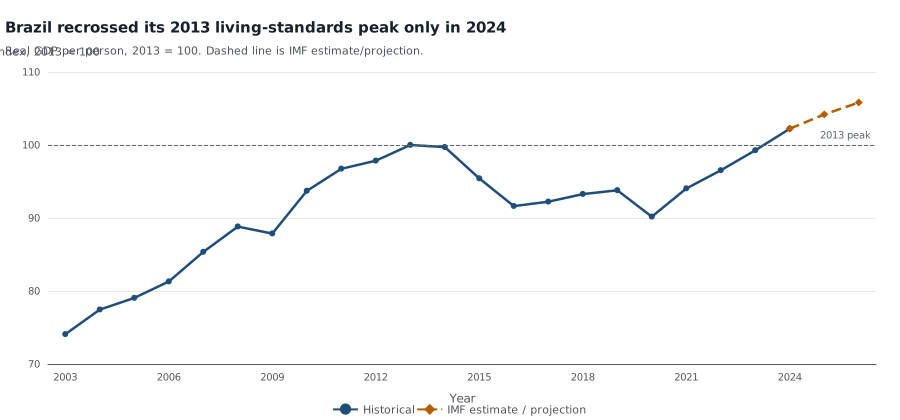
Brazil real GDP per capita at constant prices, 2013 = 100. Below 100 from 2014 through 2023; 102.2 in 2024. Dashed 2025–26 are an IMF estimate and projection. Source: IMF World Economic Outlook (NGDPRPC). Not household income.
Human Stories / Social Trends
US naval families are pushing back against official assurances. The Guardian spoke with relatives of sailors on the USS Abraham Lincoln and USS Tripoli who describe 20 to 30-pound weight loss, poor drinking water and scarce mental health support, and who accuse Trump and Pete Hegseth of dismissing their experiences. After a visit to the carrier, a US commander called mental health a ‘priority’ (BBC) — a sentence families will be watching closely.
Afghanistan’s fifth anniversary under Taliban rule is being marked in testimonies rather than celebrations. Women tell the BBC their lives are unrecognisable, while the UN has told the Taliban to open up about abuses by security forces as experts warn against normalising Taliban rule and urge the codification of gender apartheid as a crime against humanity.
Culture note from Sicily: while the town was absorbed in Assumption holiday celebrations, thieves bypassed alarms at Messina’s MuMe museum and made off with four Antonello da Messina panels worth millions (SCMP). The brighter bulletin: Italian Carabinieri have recovered stolen Renoir, Cézanne and Matisse works worth millions (AP), proving that someone in the art-crime world still reads the classics.
Dates and sources
This digest covers the news day 2026-08-16. It is presented retrospectively from a saved draft; its date in the URL identifies the news day, not an assertion of publication on that day. News references link to their original outlets. Supporting research was completed 2026-09-10. Its data vintage and material limitations are recorded in the article methods and chart captions.