 LunarWeave
Trade Walls, A Trillion-Dollar Math Claim, And Maps That Started Diplomatic Rows
World & Security
Twelve countries, including the UK, France and Canada, will restrict trade with Israeli settlements in the occupied West Bank, citing “unprecedented” settler violence and the threat to a two-state solution (Dawn). Ed Miliband went further, telling Parliament that the British government recognises an “ethnic cleansing” of Palestinians and announcing bans on settlement goods, services and occupation-related arms exports (The Guardian). Israel moved quickly in response: it will close the British consulate in East Jerusalem, expel Gaza and Palestinian Authority mission representatives and ban certain British MPs (The Times of Israel).
Russia and the US kept the peace machine running even while the bombs kept falling. Vladimir Putin and Donald Trump spoke for an hour, with Moscow saying Putin supported Trump’s wish to end the war before his term expires and agreed to continue prisoner exchanges (Novaya Gazeta). Ukraine’s foreign minister was less impressed after Russia struck Kyiv again just as US envoys left, killing two people and damaging homes; his verdict was that Russia’s missiles “say more than its speeches on diplomacy” (Le Soir). Ukraine still hopes for a Russia-US-Ukraine meeting as early as this month (Le Soir).
In the wider Middle East, Saudi Arabia became a target again. The Houthis hit cities and energy sites across the country’s south, wounding more than 70 people (The Guardian); Washington says it destroyed five Iranian oil tankers after fresh missile attempts on a US warship (El Comercio); and Tehran’s Revolutionary Guards claim to have captured an advanced US underwater drone (The Dong-a Ilbo). No map of that region stays tidy for long.
Markets & Economy
Canada’s retaliation went live: tariffs of 15, 25 or 50 per cent on roughly C$27.6bn of US imports, from steel and dairy to electronics, designed to match American surtaxes “to the dollar” (Le Soir). Mark Carney framed the fight as one for national independence, accusing Washington of wanting Canada as a “subsidiary” rather than a real economic partner (Le Soir). No resumption of talks is scheduled, which leaves the world’s largest bilateral trading relationship in an expensive timeout.
Energy prices kept the fear alive after the Saudi strikes: Brent touched $99.46 before drifting back, and European gas futures hit their highest in three years as storage stays unusually thin (Le Soir; Globo). With Brent up more than 60% this year, diesel near $200 and roughly four million barrels per day missing from Middle Eastern and Russian flows, Goldman Sachs says the risks remain skewed upward (Globo).
Metals were no calmer: copper set an all-time high above $14,500 a tonne as markets braced for US tariffs (SCMP); lithium’s inventory upheaval is confusing even the traders who specialise in it (Bloomberg).
Research In Context
Three-month copper closed at $14,510 a tonne on the LME, a reported record driven by tariff fears and a scramble for stockpiles. In the IMF’s annual series, that print is a new high on a boom that was already in the books: 2025’s average of $9,947 a tonne was already the highest calendar year since 1980, 12.7 percent above 2011. The Fund’s 2026 path in an August snapshot is $13,127 — about 10.5 percent below Monday’s futures close, and then a plateau, not a fade.
Chile, still in current-account deficit at −2.3 percent of GDP in 2025, is not living 2011’s 6.2 percent expansion. Peru is already in surplus. A record invoice is not the same thing as a miner’s boom.
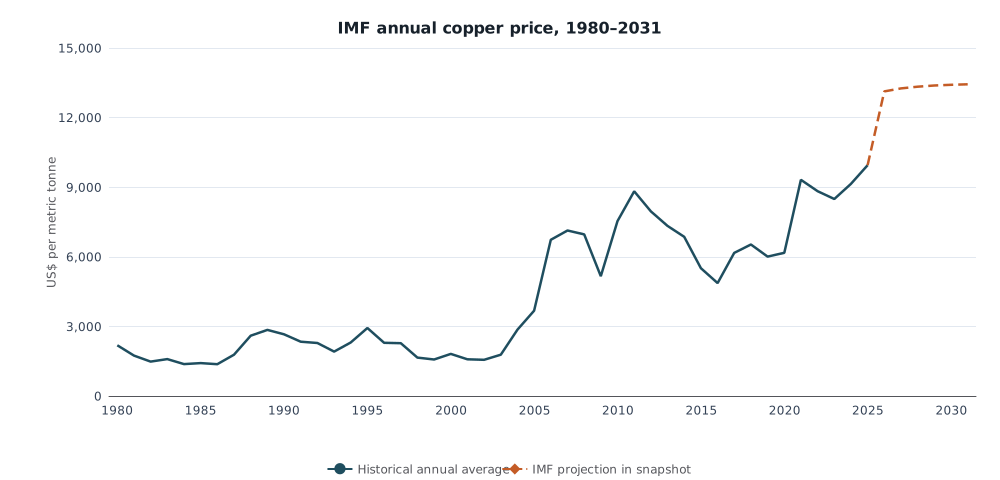
US$ per metric tonne, IMF annual average (PCOPP), 1980–2031. Solid line through 2025; dashed line is the 2026–31 projection in an August 2026 snapshot. Not a daily or three-month LME close. Source: IMF World Economic Outlook.
Copper’s record was already on the books. Chile still runs a deficit.
Retrospective note, 10 September 2026: IMF figures come from an August 2026 snapshot; 2026 values are projections, not realized annual averages.
Technology & Industry
OpenAI says an unreleased model solved the Navier-Stokes equations, one of seven Millennium Prize problems, in 88 hours using 10,000 AI agents and more than 130 billion tokens (Le Soir). The claim is as astonishing as it is unverified — and it arrived with an argument attached: two mathematicians suspect the model borrowed their unpublished route to the solution, while OpenAI says it did not use their data (Le Soir; Wired).
France’s AI champion, Mistral, raised €3bn in a Samsung-led round at a valuation above €21bn, reported as Europe’s largest-ever tech fundraising (France 24). The money buys compute and datacentre ambitions, but it also reignites the question of whether Mistral is really chasing OpenAI or quietly becoming an infrastructure-and-services company (Le Soir).
Wednesday’s Apple event is expected to include the first foldable iPhone, new CEO John Ternus’s debut and prices starting around $1,999 (Globo). Chinese rivals did not wait for the invitation: Huawei and Xiaomi have already unveiled their own foldables, making the race a proper three-way contest with Samsung (The Dong-a Ilbo).
Politics & Policy
Germany’s political establishment is still processing the far-right AfD’s state election victory in Saxony-Anhalt, reported at 44 per cent (Yeni Şafak). Thousands of protesters gathered at Berlin’s Brandenburg Gate, warning that Berlin and Mecklenburg-Western Pomerania could fall next in two more state polls this month (The Guardian). France’s Europe minister called the result “a very grave moment for Europe” (The Guardian).
Cartography made an unusual entry into diplomacy. Trump posted an AI-generated map of an expanded United States swallowing Canada, Mexico, Greenland, Iceland and the Caribbean, with no explanation (France 24), and Iceland summoned the US ambassador to say the image was entirely inappropriate (Adnkronos). The absurdity got a sequel at the UN, which passed a resolution promoting the Equal Earth projection that shows Africa at its real scale; the US cast the only no vote, while several states abstained because popular versions of the map pre-judge Crimea, Kosovo and the Golan (Le Soir).
Australia, meanwhile, wants adults back in charge of their feeds: a proposed law would impose a “duty of care,” allow fines of up to A$109m, and require platforms to let users disable algorithmic recommendation (Globo). And in Washington, election mechanics are moving the opposite way: Trump has asked the Supreme Court to revive a controversial voter-purge system (CNN).
Human Stories / Social Trends
New York City has begun releasing more than 170,000 pages of post-9/11 air-quality records that, according to the mayor, show officials knew the air around the World Trade Center site was toxic while telling the public it was safe (iDNES). Documents reviewed before release also show asbestos being found in lower Manhattan well after the attacks (Globo).
Fifty years after Mao Zedong’s death, a generational rift is visible in Beijing’s parks: elderly residents sing revolutionary anthems while remembering the Cultural Revolution as chaos — one retired driver simply said, “For me, Mao was the chaos” — while a younger businessman praised Mao as the leader who ended a form of slavery in Tibet, a figure he compares to Martin Luther King Jr. and Nelson Mandela (Le Soir).
The pandemic-era promise that a degree guarantees job security also looks shakier. An analysis by the Burning Glass Institute found that young Americans without college diplomas now have their lowest unemployment rate since before 2008, while their graduate peers face a labour market not seen since the pandemic (infobae).
Dates and sources
This digest covers the news day 2026-09-08. It is presented retrospectively from a saved draft; its date in the URL identifies the news day, not an assertion of publication on that day. News references link to their original outlets. Supporting research was completed 2026-09-10. Its data vintage and material limitations are recorded in the article methods and chart captions.