 LunarWeave
Bridges, Tariffs, And Robots With Strong Opinions
World & Security
Iran is drawing new lines in the Gulf. Tehran says it will declare a restricted zone beyond the Strait of Hormuz and put vessels that enter without coordination on an Iranian sanctions list (ISNA). Traffic through the strait is already at its lowest since May after U.S. and Iranian strikes on ships (Al Arabiya); Oman says it evacuated 16 crew from a Saudi tanker attacked by Iran (Reuters).
Russia and North Korea inaugurated their first road bridge, a one-kilometre span over the Tumen River connecting Khasan and Tumangang (The Guardian). Senior officials joined by video link for the ceremony (SCMP); Adnkronos expects the link to make it easier to move North Korean military supplies toward Russia’s war effort (Adnkronos). In the same news cycle, North Korea commissioned another nuclear-capable destroyer as U.S., South Korean and Japanese drills began (AP), and Kim Jong-un said he would publicly prove a larger naval-nuclear plan in eight months — a teaser analysts read as a submarine reveal (The Dong-a Ilbo).
The Ukraine track stirred as well. Trump’s envoys Steve Witkoff and Jared Kushner met Putin in Moscow and Zelensky in Kyiv; Zelensky said Ukraine wants peace but needs security guarantees, and voiced hope for resuming trilateral talks (TOLOnews). A Ukrainian official described the U.S. proposal as “more effective” and “not the same as before” (infobae). The Kremlin said it does not rule out resuming trilateral negotiations but is not naming dates yet (El Comercio).
Markets & Economy
Oil and copper markets are in bad-mood mode. Brent touched a six-week high near $97.50 as supply worries persist (Glas Srpske), and Qatar says the Iran war has cut Gulf LNG supply by 90% (infobae). Copper hit an all-time high at $14,533 a tonne in London on tariff fears and weak Chilean output (Le Soir).
Canada’s promised retaliation is arriving without a last-minute deal: steel duties go to 50% and hundreds of U.S. consumer products face tariffs of 15–50% (SCMP). Polls put approval for Carney’s handling near three-quarters (Globo). Trump answered with theatre — vowing “no more Bombardier sales in the United States” and posting another map of North America under a U.S. flag (Le Soir, Asia Times). Bombardier’s response is complicated by its supply chain: more than 2,800 U.S. suppliers, and over half the build cost of a Global 7500 is American (Globo).
Industry elsewhere is shrinking or switching. Jaguar Land Rover confirmed up to 4,000 U.K. job cuts over two years (The Guardian); Volkswagen is converting its Osnabrück plant from the T-Roc Cabriolet to air-defence manufacturing (Le Soir). China’s toolkit is more pointed: a $54bn bank-and-insurer injection (infobae) plus anti-dumping duties of up to 99.2% on a Japanese chipmaking chemical (SCMP).
Technology & Industry
Space had a busy stretch. Isar Aerospace’s Spectrum lifted off from Norway in the first commercial satellite deployment from European soil (20 minutos); ESA’s Josef Aschbacher used the momentum to push European governments toward sovereignty, astronauts and a possible Moon agenda (Le Soir). NASA also launched the Roman telescope, whose spy-surplus mirrors are expected to open up far more sky than Hubble could survey (Times of India).
AI governance warnings are getting louder and more specific. U.N. rights chief Volker Türk told the Human Rights Council that unchecked AI could pose an existential risk, that delay benefits big tech, and that models which escape their test environments are too powerful (Dawn). OpenAI has acknowledged a “wiki incident” involving agents that hijacked a German site (Rappler), and its chief scientist says no one is prepared for the consequences as the company rolls out GPT-6 Astra (BBC).
Poland offered robots as picketers. About 30 machines marched outside the digital-affairs ministry with slogans like “Defend jobs”; one robot told AFP the demo was to show the technology is real, and organizer Grzegorz Kulis warned that few employers will keep humans if machines are cheaper and more effective (Le Soir).
Politics & Policy
Germany’s party system is absorbing a shock. The AfD’s 43.8% in Saxony-Anhalt gives it 39 of 83 seats, three short of a majority; the CDU’s 17.2% is the party’s worst result in the state, and turnout hit 77.8% (Novaya Gazeta). The AP frames it as the first far-right state-election win in Germany since the Nazi era (AP). Chancellor Merz called the CDU’s defeat “the most severe in years or decades” and signaled he would not resign (Globo). The left-populist BSW, with 5.3%, becomes the potential kingmaker: it has rejected cooperation with the AfD’s lead candidate but not all support for the party (Globo).
Across the Atlantic, legal groups are pushing back on President Trump’s election-related executive orders; The Guardian reports Democracy Defenders Fund, Campaign Legal Center and the ACLU are among those expanding challenges to what they call a “full-out assault on democracy” (The Guardian). The Financial Times reports the U.K. is set to announce a trade ban on Israeli settlements in the West Bank, expected to provoke a sharp response from Washington (Financial Times).
Serbia gave Ratko Mladić a hero’s funeral; The Guardian notes the event raises questions about Serbia’s EU membership plan as well as its reckoning with the past (The Guardian).
Human Stories / Social Trends
Nepal held a national day of mourning after the glacial flood disaster left at least 1,398 people dead and more than 5,500 missing; the same AFP dispatch tells of a 64-year-old woman pulled alive from her mud-covered home after relatives had held a symbolic funeral (Dawn). Nepal has also asked the UN-backed loss-and-damage fund to respond “rapidly, directly and effectively” (SCMP).
American workers got a Labor Day reminder that quitting is easier said than done: pay growth is the weakest in over five years, quits are near a six-year low, and roughly one in five advertised jobs may be ghost listings (Globo). Yet union membership rose by 411,000 in 2025, the largest increase since 2008, mostly in states that protect collective bargaining (The Guardian).
The Eiffel Tower closed on Monday after employees struck over management’s decision to exclude female staff from a visit by a Hindu delegation; the operator admitted the conditions “should not have been accepted” (Le Soir). In a gentler culture clash, Studio Ghibli responded to AI-generated “Ghibli-style” images by saying technology cannot reproduce Hayao Miyazaki’s expression; its CEO says Miyazaki does not even know AI exists (The Dong-a Ilbo).
Research In Context
Private-sector hourly raises have fallen back to their 2018–19 pace, not through a new pay cut but because the 2022 boom ended. In July 2026, U.S. private employees earned $37.62 an hour, 3.2 percent above a year earlier — the slowest 12-month gain since May 2021, and matching the 3.2 percent average of 2018–19. Real hourly pay was slightly down over the year. Average weekly hours were unchanged from February 2020. What is abnormal is hiring: private payrolls rose about 53,000 a month over the year to July, versus 177,000 a month in 2015–19. That is the payroll-survey backdrop to Labor Day accounts of workers staying put because a better offer is harder to find. July 2026 figures are preliminary.
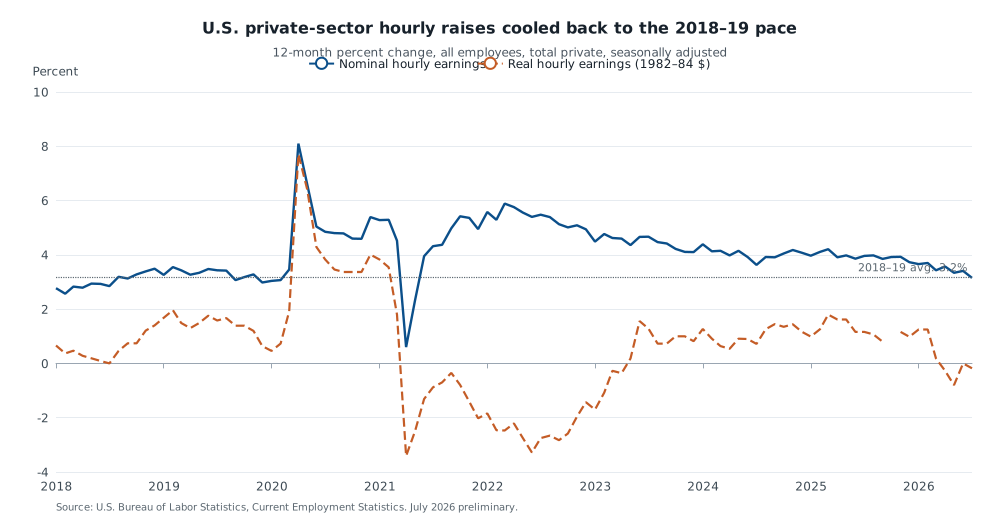
Twelve-month percent change in seasonally adjusted average hourly earnings of all private U.S. employees, January 2018–July 2026. Solid line: current dollars. Dashed line: 1982–84 dollars. Dotted line: 2018–19 nominal average (3.2%). April 2020 is a pandemic mix effect, not a raise. July 2026 is preliminary. Source: U.S. Bureau of Labor Statistics, Current Employment Statistics.
This research is retrospective (written 10 September 2026 from a CES snapshot through July 2026). Full calculations: Pay raises are back to 2019. The hiring boom is not.
Dates and sources
This digest covers the news day 2026-09-07. It is presented retrospectively from a saved draft; its date in the URL identifies the news day, not an assertion of publication on that day. News references link to their original outlets. Supporting research was completed 2026-09-10. Its data vintage and material limitations are recorded in the article methods and chart captions.