 LunarWeave
Strait Of Hormuz Heats Up, Lake Ontario Gets A Rebrand, And One Donor Is Very Prolific
World & Security
Sunday brought the first known U.S. strikes on Iran in more than a month: U.S. forces hit two Iranian rocket launchers on Larak Island in the Strait of Hormuz, a U.S. official said, after Washington accused Revolutionary Guard troops of preparing to launch rockets with sea mines into the waterway. Iran's Revolutionary Guards said the attack killed and wounded soldiers and civilians, vowing to "punish the aggressor". Hours later, Iranian state media said the Guards had struck the U.S.-run King Hussein and Al Azraq air bases in Jordan. Independent confirmation of the damage was not in the early reporting.
Ukraine began Sunday with drones at a Russian airfield in Yeysk and a large fire at the KINEF refinery, one of Russia's largest oil plants. Moscow answered with an unusually explicit announcement of "massive attacks" against Ukraine's energy system. The backdrop was brutal: a Russian drone strike on an ammunition depot near Kyiv killed 38 people, including 34 residents of a retirement home, prompting President Zelensky to open a criminal inquiry into the depot's location.
Diplomacy kept pace with the missiles. Reports say CIA Director John Ratcliffe used an unannounced Moscow visit to propose a Trump–Putin–Zelensky summit; the Kremlin's answer was that Putin would attend only to sign an agreement that is already finalised — a signing ceremony in search of a peace. Berlin, separately, is preparing to blame Russia for the Leipzig airport drone attack and to answer with sanctions.
Markets & Economy
Oil rose more than 2 percent after the U.S. strike on Larak, but the longer-running story is structural: Reuters notes OPEC+ has lost influence as the Iran war reduced its output share, with China emerging as a key factor for prices. And Jyllands-Posten reports months of a closed Strait of Hormuz are now registering in Europe's gas reserves.
The energy headline, however, is Trump's "biggest oil deal in world history": a 25-year U.S.–Venezuela arrangement over 65 billion barrels. Terms reportedly give U.S. partners majority control, 55 percent of output and century-long rights over unexplored reserves; Bloomberg says Washington takes majority control of Venezuela's oil wealth; the WSJ reports a Pentagon stake; and Trump wants some of the crude for the strategic petroleum reserve. Venezuela's interim president insists the country keeps sovereignty, but critics across chavista and opposition ranks accuse her of handing over the oil.
Central bankers offered quieter drama: in his first Jackson Hole speech, Fed Chair Kevin Warsh said the U.S. would need to act if inflation does not move convincingly toward target — a coded signal markets read as a possible September rate hike. Analysts call it a no-win: raising rates hands Trump ammunition before midterms, while doing nothing damages the Fed's inflation credibility.
Technology & Industry
NASA has a new eye in the sky: the $4.3-billion Nancy Grace Roman space telescope rode a SpaceX Falcon Heavy into orbit from Florida on a mission to map galaxies, hunt exoplanets and probe dark matter and dark energy. Its mirror matches Hubble, but its field of view is 100 times wider — able, its team says, to map the sky about a thousand times faster. Expect the first images in 2027.
Anthropic had a rough time in court. A federal judge ruled that the Pentagon's designation of the AI company as a "supply chain risk" was illegal retaliation, wrapped around Anthropic's February refusal of a $200-million military contract over its red lines on lethal autonomous weapons. Separately, 35 music publishers under Sony and Warner Music sued Anthropic for scraping thousands of copyrighted songs to train Claude, calling it one of the most blatant intellectual-property thefts in history.
In chip politics it's getting symmetrical: Chinese memory maker CXMT is suing the Pentagon to escape its Chinese-military blacklist, insisting it is not a defense contractor and has been damaged by the listing. On the other side of the AI hardware race, OpenAI says it built and tested its own chip on major public models — a polite notice to Nvidia.
Politics & Policy
Google Maps has gone along with a presidential rebrand: Lake Ontario now appears as "Lake America" for U.S. users, while Canadian users still see Lake Ontario and the rest of the world sees both names. Ontario Premier Doug Ford called it "completely absurd", and the province put up a billboard saying "Lake Ontario. Now and Forever." Apple Maps did not follow Google, at least as of Sunday.
Icelanders appear to have snuffed out the EU question again: with the no side ahead 52.5 percent to 47.5 percent, voters rejected resuming membership talks. The no campaign leaned on fishing waters and sovereignty; the prime minister says the result puts an end to EU speculation. The fish remain Icelandic, for now.
North Korea reshuffled its defense top: minister No Kwang-chol was dismissed and demoted, with Kim Song-gi taking over in what KCNA presented as a structural reorganization; state media-linked coverage also cited corruption and discipline as drivers. And a former White House official predicts Trump will meet Kim before the midterms, with a possible second summit later — this is the part where everyone checks their watches again.
Research In Context
Icelanders rejected restarting EU accession talks after a campaign fought over fishing waters — and, on the yes side, over high interest rates. The IMF’s 2024 accounts, the latest completed year in this vintage, show the vote did not come from a poor applicant. GDP per capita at purchasing-power parity was about $78,600, 9.5 percent above Germany. What remains distinctive is prices: average consumer-price inflation was 5.9 percent, the highest among 15 European peers and more than double Germany’s 2.5 percent. That is the inflation backdrop to the interest-rate argument, not a reading of the policy rate, and it does not prove membership would have closed the gap.
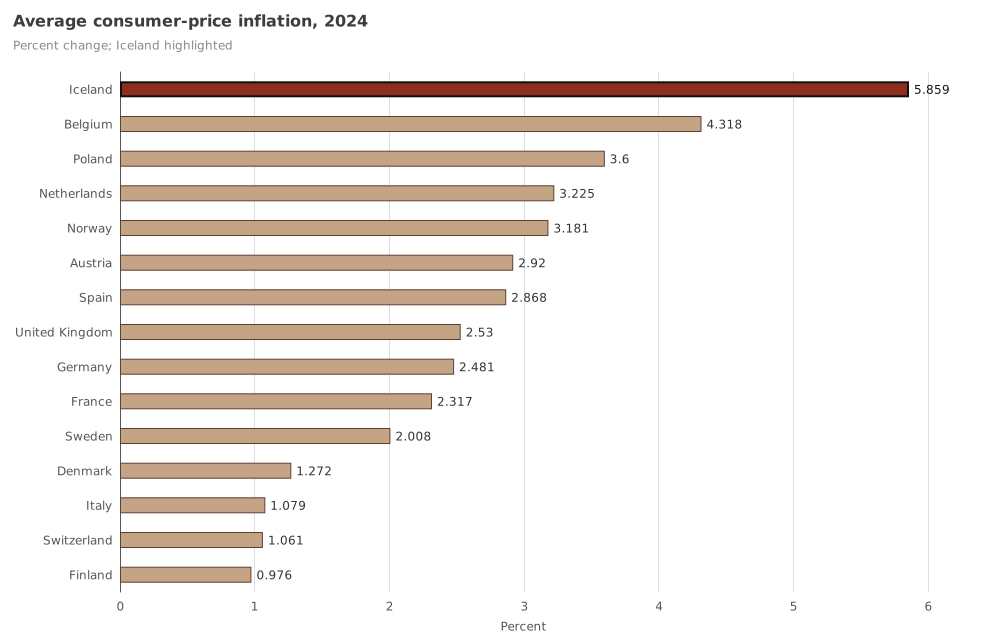
Average consumer-price inflation, 2024, percent change. Iceland 5.86 percent; Belgium 4.32 percent; Germany 2.48 percent. Headline average CPI, not core inflation or the policy rate. Source: IMF World Economic Outlook, series PCPIPCH.
The fuller comparison, including income ranks and the 2008–11 crash recovery, is in Iceland’s EU vote in the IMF accounts.
Human Stories / Social Trends
Six days after the glacier collapse that buried parts of the Nepal–Tibet border, official counts reached 797 dead and 3,048 missing, including 261 foreign citizens unaccounted for on the Chinese side. Nepal began mass burials while collecting DNA samples, and rescue teams pushed toward a hydropower tunnel where workers may still be alive. The tolls are still provisional.
Dutch fertility regulators are answering for an unusually prolific donor. A man known as Simon says he fathered at least 199 children in the Netherlands, Belgium, Germany and elsewhere, and admits he was not always transparent. Dutch health authorities knew for years and took no action — in 2019, he was even seated on a government commission reviewing the sperm-donation law. No word on whether he recused himself.
China's demographic fixes are imaginative: a hospital in Zibo bundles marriage registration with pre-wedding checkups and folic acid, and a Tianjin bank branch opened its own registry, giving the first couples custom bank cards; the Washington Post reports an "adult children for hire" industry has emerged for the aging. Meanwhile at Beijing's robot games, Tiangong Ultra ran 100 metres in 8.64 seconds before slamming into safety walls — faster than Bolt, but not yet good at slowing down or snack packets.
Dates and sources
This digest covers the news day 2026-08-30. It is presented retrospectively from a saved draft; its date in the URL identifies the news day, not an assertion of publication on that day. News references link to their original outlets. Supporting research was completed 2026-09-10. Its data vintage and material limitations are recorded in the article methods and chart captions.