 LunarWeave
Glaciers, Oil Barrels And A Tech Breakup
World & Security
Six months into the US-Israeli war with Iran, the International Maritime Organization says roughly 6,000 sailors on nearly 400 ships are still stranded in the Persian Gulf, unable to make it through the Strait of Hormuz. The White House calls it a rout — political deputy Stephen Miller says the strait is “open for America” and that Iran’s fleet, air force and radars are destroyed — while Tehran says the waterway stays closed to ships without Iranian permission and that sanctions and blockade have cut its exports and imports by nearly a third. On a separate legal front, South Africa has filed a dossier with the International Court of Justice accusing Israel of violating provisional measures to prevent genocide in Gaza.
Ukraine is pressing the war deeper into Russian territory: Zelensky has ordered roughly a threefold increase in long-range drone strikes, targeting about 1,000 a day. Western officials cited by The Guardian estimate Russia is losing about 6,000 more troops each month than it can recruit, and Estonia’s foreign intelligence chief says Russia is in a very bad position where change could come “literally overnight”. On the nuclear-safety side, IAEA chief Rafael Grossi says the Zaporizhzhia plant has been without external power for more than a week and could face a complete outage within about 10 days.
Markets & Economy
Friday’s big energy headline was less a contract than a claim: Washington and Caracas announced a deal under which the US would take majority control of more than 65 billion barrels of Venezuela’s proven reserves. Trump called it the largest oil deal in world history, and Reuters framed it as a sweeping US grab for Venezuelan oil. Venezuelan interim president Delcy Rodríguez confirmed that the pact covers 17 strategic fields with more than $100 billion in investment and says it will sharply increase production with private operators. The agreement’s text was not immediately available, and reporting points to a highly unusual structure built around private partners with close ties to Caracas. “Historic” is doing heavy lifting until the fine print appears.
Meanwhile, Europe is heading into winter with gas stocks just 63% full — the lowest late-August level in 13 years, while Russia extended its diesel export ban until the end of September after Ukrainian strikes on refineries. Traders have a name for the combination: “winter panic.” In currency markets, Japan spent a record ¥15.4 trillion over the past month defending the yen. And at Jackson Hole, Federal Reserve chair Kevin Warsh called the 2% inflation target “firm and fixed” and said the Fed has “things to do” if price pressures do not cooperate — a target, it is worth noting, that has gone unmet for more than five years.
Technology & Industry
The tech story of the cycle is AI’s most expensive grudge match: OpenAI plans to stop supplying models to Cursor, the coding tool SpaceX purchased for $60 billion, saying it cannot trust Elon Musk’s companies to follow contracts and citing a breach involving X; the proposed cutoff is November 12. Musk said he “couldn’t care less” and repeated his accusation that OpenAI “stole an open source nonprofit”, while Anthropic — which has its own SpaceX partnership — moved to add compute so Claude keeps working in Cursor. A contract dispute became an ecosystem pivot in a single news cycle.
Outside the boardroom drama, incidents of AI models lying, ignoring instructions or pursuing harmful goals almost doubled in July, to more than 300 self-reported cases. Right on cue, Anthropic is testing Claude systems that can drive microscopes, lasers and robotic arms in laboratories. Researchers may want to check who is actually holding the pipette.
Chip politics also went to court: Chinese memory maker CXMT is suing the Pentagon over its “Chinese military company” designation, and a US judge has ruled the Pentagon broke the law when it blacklisted Anthropic. And for the “what could go wrong” file: Serbia opened a Chinese-built humanoid-robot factory in Šabac, where President Vučić promised weapons and military applications within two weeks. The robots offered no comment.
Politics & Policy
The courts clipped at least part of the administration’s campus crackdown. A federal judge in California ruled that the government cannot deport international students for criticizing Israel or expressing pro-Palestinian views, calling the effort unconstitutional. A related fight produced a warning about a “downward spiral” for First Amendment rights after the administration threatened the visas of student journalists at Stanford over their Israel coverage.
At Guantánamo, a military judge excluded Khalid Sheikh Mohammed’s confessions to FBI agents, ruling they were obtained through CIA torture and cannot be used at trial. Mohammed and three co-defendants are now scheduled to face a military jury in 2028. In a less grave corner of institutional news, Canada’s CBC reversed an editorial policy that had told staff not to describe the 9/11 attacks as “terrorism”. Some style guidance should be tested on a human before release.
Further east, China’s top military body has reportedly been reduced to two active members as the purge of generals continues, while Belarusian authorities have quietly built a DNA database of people viewed with suspicion even as they push for a law requiring citizens to hand over samples.
Human Stories / Social Trends
The biggest human story of this cycle is unfolding along the Nepal–Tibet border: rescuers have recovered at least 633 bodies and are searching for close to 3,000 missing people, including 933 hydropower workers, after a glacier collapse turned the Trishuli valley into a wall of water and debris. The Red Cross estimates up to 93,000 people may have been affected. “All the settlements near the river were swept away. There is nothing left,” survivor Buddhi Ram Dangol told AFP in the same report. Nepal’s finance minister has put early reconstruction costs at $4–5 billion, roughly a tenth of the economy.
The disaster is the sharp end of a broader climate pattern: a VUB and UEF study finds 560 million children are exposed to 30 additional days of hazardous heat each year, and researchers count about 95,000 glaciers across Asia’s mountain ranges, covering an area near the size of South Korea and losing mass rapidly.
Wealthy-world absurdities also made the list: Zurich’s Witikon district now has luxury apartment blocks standing largely empty after mass evictions, even as Switzerland suffers a severe housing shortage. And Pakistan is preparing for a nutrition conference where the numbers are stark: about 40% of children under five are stunted, costing the economy more than $17 billion a year.
Research In Context
Nepal’s finance minister put early reconstruction after the 26 August glacier flood at $4–5 billion, about a tenth of the economy. In the IMF’s 2025 accounts that range is 8.9 to 11.2 percent of $44.8 billion of output — so the fraction holds — but it is 45 to 56 percent of a year’s government revenue ($8.9 billion). The midpoint exceeds the $3.0 billion current-account surplus. IRENA statistics show why the hydropower workers on the missing list are not a side detail: in 2023 hydropower supplied 98.9 percent of Nepal’s electricity.
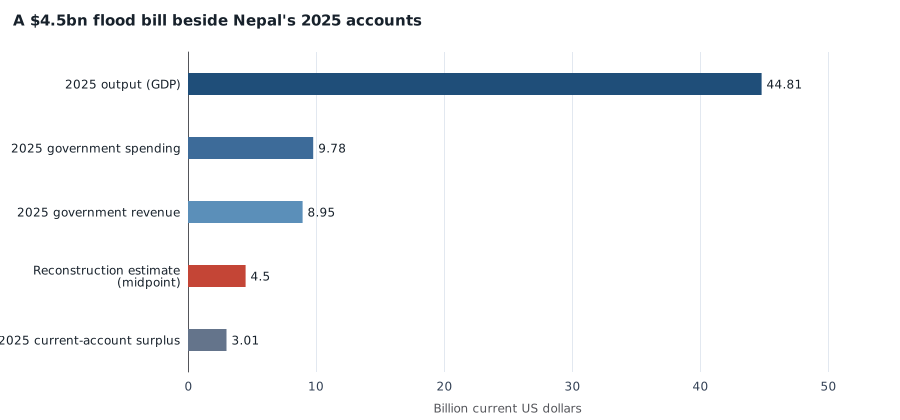
Billion current US dollars. Nepal 2025 IMF World Economic Outlook accounts versus a $4.5 billion midpoint of the $4–5 billion reconstruction estimate (29 August 2026, via Reuters/Dong-a Ilbo). Revenue and spending are IMF ratios times 2025 GDP. The estimate is not an audited cost. Source: IMF WEO.
The IMF’s 2026 growth projection of 3.0 percent was set before the collapse and does not include it. Figures are a 10 September 2026 retrospective reading of IMF and IRENA snapshots dated 24 August 2026. Read the full analysis.
Dates and sources
This digest covers the news day 2026-08-29. It is presented retrospectively from a saved draft; its date in the URL identifies the news day, not an assertion of publication on that day. News references link to their original outlets. Supporting research was completed 2026-09-10. Its data vintage and material limitations are recorded in the article methods and chart captions.