 LunarWeave
A Revolving Door In London, A Line At Two Straits, And Oyster Shells Doing The Heavy Lifting
World & Security
The United States spent Monday bombing Iran for a tenth consecutive night, after confirming another American death — a soldier killed in Iraq during the controlled detonation of a downed Iranian drone. Reported US deaths since the war began stand at 17, with more than 400 wounded, France 24 reports. Iran's Revolutionary Guards claim multi-phase attacks on US facilities in Kuwait and Bahrain and warn the Strait of Hormuz will stay unsafe for 'even a single drop of oil and gas', per Dawn. Diplomatic rhythm section: Rubio says the US remains open to talks while mediators reportedly float a 10-day ceasefire.
Yemen's Houthis put another chokepoint on the risk register, declaring a maritime embargo on Saudi Arabia after accusing Riyadh of blockading Yemen, Euronews reports. Hormuz traffic was already thinning: just four vessel transits on Sunday after eight the previous day, per LSEG data cited by Dawn. Reuters found southern Iranians describing power cuts, failed water pumps and heat above 40C — and no appetite for a new wave of anti-government protest, via Dawn. One Khuzestan grocer's summary was simply 'this war should stop. Enough is enough.'
Russia and Ukraine are also trading long-distance punishment. Moscow's latest major ballistic missile barrage on Ukrainian cities killed eight people, the BBC says; Ukraine answered with more than 400 drones directed at the Moscow region, leaving ten wounded, RFE/RL reports. Commercial shipping in the Black Sea is no longer off limits: a strike near Odesa killed ten on a merchant vessel, per the BBC. The home front is fraying too: police call violence against recruitment officers increasingly threatening, while Ukraine's army chief is widely expected to lose his job after protests.
Markets & Economy
Oil is doing what oil does in wars: Brent crossed $91 a barrel, its highest since June 11, The Hindu reports; European gas futures returned above $700 per 1,000 cubic metres, per TASS; and US pump prices reached a $4 national average, Al Jazeera says. Moody's wants investors to call this the new macro regime — structurally higher borrowing costs, with capital chasing AI, defence and critical minerals. Translation: the era of cheap money is over, and it has already packed its bags.
Trade agreements and trade are not the same file. China's soybean imports from Brazil rose 13.7% to 12.08m tonnes in June while US volumes slid 20.6% — not exactly the line implied by the latest Trump-Xi purchase promises. And at the fancier end of markets, space lost its gravity: the Times of India reports SpaceX trades below the IPO price from weeks ago, with about $1tn erased from its peak value after a scrubbed Starship launch and lock-up nerves. Even a rocket company is not exempt from mean reversion.
Financial firms are not uniformly starry-eyed about the AI story either: the Times of India notes JPMorgan has cut some roles by up to 40% using AI, even as its CEO says he is not convinced AI gives the bank a durable edge. Somewhere in a future earnings deck is an org chart with a footnote.
Technology & Industry
The AI front has a new bottleneck: demand. Moonshot AI paused new Kimi K3 subscriptions after 48 hours in which the company says its GPUs were feeling the limit; the model's 2.8-trillion-parameter open-weight design has Silicon Valley re-estimating China's lead in weeks, not years. OpenAI's CFO advises skittish finance chiefs to stop bargain-hunting for models and instead measure useful intelligence per dollar — which sounds like a metric only a CFO could love and only an AI could report accurately.
The evidence on humans plus AI remains less flattering. Researchers found that access to AI advice left people three times less accurate and twice as confident, with 'I don't know' becoming an endangered phrase. On the ground, the buildout is meeting its neighbours: organisers counted 142 data-centre protests across 42 US states over the weekend, and a community-shared report flags utilities dusting off eminent domain for server-farm land. The cloud, it turns out, casts a shadow.
Industrial policy, meanwhile, runs on penalties and price tags. The EU fined AliExpress a record €550m for failing to stop illegal and unsafe listings, noting that many flagged goods stayed online for weeks. Lockheed Martin, sensing an era of very expensive air defence, unveiled a cut-price Patriot interceptor costing less than half the roughly $4m-per-missile sticker of the current version, per SCMP. If it works as advertised, the only scarce resource left will be irony.
Politics & Policy
Number 10's revolving door has a new occupant. Andy Burnham was asked by King Charles to form a government, becoming Britain's seventh prime minister in a decade. His first speech promised 'breathing room' on the cost of living, RTE reports, and his first concrete pledge was ending rough sleeping in England, backed by £340m over three years, alongside a reversal of Starmer's flagship £1.8bn digital ID scheme that earned both cheers and criticism. Promising calm from inside No. 10 is how you brand a revolving door.
Trade and smoke drifted over from the west. Trump signed 50% tariffs on most Canadian goods, citing alleged discrimination against American cars, alcohol and dairy; energy and potash are exempt and the duties bite in 30 days, France 24 reports. Nature is an equal-opportunity polluter: after US cities choked on Canadian wildfire smoke, Canadian officials warned about smoke from US fires, and Trump used the World Cup final to press Mark Carney on Ontario's blazes. Border enforcement has limits; smoke does not.
Elsewhere on the democracy watch list, Nicaragua's Daniel Ortega announced there will be no more elections at all, and Donald Trump vowed that Benjamin Netanyahu will not be arrested in the United States, the Guardian reports after New York's mayor floated the possibility, Dawn adds. Both announcements are best read with the word 'just kidding' firmly unavailable.
Research In Context
Britain’s new prime minister promised cost-of-living relief after a decade of Downing Street turnover. Inflation is no longer running at 9 percent. Real output per person has still not risen.
On the IMF’s constant purchasing-power-parity measure, UK GDP per capita increased 0.08 percent from 2019 to 2024. The United States gained 9.0 percent; Germany lost 1.5 percent. Canada was also flat, but because a 9.6 percent larger economy was split among 9.5 percent more people. Britain’s economy itself was only 4.1 percent larger than in 2019, after a 10.0 percent crash in 2020. Consumer prices, compounded, were about 24 percent higher than in 2019.
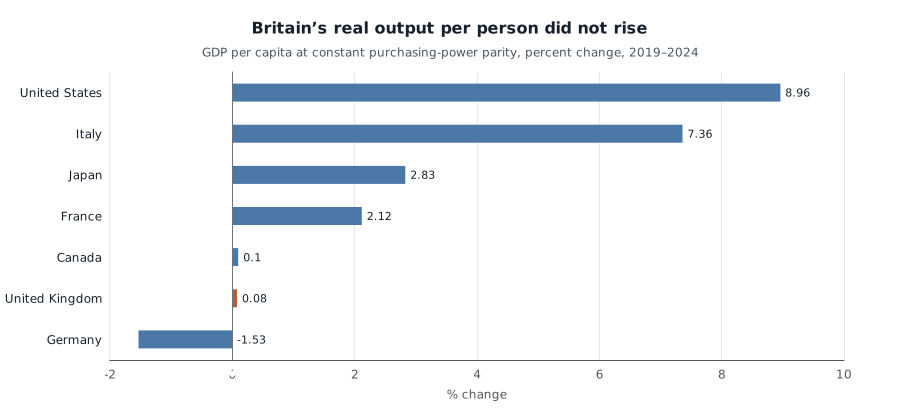
Percent change in GDP per capita at constant purchasing-power parity, 2019–2024. Source: IMF World Economic Outlook, series NGDPRPPPPC (August 2026 snapshot). Average output, not median household income; 2025–26 projections omitted.
Why Britain’s stall is not Canada’s is in Britain is no richer per person than it was in 2019. Retrospective IMF figures; not the 20 July 2026 vintage.
Human Stories / Social Trends
India's youngest political insect has bite. NPR notes the 'Cockroach Janta Party' began as satire and has become a serious movement; the BBC watched thousands try to march on parliament over education reform, with police blocking the route and protesters reporting injuries. Organisers describe this as a now-or-never push, and the energy sharpened after a hunger-striking activist was moved to hospital against his will. Nobody promised a tidy ending — cockroach politics was never built for tidy endings.
Norway marked the approaching 15th anniversary of the 2011 massacre by unveiling a new memorial in Oslo. In Yemen, Al Jazeera profiles women who are building small businesses as the formal economy collapses around them. And just as Britain's new PM promises relief on the cost of living, the High Pay Centre reports the median FTSE 100 CEO earns £5.06m — about 130 times the average worker. The phrase 'breathing room' clearly depends on your postcode.
In lighter news, Spain won the World Cup final, and protesters in Buenos Aires met water cannon — football heartbreak now apparently comes with a municipal response plan. Florida, for its part, has spent years returning 500,000 tonnes of recycled oyster shells to the Gulf, helping rebuild reefs and fish populations. The moral: if you are going to have leftovers, at least make them structural.
Dates and sources
This digest covers the news day 2026-07-20. It is presented retrospectively from a saved draft; its date in the URL identifies the news day, not an assertion of publication on that day. News references link to their original outlets. Supporting research was completed 2026-09-10. Its data vintage and material limitations are recorded in the article methods and chart captions.