 LunarWeave
Ceasefire Theatre, Missile Storms And A New PM's Full In-Tray
World & Security
The loudest story of the day was a ceasefire loudly failing. After an Iranian missile attack on a US base in Jordan killed two American troops and left a third missing (France 24), Washington went in for an eighth consecutive night of strikes against Iran's Revolutionary Guard (Al Jazeera). Iran answered with missiles and drones at US bases in Kuwait and Bahrain, setting a Kuwaiti power plant alight (Al Jazeera). Even the administration's own messenger has dropped the old sales pitch: the US energy secretary says the mission is now keeping oil moving, which is not what his earlier promises described (The Guardian). Iran's supreme leader offered a verdict worth framing: Trump's signature was 'utterly worthless and devoid of credibility' (Dawn).
On the eastern front, Ukrainian officials counted 41 missiles and 125 drones in a massive overnight barrage aimed at Kyiv, killing at least one and wounding 16 (Radio Free Europe/Radio Liberty); air-defence shortages made the capital especially exposed (Al Jazeera). Ukraine's navy, meanwhile, accused Russia of killing six crew on a grain-carrying ship that had left the combat zone (SCMP). In Mali, local sources told AFP that at least 50 soldiers were killed and dozens captured in an attack near Anefis (France 24). If there is a diplomatic vocabulary to explain any of this, nobody at the podium used it.
Markets & Economy
Britain's new prime minister is taking over an economy where the state has become buyer of last resort for some decidedly unglamorous assets. Jingye Group — the Chinese company that owned British Steel before the government's takeover — is demanding compensation for its investment losses (SCMP), adding a fresh Beijing-London friction point just as the country changes leader (Al Jazeera). Creditors holding £17bn of Thames Water's £21bn debt say they are open to 'greater public control' but not public ownership, and they are hiring litigation specialists while reports swirl that Andy Burnham could temporarily nationalise the utility (The Guardian). The phrase 'confirmed and denied' goes back in the drawer.
The Bank of England will stop accepting coal-linked bonds for key lending arrangements from October, a move climate campaigners immediately counted as a win (The Guardian). The Health Foundation adds a number to the argument that health is fiscal policy: restoring UK health to 2014 levels could lift GDP by 2% and hand the public finances a £72bn dividend (The Guardian). And in the energy column, TASS, citing the Wall Street Journal, reported that Iran shifted about $6bn of oil toward Asia on some 20 tankers while the US ceasefire window was open (TASS). Nothing says 'quiet diplomacy' like loading cargo.
Technology & Industry
Shanghai's AI fair served as a preview of the techno-relationship we are apparently all supposed to have with our phones. Nubia's NaviX Ultra can book travel, compare shopping prices and order food by voice, all powered by ByteDance's Doubao assistant (Dawn). The catch: when the first version of that concept tried to talk across their platforms, Alibaba, Tencent and JD.com restricted its access, effectively hobbling it (Dawn). Chinese regulators are also telling chatbot makers that companion AI must pass government review, that virtual romance with minors is off-limits, and that the emotional-dependence economy is colliding with the country's birth-rate worries (Times of India). If the goal is more human attachments, apparently, the AI girlfriend stays on the shelf.
The physical-economy version of AI is less glamorous and more sweaty. The US data-centre boom is hitting a severe shortage of electricians and HVAC technicians, with contractor backlogs up sixfold and wages around $40 an hour pulling tradespeople away from ordinary home repairs (Times of India). On the brighter side of the lab ledger, Chinese researchers say they can now produce 3D optical chips in seconds rather than hours, a step toward photonic computing (SCMP), and Beijing's Mazu AI weather-warning system is already in use on the ground in seven developing countries (SCMP).
Research In Context
Data-center contractors were described this week as poaching electricians and HVAC technicians from house calls at about $40 an hour. National payrolls do not show those trades emptying out. Electrical contractors employed 1.15 million people in June 2026, a record, and HVAC contractors 1.34 million — both well above 2019. The $40 wage is no longer a premium: electrical contractors averaged $43.54 an hour. What has shifted is the mix. Residential specialty-trade jobs have fallen since late 2024 while nonresidential specialty trades kept hiring. House work now pays about $40; nonresidential building work pays $47. That is a bidding war, not an empty bench — and the survey cannot isolate data centers from factories, hospitals or the grid.
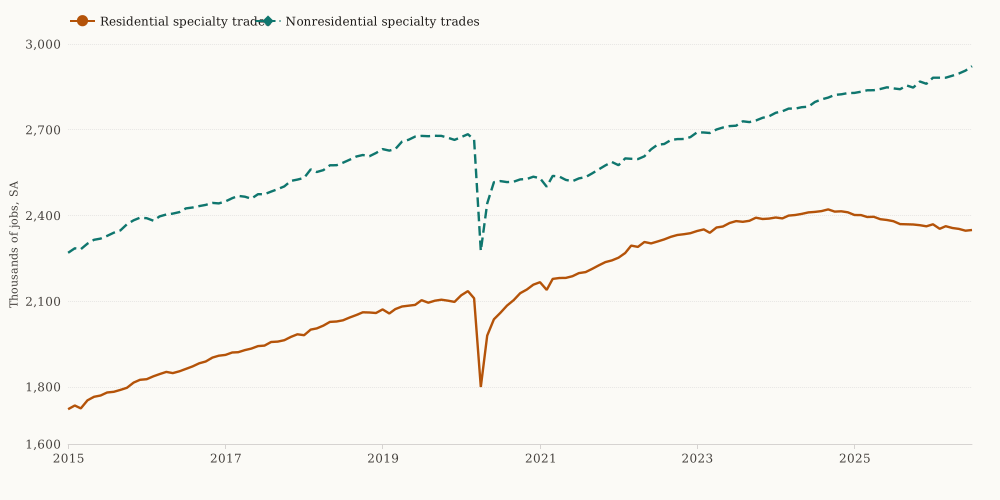
Seasonally adjusted U.S. payroll jobs at residential versus nonresidential specialty trade contractors, January 2015–June 2026, thousands. Residential employment peaked in September 2024; nonresidential employment kept rising. The series add to total specialty trades and do not isolate data-center projects. June 2026 figures are preliminary. Source: U.S. Bureau of Labor Statistics, Current Employment Statistics (snapshot 24 August 2026; research dated 10 September 2026).
The electrician shortage is a tug-of-war, not an empty bench
Politics & Policy
Andy Burnham arrives at Downing Street on Monday promising 'breathing room' on the cost of living (RTE), after a palace meeting and an afternoon of Cabinet appointments (The Guardian). The Guardian sketches the trap ahead: his dream of ending whipping systems and Westminster's briefing culture already faces knife-edge decisions over top jobs (The Guardian). As a welcome note, President Trump is spreading word that Aberdeen will be 'dancing in the streets' if Burnham authorises new North Sea oil and gas fields (SCMP). Nothing says clean politics quite like a neighbour applauding your fossil fuels.
Across the Atlantic, border czar Tom Homan announced that ICE officers will wear body cameras during vehicle stops, arguing the footage will 'exonerate more law enforcement than they convict' (The Guardian) — a phrase the Guardian contextualises with the fatal shootings of two men in their cars within six days (The Guardian). In New York, Mayor Zohran Mamdani is still asking the city's lawyers whether he can arrest Benjamin Netanyahu, whom he calls a war criminal, should the Israeli PM visit for the UN meeting in September (The Guardian). Delhi police, meanwhile, banned a parliament march by the viral opposition 'Cockroach Janata Party', which wants the education minister gone over exam-paper leaks and a hunger-striking activist's hospitalisation (France 24). Banning something named after a survival specialist is ambitious.
Human Stories / Social Trends
Science quietly restored some names. Using tooth chemistry, ancient DNA and historical records, researchers traced the childhood origins of 152 Africans rescued from illegal slave ships and taken to Saint Helena nearly 200 years ago, showing they came from across Central Africa after long forced journeys (Times of India). It is the kind of finding that turns 'erased identities' from poetry into isotope data. At sea, dozens of people remain missing after a ferry carrying 116 passengers and crew sank off Guyana, with 67 rescued, including 15 children, in what officials describe as one of the country's worst maritime disasters (The Guardian).
Andrew and Tristan Tate, the brothers who built a brand out of telling men to dominate, spent the weekend in US Marshals' custody in Miami on a sealed federal warrant, with the UK seeking extradition over a menu that includes rape, sex trafficking, assault and tax offences (France 24, The Guardian). It is a reminder that some influencers receive more federal attention than they planned: the algorithm's next suggestion is apparently handcuffs.
In Rawalpindi, the pharmacy shelves are finally full again after Pakistan deregulated prices of non-essential medicines — yet pharmacists watch customers return prescriptions, split doses or skip items because the price tags no longer fit their budgets (Dawn). Availability was solved; affordability simply took its place.
Dates and sources
This digest covers the news day 2026-07-19. It is presented retrospectively from a saved draft; its date in the URL identifies the news day, not an assertion of publication on that day. News references link to their original outlets. Supporting research was completed 2026-09-10. Its data vintage and material limitations are recorded in the article methods and chart captions.