 LunarWeave
Chip Spies, Missile Greetings, And A Record Crypto Heist
World & Security
Spain began three days of mourning after a high-speed train collision in Toledo province killed at least 68 people, one of the worst rail disasters in modern European history — and the details keep getting worse. Audio reported by the BBC appears to show a control centre clearing a train to move while the train ahead had stalled on the same line, and the transport minister called the decision to resume at full speed 'inexplicable' — a strong word for a public official and, here, an understatement.
North Korea, meanwhile, chose to greet German Chancellor Friedrich Merz's visit to Seoul with roughly a dozen ballistic missiles fired toward the East Sea; Japan's defense ministry said the suspected missiles fell harmlessly outside its exclusive economic zone. Nothing says 'welcome to the neighborhood' like live ordnance.
The Strait of Hormuz remains the world's most flammable chokepoint: Iran's Revolutionary Guards say three oil tankers burned after hitting naval mines, and they separately claim to have hijacked a US surveillance drone and landed it intact. AP-reported dispatches say Washington has told regional allies any new strikes on Iran could last several days — even as Vice President JD Vance sent Tehran a letter offering diplomacy in exchange for nuclear commitments and a reopened strait. Talking and targeting, in parallel.
Markets & Economy
The US economy grew at a 3.4% annualized pace last quarter, its fastest in a year, as resilient consumers and an AI infrastructure spree offset pricier oil; equipment investment did more heavy lifting than in any quarter since 2011. The fine print: the Fed's preferred inflation gauge jumped 0.5% in September and the central bank held rates steady, and federal debt has now surpassed the size of the entire economy for the first time since World War II.
Earnings season delivered the AI trade's two endings. Microsoft's shares surged toward record highs after hours on results that left it sitting on spare cash, while Alphabet plunged nearly 10% having spent roughly 12 trillion won more than it earned — $9.07 billion in negative free cash flow and $51.36 billion of quarterly capex buys a lot of GPUs and very little patience. Samsung, for contrast, posted a fourth straight record quarter on AI memory, with next year's HBM supply already sold out.
The week's risk-management seminar: hackers drained an estimated $1.7–5.5 billion from Binance in what would be crypto's biggest heist ever, tanking bitcoin and ether; Volkswagen booked a €5.8 billion net loss on Porsche writedowns and a 38.5% plunge in China deliveries; and Intel shares fell 18% on an Israel factory blast and soft PC demand.
Research In Context
The 3.4% third-quarter growth print was sold as households plus AI equipment. The production accounts through June already showed a different split. U.S. real GDP rose at a 2.2% annualized pace in 2026 Q2. Information — software, data processing, telecom, and related services — added 0.52 percentage point, about a quarter of that growth, despite being only 6% of the economy. Durable-goods factories added 0.50 point. Construction added 0.14. Forty-four of 50 states grew; the six that shrank were mostly energy states. That quarter is not the new 3.4% estimate, and information is not a synonym for AI. It is the last complete map of which industries were actually producing.
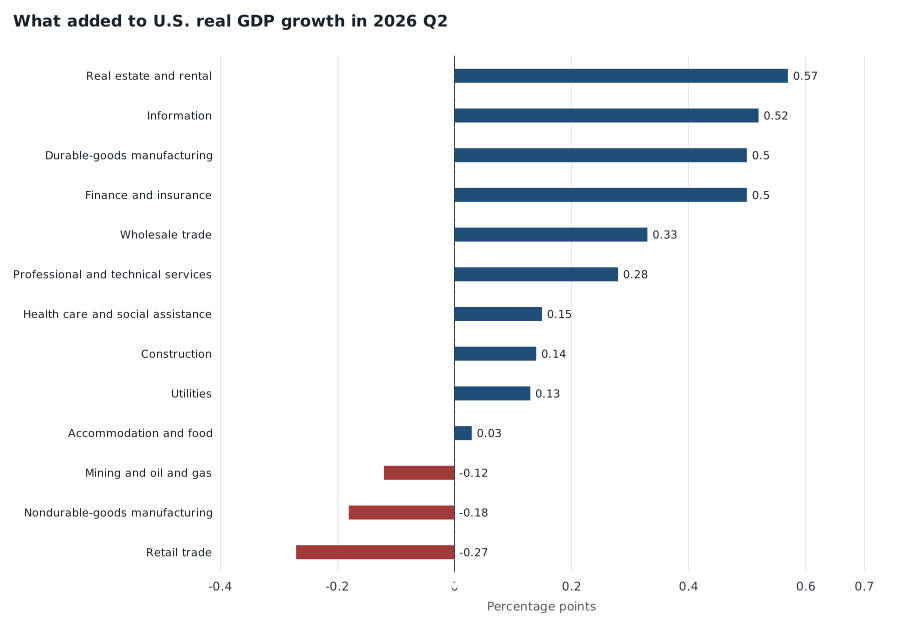
Industry contributions to U.S. real GDP growth in 2026 Q2, percentage points, seasonally adjusted annualized quarterly change. Information 0.52 and durable manufacturing 0.50 together were 46% of the 2.2% pace. Construction 0.14; retail −0.27. BEA SQGDP11, United States. Not every industry is shown.
Technology & Industry
The spy story of the week has a silicon core: per the New York Times, US intelligence concluded that Alice Huang — a Singapore data-center executive with a close relationship with Nvidia CEO Jensen Huang — was passing information to Beijing while her company bought billions of dollars in Nvidia chips believed destined for China via detour. Trump was briefed about a year ago and declined to act, reportedly wary of denting Nvidia's sales.
Orbital politics got weirder: Vladimir Putin called Elon Musk a 'real genius' and said Russia is in 'close' contact with him about satellite technology, though what that coordination actually involves is unclear. Meanwhile the Pentagon's inspector general declined to investigate Starlink and Starshield outages that affected Ukraine, referring senators to the Air Force — though German police did arrest two men accused of leading attacks on Starlink ground stations in three EU countries.
The backlash is getting structural: New York enacted the country's broadest ban on AI companions for minors, the European Commission temporarily blocked member states from enacting their own social-media bans for a year so it can propose one at EU level, the FTC ordered Delta, Uber and DoorDash to explain their algorithmic pricing — and xAI offered to buy 418 homes near its Mississippi data center, whose noise the neighbors had somehow noticed.
Politics & Policy
Israel's election produced no majority — opposition parties won 67 of 120 Knesset seats to Netanyahu's bloc's 53 — and then the sequel wrote itself: the election chairman asked the Shin Bet to investigate 'serious suspicions' of foreign financing in the vote, with reporting pointing at Qatar, while stressing he could not vouch for the suspicions himself. Likud instantly branded it 'Ra'amgate', which tells you the fraud narrative was ready before the evidence was.
Brazil exported its post-election chaos: Senator Flávio Bolsonaro filmed himself vowing not to flee, then fled after his runoff defeat by Lula — crossing into Argentina on an Italian passport and surfacing in Miami, where Trump admitted him on humanitarian grounds as 'a decent person' after a 'terrible' election. He declared himself president-elect in an open letter, then demoted himself to 'leader of Brazil'. Federal police are reconstructing his escape route, and the Justice Ministry counted ten political killings in the days around the runoff.
Softer landings elsewhere: ECB President Christine Lagarde said she'll resign on February 7, nine months early, because she wants to speak freely as Europe's political temperature rises. And France's Senate voted 252–80 to make sex crimes against children imprescriptible, a status previously reserved for crimes against humanity.
Human Stories / Social Trends
Novaya Gazeta test-drove Russia's new 'Azov Ring', a planned 1,427-kilometre tourist loop through Taman, Taganrog, Mariupol and Melitopol, and found the brochure omits a few amenities: drone sirens in Temryuk run on a schedule — ten in the evening — roadside petrol sells for 180 rubles a litre, and Taganrog locals describe nightly explosions as unremarkable. Agricultural tourism, now with air-raid timetables.
Two quieter ledgers: South Korea reported income mobility at its lowest since statistics began in 2017 — only about a third of people change income brackets in a given year, and one in four who sat in the bottom 20% in 2017 remained there in 2024. Colombia counted 256 citizens dead and 973 missing in the Ukraine war, where UN officials estimate at least 10,000 Colombians have been drawn abroad as mercenaries, often on false promises of pay and safety.
AI's prophets can't agree on how it ends: Musk says saving for the future is pointless because abundance is coming, while a former Google engineer warns humanity may not exist in ten years — a rare consensus against retirement planning. Slightly better news from the animal kingdom: dogs living in Chernobyl's exclusion zone show genetic signs of adapting to decades of radiation, per a University of North Carolina-led study. Evolution remains the only forecaster with a track record.
Dates and sources
This digest covers the news day 2026-10-29. It is presented retrospectively from a saved draft; its date in the URL identifies the news day, not an assertion of publication on that day. News references link to their original outlets. Supporting research was completed 2026-10-30. Its data vintage and material limitations are recorded in the article methods and chart captions.