 LunarWeave
Satellites, Standoffs And A Village Hunting For Twenty-Somethings
World & Security
The loudest drumbeat was Tehran: US intelligence warned Iran is in 'advanced stages' of planning attacks on American officials, and Washington answered by ordering diplomats out of Saudi Arabia and drawing down embassies regionwide. Trump teased 'another little Epic Fury' strike; the Houthis, unimpressed, hit back with claimed strikes on Saudi airports and Aramco sites after accusing Riyadh of attacks that killed 17 — making October the worst month on record for ship attacks. Reuters reports Iran has drawn up plans to hit undersea internet cables if bombed again, though reported offers to reopen the Strait of Hormuz in exchange for lifting the US naval blockade suggest someone in Tehran can still count. In Istanbul, eight governments agreed to meet regularly, with Egypt, Saudi Arabia, Turkey and Pakistan jointly calling Israeli occupation the region's 'primary source of instability'.
Days before Israel's election, its army displaced around 1,200 Palestinians in Hebron after a shooting killed two soldiers — demolitions included, with B'Tselem warning of possible war crimes and Netanyahu promising an operation unseen since 1967. Gunmen also killed seven worshippers at a church in Jordan's Karak. Zelensky set the first Ukraine-US-Russia technical meeting for Abu Dhabi next month; Kim Jong-un made an unannounced dash across a bridge twelve years in the making to Dandong, where Beijing's top political adviser waved him off — diplomacy at the speed of a day pass.
Markets & Economy
Oil is the market's mood ring: Brent closed above $116, its highest since April, and MSCI analysts warn a full Hormuz shock could fell stocks, bonds and the dollar at once. American households aren't soothed — consumer sentiment slid to 48.0, brushing record lows, and 78% of Americans tell pollsters Trump's policies are behind prices rising faster than pay. The White House's remedies argue its critics' case: Russian diesel sanctions were lifted to tame fuel prices, fertilizer-related restrictions may be loosened next, and the plan for peace in Ukraine now apparently involves threatening both belligerents with 200% tariffs.
The AI economy keeps colliding with electrical physics: Bank of America expects global data-center spending to double past $200 billion by 2028, while Amazon reportedly warehouses $5 billion in servers it lacks the power to switch on. Anthropic, maker of Claude, starts trading in November, with Google and Amazon holding the good seats. Beijing, meanwhile, is weighing export quotas on rare earths and solar and lithium technology — leverage few capitals can match — while blasting Washington's tightened biotech investment curbs as security policy stretched over economics.
Research In Context
American households are being asked to judge the economy by pay versus prices, with sentiment reported near a record low and oil above $116. The government’s main income total is a broader object. In 2026 Q2, net earnings from work were 59.9% of U.S. personal income, down from 63.2% in 2019 Q4. Dividends, interest and rent rose to 21.4%, transfer receipts to 18.7%. Since late 2019, transfers rose 62% and asset income 60%; wages rose 42%. The extra transfers are Social Security, Medicare and Medicaid, not leftover stimulus; Medicare and Medicaid alone were 8.8% of official income — counted by BEA, not received as cash. That does not prove prices outran pay in October; the accounts end in June, and inflation-adjusted income is only complete through 2024.
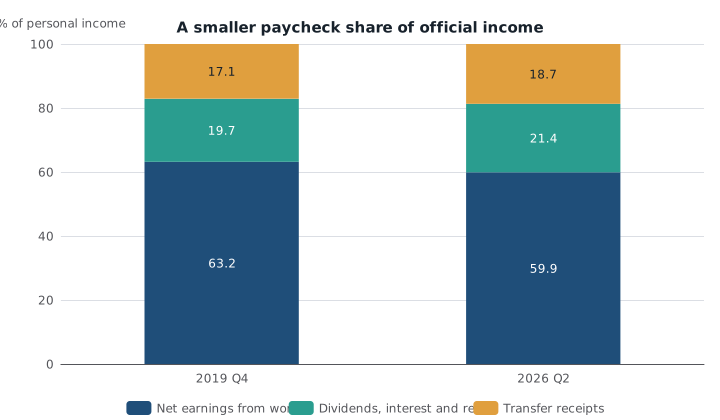
Share of U.S. personal income, seasonally adjusted annual rates, 2019 Q4 vs 2026 Q2. Net earnings, asset income and transfers sum to the total. Current-dollar shares, not inflation-adjusted. Source: U.S. Bureau of Economic Analysis, SQINC4.
The paycheck is a shrinking share of America's official income
Technology & Industry
Starlink spent the week as both lifeline and hostage. After a week of throttled speeds, Zelensky said service was back to normal — shortly after Musk admitted deliberately curbing it, accusing Ukrainian forces of violating the terms. Then Reuters reported that both the Biden and Trump administrations have spent years asking Musk to switch Starlink on or off in Ukraine, Iran, Yemen and Lebanon, which rather reframes 'independent billionaire' as 'contractor with strong opinions.' Musk also floated the unverified claim that US aid to Ukraine secretly funds American political campaigns, and bipartisan senators now threaten to hold up Trump's nominees until Ukrainian connectivity is guaranteed.
Security, meanwhile, is the growth industry. A flaw in PHP, the language behind roughly 70% of websites, triggered a 72-hour global scramble, with North Korea-linked Lazarus reportedly scouting targets. Britain is building the world's first AI biosecurity lab — a £100 million effort with OpenAI and Anthropic models inside. Moonshot's new Kimi model beat OpenAI on some agent benchmarks, and its maker curbed the model's hacking abilities. OpenAI resumed frontier training after a security overhaul, now keeping models offline while they learn. Some 400 scientists, Hinton and Bengio among them, want an international AI control body. NASA reconfirmed a 2028 Moon landing as its chief warns China is closing the gap.
Politics & Policy
America's midterms are close enough that gloves, and several norms, are off. Trump says he ordered a Justice Department lawsuit to block Alaska's Senate certification if the Republican loses — a sentence that answers the 'will he accept the result' question all by itself. Two former FBI agents were charged with lying to Congress about the Hunter Biden laptop investigation; the administration accused Canada of election interference, to Ottawa's flat denial of merit; and Rubio told Cubans seeking change that now is the time — including, apparently, to work with the CIA.
France marched again: unions counted 800,000 protesters, the Interior Ministry 410,000 — arithmetic being the first casualty of any French demonstration — under a 70,000-officer security umbrella, with a national strike set for November 5. Polls now give Le Pen a first-round lead of 33–35% and a projected runoff landslide. Brazilians vote Sunday in a Lula–Flávio Bolsonaro runoff with the polls dead level. Israel's central bank, showing a spine many finance ministries lack, rejected Netanyahu's plan to dodge sanctions with crypto. And the White House debuted an 'Arcade' of patriotic browser games; the Tetris-flavoured wall-builder vanished after the Tetris Company objected — the week's only border policy to be repealed. In Japan, revised imperial succession rules took effect, keeping a widely popular princess off a 1,500-year-old throne.
Human Stories / Social Trends
Medicine had a big week. American scientists published, in Nature, a mechanism by which microplastics in water generate reactive substances that damage cells. Users of GLP-1 weight-loss drugs keep reporting they've lost the craving for alcohol and cigarettes, and drugmakers are now chasing compounds for addiction, depression and schizophrenia. And the WHO began its first clinical trial of a vaccine against the Ebola strain ravaging the DRC, where the outbreak has killed over 4,600 and spread toward West Africa — first doses went into arms in Bunia.
Human ingenuity filled the gaps. A Japanese village where 70% of residents are over 65 is courting twenty-somethings from the Peruvian Amazon; Chinese couples who play 'Mum and Dad' to 126 million urban pets are discovering the law sees only property when love ends; and 18 incarcerated women collected Northwestern degrees. In Indonesia, students marched in six-plus cities over wildfire haze, carrying the banner 'If We Burn, You Will Burn Too' — the week's most honest piece of climate communication. Elsewhere, researchers corrected a 155-year-old mix-up: the famous solar-storm train delay was in 1848 — history's most overdue timetable apology.
Dates and sources
This digest covers the news day 2026-10-24. It is presented retrospectively from a saved draft; its date in the URL identifies the news day, not an assertion of publication on that day. News references link to their original outlets. Supporting research was completed 2026-10-25. Its data vintage and material limitations are recorded in the article methods and chart captions.