 LunarWeave
Hormuz Burns, The AI Boom Wobbles, Finland Thinks In Centuries
World & Security
Overnight in the Strait of Hormuz, seven tankers ended up ablaze or damaged — the worst day there since the American–Israeli strikes on Iran began in February, per AP's count Novinky reports. The fires followed either an Iranian attack or a mine strike; Iran's government confirms the number, less so the blame the Los Angeles Times relays. In Saudi Arabia, a strike on Dammam airport killed two, bombs hit Aramco's Dhahran complex, and the world's largest oil company evacuated staff.
Washington is hedging: non-emergency diplomats and families were ordered out of Saudi Arabia, with similar drawdowns reported in the UAE, Jordan, Qatar and Bahrain. The New York Times reports the US and Israel have drafted plans for a short, intense operation against Iran — energy and nuclear sites included — timed for after the 3 November midterms; dozens of Israeli jets have already flown a 'power demonstration' to Iran's border. War, apparently, waits for midterms.
Ukraine dangled the obvious off-ramp: Zelensky told Fox News he would accept freezing the current front lines to end the fighting. Moscow's reply-by-drone: 630 heading for the capital overnight, the year's largest attack by the mayor's tally — and hours after Putin agreed to resume three-way talks, Kyiv took ballistic missiles. Europe's parliament, reacting to attacks on ships off Bulgaria and Romania, now wants the EU to weigh a Black Sea naval operation.
Markets & Economy
Oil did the talking: Brent closed at $113.17, up 4% and at its highest since May, while IEA numbers relayed by Berita Harian put tanker rates from the Gulf to Asia at five times pre-conflict levels. The IMF now expects output across Pakistan, the Middle East and North Africa to shrink 1.3% this year because of the war — with oil importers, for once, proving sturdier than exporters.
Then the AI bill arrived on screens: the Nasdaq fell 2.6%, the S&P 500 shed 1.2%, and Meta dropped nearly 7% despite beating revenue estimates, as investors balked at a company planning to raise 'hundreds of billions' for AI while its free cash flow sits in the red. Bloomberg has SoftBank's market value on course to halve from its peak; DeepSeek, meanwhile, raised $15bn to chase the American labs. Same boom, opposite directions.
France supplied the sovereign wobble: its 10-year yield passed 5% for the first time since 2002 and closed above America's — a premium Reuters calls eurozone-crisis territory. The truly prepared, meanwhile, are moving their gold to Singapore; wars and public debt make poor neighbours for vaults.
Technology & Industry
The internet had a near-death-by-plumbing moment: AI models uncovered two critical memory bugs in PHP, the venerable language running an estimated 70% of all websites — it once stood, adorably, for 'Personal Home Page'. OpenAI called it 'one of the most impactful vulnerabilities in recent memory,' and operators worldwide took sites offline to patch safely, briefly darkening everything from the Paris police to a Pokémon sleep tracker.
The attackers automate too: Microsoft says the China-linked group Storm-0940 used ARTEX, an open-source AI penetration tool that runs reconnaissance through data theft without human help, against hundreds of organizations — IT firm ConnectWise and, reportedly, South Korean banks among them. American banks, rattled, are restricting third-party AI 'agents' after US banks detected unvetted ones inside customer accounts, per Axios. Europe, meanwhile, ordered up its answer to Starlink: Thales booked €6.7bn in quarterly orders, led by the EU's Iris² secure-satellite constellation.
Courts and chainsaws kept pace: Meta was ordered to pay $25bn in a data-harvesting case; regulators suspended Google's Finnish data-center works after it cleared roughly 250,000 trees without the required environmental assessments; and Barclays is cutting about 5,000 jobs in an AI efficiency drive. All that progress, and the trees still lose.
Politics & Policy
Europe spent the week decorating institutions Washington is squeezing: the European Parliament gave its Sakharov Prize to the International Criminal Court, under US sanctions since it sought Benjamin Netanyahu's arrest warrant over alleged crimes in Gaza, while the Nobel Peace Prize went to South African jurist Navi Pillay. The ICC noted the honour lands amid 'unprecedented challenges' — diplomatically phrased, that.
The Ukraine peace track remains more costume drama than diplomacy: envoy Steve Witkoff visited St Petersburg, called Putin a 'humanist,' and left Trump's fellow Republicans sputtering until the president and JD Vance rode to his defence. The New York Times reads it all as Trump's search for a new Yalta — great powers dictate, smaller countries sign — and the Telegraph floats a possible Trump–Putin–Xi meeting at APEC in Shenzhen, confirmed by no one official.
At home, Trump decreed that federal agencies say 'super intelligence' instead of artificial intelligence — renaming the technology before agreeing on what, exactly, is being renamed. His operation has already poured some $277m into November's midterms, with the president promising well over $400m by election day, while lawyers squint at him calling super PAC money 'his'. And at the UN, after every secretary-general candidate drew a veto, the UAE's Rana Nuseibeh has stepped forward — potentially the first woman in the job.
Human Stories / Social Trends
The summer sent its invoice in lives: scientists estimate more than 50,000 premature heat deaths across 854 European cities between June and August — the continent's deadliest such summer on record. A Nature analysis finds the Amazon now emits over 1.17 billion net tonnes of greenhouse gases a year, fires and logging having cancelled out its atmospheric cleaning service, and UN advisers warn 96% of tropical reefs face high collapse risk by 2075. Britain, taking notes, is holding its first wildfire summit, military aircraft on standby.
Health authorities logged a first: France confirmed the initial known human case of Shamonda, a virus until now confined to cattle; the patient, treated in Lyon, died in early October, though officials stress human-to-human spread isn't established, and the virus has turned up in livestock across 54 departments. In Tibet, a magnitude-7.0 earthquake killed at least 16 and injured 32.
The irony prize goes to Wikipedia, down over a billion visits as chatbots — trained partly on Wikipedia — answer questions nobody bothers to verify. Better news from Libya: an Austrian and a Swiss woman, kidnapped separately in Niger more than a year ago, were freed in Benghazi and are heading home. And Finland licensed the world's first permanent nuclear-waste repository — 6,500 tonnes of spent fuel engineered to outlast every government now arguing about it.
Research In Context
Finland licensed Onkalo, the first permanent repository for high-level nuclear waste — 6,500 tonnes of spent fuel from five reactors. That is not the act of a nuclear giant. In 2023 Finland generated 34,308 GWh of nuclear electricity, 42% of its power, but only 1.3% of the nuclear output recorded that year across 34 countries. The United States generated 808,076 GWh, 23.6 times as much — more than Finland produced from 2000 through 2023 combined. Electricity is not spent-fuel mass; it is the right scale check.
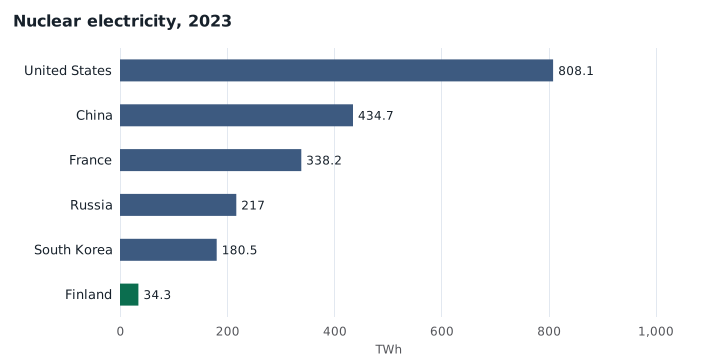
Gross nuclear electricity generation in 2023, terawatt-hours. Finland generated 34.3 TWh, about one twenty-fourth of US output (808.1 TWh) and one-tenth of France’s (338.2 TWh). Source: IRENA country electricity statistics. Generation is not spent-fuel mass; 2024 figures are omitted because IRENA flags them as preliminary.
Finland’s nuclear fleet is small. That is why a national dump could finish.
Retrospective: Onkalo licence reported 22 October 2026; IRENA electricity figures are 2023, from a later pinned snapshot.
Dates and sources
This digest covers the news day 2026-10-22. It is presented retrospectively from a saved draft; its date in the URL identifies the news day, not an assertion of publication on that day. News references link to their original outlets. Supporting research was completed 2026-10-23. Its data vintage and material limitations are recorded in the article methods and chart captions.