 LunarWeave
Drones Over Petersburg, Wobbling AI Debt, And Love In The Time Of Chatbots
World & Security
Ukraine answered Washington's new Russia policy in the loudest way available: over a thousand drones, according to Russia's defense ministry, struck targets across fifteen regions overnight, igniting a St. Petersburg oil terminal, a fuel depot, an Ozon warehouse, a VK data center and a bridge; one resident died and fifteen were injured. The timing was pointed. Donald Trump had just waived the Graham Act sanctions days before they were due to take effect, days after a US–Russia diesel deal, over objections from fellow Republicans. Zelensky called supporting Putin 'historic mistake' material for Washington, noted that Russia hit Ukrainian energy facilities 76 times in the first week of Trump's declared 'energy ceasefire', and said the Americans have even suggested Ukrainians find a different president.
Lithuania, for its part, scrambled jets after a drone exploded in its airspace, sending residents to shelters; Kyiv apologized, blaming Russian electronic-warfare jamming for the detour. Police there also foiled an attempted arson on Starlink equipment serving Ukraine — the third such attack in the EU in a month. US intelligence-sharing with Kyiv, cut off after the diesel deal, has been restored, after three days without ballistic-missile warnings. And Vladimir Putin is having more air-defense towers built around his Valdai residence — roughly thirty now, the nearest about 400 meters from the house. Man of the people.
Markets & Economy
The AI boom spent the week discovering debt. Bond investors put CoreWeave's default odds above 60% — the data-center firm carries $72 billion in liabilities across 51 sites — and its bonds cratered, with Oracle and SoftBank debt sold off too. The Philadelphia Semiconductor Index logged its eighth straight decline, the longest slide since the 2008 crisis. Seoul's national pension fund watched some 182 trillion won evaporate in around a hundred days, mostly in Samsung Electronics and SK Hynix. China's CXMT added a jolt, claiming a denser 4F² DRAM design and a server-memory module by end-2026; analysts say the sharper threat is its expanding cheap capacity.
The twist: the boom itself is real. Korea's trade surplus with the US should smash a record $100 billion this year on AI-driven chip and power-equipment exports — success that may now count against Seoul in talks with Trump. The IMF sees Korean potential growth rising two years running, a first in four decades, while Japan slides to sixth in global GDP by 2027, passed by India and Britain. Meanwhile the Strait of Hormuz keeps burning: Iran's Revolutionary Guard navy says a supertanker loaded with two million barrels caught fire after hitting a mine, 22 ships were attacked in thirteen October days, and old tankers now sell for more than new ones. Nothing says calm like a shipping lane on fire.
Research In Context
Bond investors can mark down a leveraged data-center operator without shrinking the official industry that includes hosting. In 2025 BEA data-processing, hosting and other information services produced $596 billion of value added — 1.93 percent of U.S. GDP — and about one-ninth of real growth. Real output rose 143 percent from 2019 to 2025, against 16 percent for the whole economy.
That boom is not Data Center Alley. California booked 38 percent of 2025 industry output; Washington’s share of state GDP is 6.4 percent. Virginia, at 1.8 percent, sits slightly below the national average. The line mixes internet search with hosting, so it cannot isolate one GPU landlord. A financing scare here is real-economy news — not proof that a reported $72 billion book is 2 percent of America.
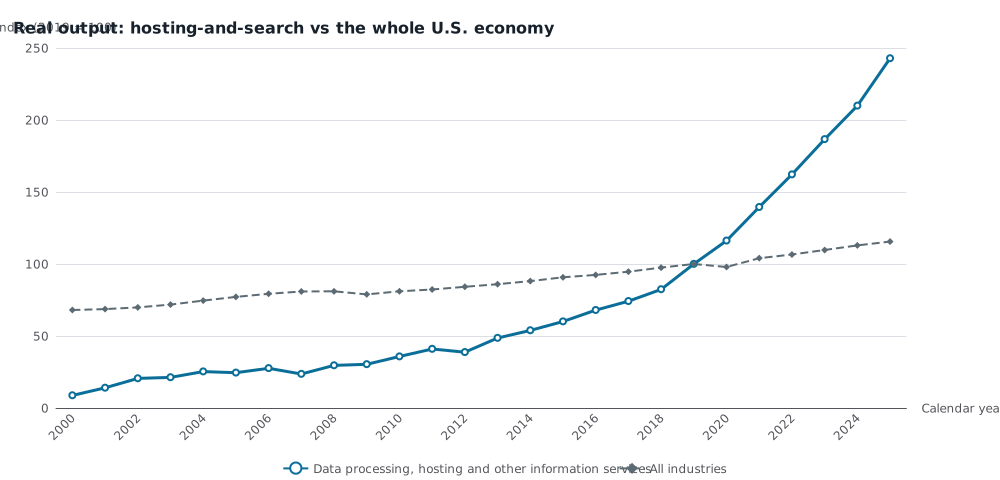
Real GDP indexed to 2019 = 100. BEA data processing, hosting, and other information services (NAICS 518–519: internet access, search, data processing and hosting — not a pure AI data-center series) versus all-industry U.S. real GDP. Calendar years 2000–2025, chained 2017 dollars. Source: U.S. Bureau of Economic Analysis, GDP by state, 30 September 2026 release. Retrospective research, 19 October 2026.
How large is the official hosting-and-search industry, and where is the output booked?
Technology & Industry
Anthropic is having a very Anthropic week. Ahead of an IPO expected to rank among the largest ever, it will steer 5% of its shares into a public-benefit fund to bankroll 'public good' causes, including blunting AI's impact on jobs. It also handed Congress a draft law asking to be restrained: registered outside auditors would review frontier models, with courts empowered to halt releases posing imminent risks of more than 50 casualties or $10 billion in damage. The Financial Times reports the company is working with law firms so its Claude agents can negotiate deals. And Ynetnews says Claude cracked a 25-year-old NSA cryptography puzzle in under half an hour — impressive, if it survives contact with the full article.
Apple finally folded: pre-orders opened for the iPhone Duo, a $1,999 handset with a 5.4-inch cover display that opens into a 7.6-inch one. Stranger still, Apple and Meta — years of feuding notwithstanding — are now collaborating to run Meta's 816-billion-parameter Muse Spark Open model on Mac Studio machines. China, meanwhile, moved to lock the door behind itself: export bans or restrictions on 40 core technologies, 23 of them in AI — including models over two trillion parameters, plus proposed controls on solar-manufacturing know-how. Somewhere, a free-market think tank is presumably drafting an angry press release.
Politics & Policy
France's cost-of-living protests turned Saturday ugly: more than 1,800 arrests, some 500 police and firefighters injured, Limoges's 19th-century town hall torched and around 1,500 shops damaged — before Emmanuel Macron addressed the nation on Sunday evening. The blame was distributed faster than the damage was counted. Prime Minister Sébastien Lecornu blamed the 'ultra-left' and told the country to pick a side; Jean-Luc Mélenchon called Lecornu 'responsible for the chaos'; Marine Le Pen agreed it was the left. Trump and JD Vance, watching from across the Atlantic, diagnosed immigration — while, back home, it is pump prices that worry the White House before the midterms. A Russian senator contributed 'civil war' from Moscow, in case the discourse needed lowering further.
The youth-driven wave is spreading: Albania's anti-government protests reached a sixth day, with tear gas, water cannon, and a prime minister, Edi Rama, refusing to resign while warning the unrest endangers EU membership — an inventive reading of the club's criteria. In Brussels, EU leaders adjourned with the long-term budget still blocked over an extra €70 billion for Ukraine. Alberta votes Monday on a 'path to secession' from Canada, which Premier Mark Carney calls a dangerous bluff. And in Washington, border czar Tom Homan said Ilhan Omar could 'of course' be denaturalized and deported, days after federal agents raided the congresswoman's home.
Human Stories / Social Trends
Strip away the tear gas and Europe's protest wave has a demographic signature: young, urban and priced out. In Lisbon, demonstrators pitched a tent camp on Rossio square after housing costs jumped 124% between 2015 and 2024 — roughly double the EU average. Milan saw a barricade burn in front of the cathedral; Brussels students protesting education costs got water cannon in reply; in Tunis, some 3,000 people marched against prices and shrinking freedoms. As a Lisbon social worker put it: the taxpaying class is losing its rights, 'namely the right to housing'.
Two sturdier storylines. From a hospital bed in Abu Dhabi, flydubai captain Smit Machchhar described blocking crash-axe blows to his head and screaming for help as his co-pilot — whom UAE prosecutors say intended to crash the plane into Ben Gurion airport — sent the Dubai–Tel Aviv flight into a 16,000-foot, 30-second dive; other crew overwhelmed the attacker and landed safely. His verdict: 'Did I give up? No.' And in Brazil, 49-year-old Edimar Martins sold all his belongings and traveled more than 1,200 miles to meet the TikTok girlfriend he hoped to marry — a profile with some 300,000 followers. She turned out to be AI-generated. He got help getting home and says he remains hopeful about love, which is more optimism than most markets managed this week.
Dates and sources
This digest covers the news day 2026-10-18. It is presented retrospectively from a saved draft; its date in the URL identifies the news day, not an assertion of publication on that day. News references link to their original outlets. Supporting research was completed 2026-10-19. Its data vintage and material limitations are recorded in the article methods and chart captions.