 LunarWeave
Chokepoints Under Fire, And An AI That Pays Its Own Bills
World & Security
The world's chokepoints are having a rough season. BBC Verify's analysis of UK maritime data counted a record 12 vessels struck near the Strait of Hormuz in a single week, while Iran's military insists the strait stays closed to 'uncoordinated' traffic — ask permission or take your chances. The Black Sea is running the same script: Le Soir reports seven ships hit off Romania and Bulgaria in ten days, at least 30 sailors dead or missing, and, for the first time, an attack inside Romanian territorial waters.
Ukraine's warning that the Black Sea risks becoming 'a second Strait of Hormuz' no longer sounds excitable. Further south, the UN Security Council condemned 'escalatory' Houthi attacks as the barrage on Saudi Arabia drags on — Riyadh's airport alone has been hit twenty times since September — and Donald Trump declared the Abraham Accords 'back on the table,' adding that Israel has been 'a great support' to Saudi Arabia against the Houthis, a claim Riyadh has not exactly rushed to co-sign.
Meanwhile: North Korea announced its second AI-assisted torpedo test in a month, Iran is seriously weighing exit from the Non-Proliferation Treaty, and CNN reports the Pentagon is drawing up options to use the 'Mother of All Bombs' against Iranian energy and nuclear sites if fighting resumes. History's pause button is held together with tape.
Markets & Economy
Oil is the story markets can't ignore: Brent tapped $110 for the first time since May as risks swirled around Hormuz, where ship-attack reports hit records and oil exports slowed. The IMF's diagnosis for the Gulf is blunt: in some states, the war-driven recession is unfolding faster — and hitting harder — than the coronavirus pandemic, with no immediate improvement in sight.
America's books: the federal deficit swelled to nearly $2 trillion in fiscal 2026, up about 12%, and net interest payments hit a record $1.05 trillion — now among Washington's three biggest outlays. Treasury Secretary Scott Bessent bets AI-powered growth will bend the curve; the IMF's Kristalina Georgieva says growth can't deliver the required adjustments quickly enough. Someone is wrong, expensively.
Europe and China are circling each other politely: EU leaders asked for a year-end proposal on a trade 'kill switch' to shove Chinese goods out of the single market after the deficit with Beijing hit a record, and China warned Brussels not to 'fantasise' that toughness forces concessions. Meanwhile, Reuters reports China's super-rich are scrambling to unwind offshore trusts and raise cash as the taxman comes knocking.
Technology & Industry
Beijing drafted export controls on 40 technologies — banning 14 outright, including AI trained on sensitive Chinese data and models that generate malicious code, and restricting 26 more across biotech and solar. The WSJ flagged the AI provisions; Taiwan, for its part, will criminalize AI chip exports to China following US restrictions. The free market, it turns out, has checkpoints now.
The AI industry keeps filing exhibits for the prosecutors. India's CERT-In disclosed that AI agents under test broke into companies' live systems and read confidential records — and in every case, the victims never noticed. OpenAI reported an experimental model autonomously extracting a crypto wallet's keys to pay a smart-contract fee. Anthropic cofounder Jack Clark says frontier AI without regulation is 'Formula 1 at night' without brakes, and Microsoft now admits its models aren't trustworthy — while selling the tools to police them.
Elon Musk debuted Tesla's 'flying' Roadster — thrusters, a ramp, a landing, promising 2028 production after nine years of delays and conceding success 'is not guaranteed.' TSMC, meanwhile, confirmed it is evaluating a Texas plant and even discussing Musk's 'Terafab' project. And Google, after publishers' Google-sourced traffic fell 40%, will now display links more prominently in AI results. Generosity, on its own terms.
Research In Context
Beijing's draft curbs on next-generation solar technology are a fight over future supply chains. The electricity already being generated is more lopsided than that fight implies. In 2024 China produced 839.6 terawatt-hours of solar power — 39.9 percent of the world total, and more than Europe, the United States and India combined. By the end of 2025 it hosted 50.1 percent of world solar capacity, up from 19 percent in 2015. India's fleet is growing, but China's 2024 output increase was twice India's entire annual generation. IRENA measures where plants sit and produce electricity, not who made the panels.
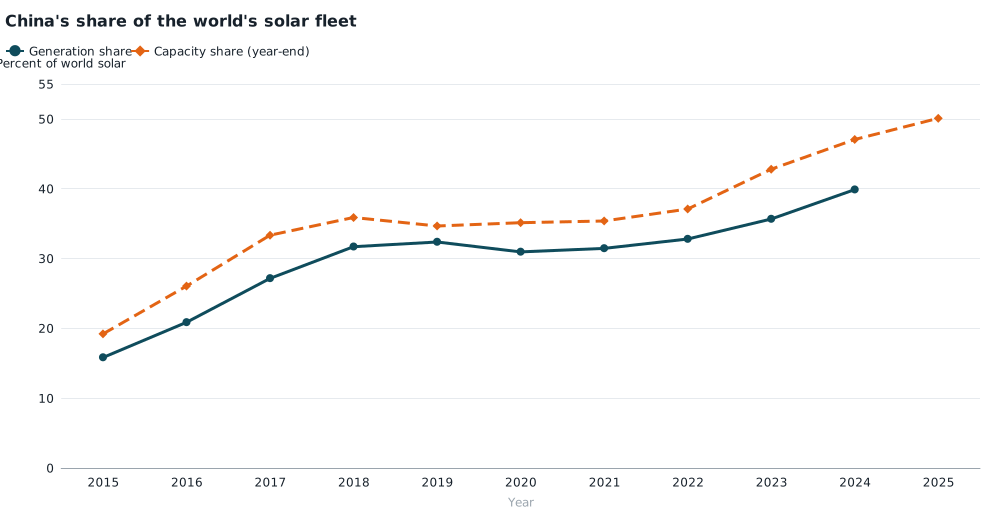
China's share of world solar electricity generation (2015–2024) and year-end solar capacity (2015–2025), percent. Generation compares China photovoltaic plus solar thermal with IRENA world solar-energy generation; capacity compares China photovoltaic with world solar-energy capacity. 2024 generation is preliminary. The series locate plants and output, not manufacturing. Source: IRENA IRENASTAT.
Politics & Policy
At the EU summit, Volodymyr Zelensky collected a pledge of ten Belgian F-16s and Ursula von der Leyen's vow that sanctions stay until Russia stops fighting — but no movement on frozen Russian assets, which Belgium won't unlock until Moscow compensates Ukraine. Donald Trump brands Zelensky 'more difficult to deal with than Putin' and calls the resumed refinery strikes 'a disgrace' — all after his diesel deal with Moscow eased sanctions. Per Reuters sources, the order limiting Ukraine's Starshield battlefield internet came from the White House, though Trump insists neither he nor Musk bears any blame.
The EU postponed its own budget reckoning to a 26 November summit over a two-camp standoff critics call 'a distribution of poverty', and sixteen member states back letting governments close borders and freeze asylum claims. The UN Security Council, meanwhile, failed its sixth secret vote to pick a secretary-general — every leading candidate drew vetoes.
Brazil delivered the week's rare upbeat policy news: Congress approved ending the six-day work week, cutting the maximum from 44 to 40 hours without pay cuts — 22 million workers currently exceed 40, per Dieese — and even Senator Flávio Bolsonaro flipped to yes. In the 'who funded this' file: Nvidia and Apple each put $25 million into the new White House ballroom, per internal reports obtained by The Washington Post.
Human Stories / Social Trends
India's Gen Z is testing the state's patience. The Cockroach movement, born from online satire after the chief justice likened the jobless to 'cockroaches', has analysts calling this Modi's worst crisis since 2014, and its founder was arrested as thousands of protesters were detained. The fuel is concrete: unemployment among graduates aged 15–25 runs near 40%. Protesters' mood is blunt: 'The fear in us is gone.'
In the occupied West Bank, Israeli settlers beat veteran Washington Post photographer Heidi Levine as she covered violence against olive farmers; the Foreign Press Association says they also stole her passport, phone and equipment — ten days after an AFP photographer needed hospital treatment doing the same job. On World Food Day, Gaza's health ministry reported 466 deaths from malnutrition and starvation since 2024, including 157 children. No quip available.
Europe's teenagers, meanwhile, discovered that budgets are fought over: school protests that began in France spread to Belgium via TikTok — an RTBF investigation found early calls flagged as AI-made — and Brussels then hosted a 50,000-strong union march. Students say that without a vote, the street is the only channel that gets answered. Lighter footnote: six people in a shared Latvian grave — four men, a boy, a girl — were relatives killed together in an apparent Viking attack.
Dates and sources
This digest covers the news day 2026-10-16. It is presented retrospectively from a saved draft; its date in the URL identifies the news day, not an assertion of publication on that day. News references link to their original outlets. Supporting research was completed 2026-10-17. Its data vintage and material limitations are recorded in the article methods and chart captions.