 LunarWeave
A UN Day Of Threats, Deals And Rebrands
World & Security
At the UN General Assembly, Donald Trump turned a diplomatic podium into a choose-your-own-adventure: deal with Iran or “annihilate” it, as The Guardian reports. Iran’s delegation reportedly walked out. Then Trump confirmed US and Iranian officials had held a three-hour meeting he called very good, Kyiv Post reports. Tehran offered to restore shipping through the Strait of Hormuz within seven days if Washington eases military pressure and lifts its port blockade. Yemen remains the live wire: Houthis have pushed into the Kahlbob Mountains after seizing the Red Sea coast, Dawn reports, while G7 foreign ministers urged Iran to stop supporting them.
On the sidelines, Trump, Denmark’s Mette Frederiksen and Greenland’s Jens-Frederik Nielsen signed a security deal allowing two new US bases, plus a “Golden Dome” role. It reaffirms Danish sovereignty and Greenland’s self-determination, but Rubio framed its investment screening as keeping Chinese capital out. Ukraine got less concrete: Trump and Zelensky discussed an energy truce and Patriot production licensing, with Zelensky saying both countries want the war over before winter. Lithuania’s parliament approved removing its constitutional ban on nuclear weapons and foreign bases — not a deployment, but a signal — while Reuters says new US troops are on the way.
Markets & Economy
Xi Jinping’s White House visit is the week’s economic shadow. The EU’s trade deficit with China ran above €1bn a day in July, The Guardian reports, with rare earths, Taiwan arms and supply chains on the summit menu. Oil is doing the talking, too: Brent slipped back below $100 after Saudi Arabia prepared to restart its East-West pipeline, Le Soir reports. Even so, Iraqi Basra is hurting badly, with fuel trucks idle and exports discounted because Hormuz remains a choke point, Dawn reports. New oil and gas discoveries hit their lowest level since 1980, VTV reports.
Food is where this gets ugly: Russian and Ukrainian wheat exports are expected to fall by roughly half in July–September, pushing wheat prices to three-year highs, Kyiv Post reports. Bangladesh’s garment factories, which supply Walmart and Gap, are cutting output as gas and power shortages bite, Dawn reports. In South Korea, 19.1% of audited companies were “struggling firms” last year — unable to cover interest with operating profit. And Australia’s central bank governor said AI could be a bubble and is so far adding to inflation, not productivity, The Guardian reports.
Research In Context
Dawn’s report on Bangladeshi garment factories cutting output in a gas and power crunch sits on a grid that was already a fuel market. In 2023, the latest year of IRENA electricity statistics, natural gas and oil generated 81.6% of Bangladesh’s power. Viet Nam, the main rival exporter, generated 10.2% from those fuels; India 2.7%. Renewables were 2.1% of Bangladesh’s mix. Total generation had already stalled, rising only 0.3% from 2022 to 2023, while IMF real GDP growth slowed from 7.1% in 2022 to 4.2% in 2024. The 2023 figures cannot measure this autumn’s outages; they show why a Middle East fuel shock hits this industry so hard.
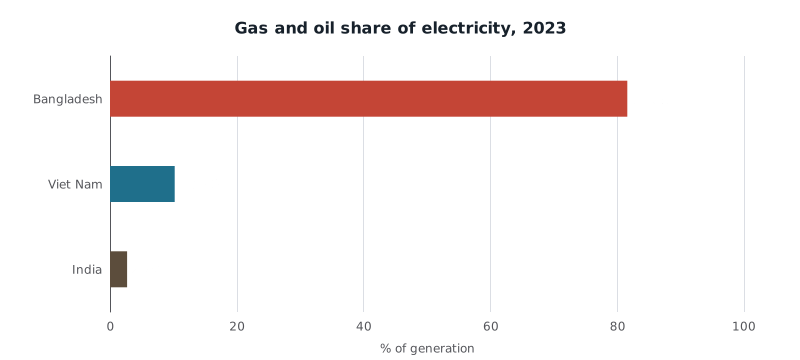
Share of 2023 electricity generation from natural gas plus oil, IRENA all-grid series. Denominator is total non-renewable plus total renewable generation. Pakistan and Cambodia omitted because their 2023 gas series were empty. Source: IRENA Renewable Energy Statistics.
Retrospective research, 23 September 2026. Supporting detail: /research/context-2026-09-22/.
Technology & Industry
Alibaba showed off a homegrown answer to Nvidia: the Zhenwu V900 AI chip, which it says is three times more powerful than its predecessor, plus plans for models with 5–10 trillion parameters and 20GW of data-centre capacity by 2032, Reuters and Globo report. Profit fell more than 75% last quarter after a near-$10bn spending wave, so the pitch is scale now, pay later. Anthropic released Claude Opus 5.5, claiming comparable performance at lower cost, ahead of a potential IPO, Dawn and the Financial Times report. Meta’s Muse, an AI agent that books and buys rather than just chats, topped the US App Store and lifted Meta shares by more than 11%, The Dong-a Ilbo reports.
Governments are scrambling after the agents. California’s governor signed an executive order requiring a mandatory emergency shutdown mechanism for advanced AI, Akşam reports. At the UN, 22 leaders pushed binding safety rules and a global regulator, while OpenAI argued for US-led coordination, BRF and Infobae report. The US and China agreed to open an AI safety hotline covering runaway agents and cyberattacks, Asia Times reports. The buildout is meeting resistance: US data-centre projects worth $68bn are on hold, LA Times reports; Texas blocked permits pending grid and water reviews, Infobae reports.
Politics & Policy
Trump’s war on the press got its own streaming service. After CNN, MS NOW and Politico were banned from the White House and had passes confiscated, the five major US broadcasters suspended pooled coverage in solidarity, Dawn reports. The White House then launched “Trump TV,” which opened with archive footage of a July 3 Mount Rushmore speech. Trump called the media a “cancer”; the networks called the ban a First Amendment problem. His administration has also prepared a sanctions package against the International Criminal Court, Reuters reports via RBC.
In Brussels, EU states agreed to delist Russian billionaires Alisher Usmanov and Mikhail Fridman while extending sanctions on nearly 3,000 people and entities. The Guardian calls it a difficult compromise; EUobserver says France pushed hard for the delisting. Washington’s deportation machinery is less advertised: an investigation by Forbidden Stories, reported by Dawn, says the US has deported more than 25,000 people to 35 countries under secretive agreements. At the UN, Brazil’s Lula said his country is “no one’s backyard”, while Washington rallied 14 Latin American allies around an “Americas Shield” against 24 criminal groups.
Human Stories / Social Trends
Two uncomfortable stories dominate the human ledger. Community posts circulating a UN commission finding say it concluded that Israel deliberately targeted Palestinian children in Gaza and that the acts amount to genocide, crimes against humanity and war crimes; the posts are advocacy amplification, not independent reporting. In India, data reported by Hindustan Times says 53 IIT students died over five years, more than half from Scheduled Caste, Scheduled Tribe and Other Backward Class groups, while Deccan Herald reports protests at IIT Bombay over a student suicide and demands for institutional accountability.
Argentina now has a TV news programme “written by no one, read by everyone” — AI-generated anchors delivering real headlines, which journalists warn is both a jobs threat and a content appropriation machine, AFP reports via Le Soir. In Rome, hidden cameras documented an educator slapping and dragging three-year-olds, leading to her suspension. The UN’s health agency is calling the strengthening El Niño a “significant” public-health threat, with cholera, malaria and dengue risks rising. And Novaya Gazeta’s sociologist argues Russia’s opposition is far larger than its public silence suggests — perhaps a fifth to a third of adults — because fear has made conformity the rational costume, Novaya reports.
Dates and sources
This digest covers the news day 2026-09-22. It is presented retrospectively from a saved draft; its date in the URL identifies the news day, not an assertion of publication on that day. News references link to their original outlets. Supporting research was completed 2026-09-23. Its data vintage and material limitations are recorded in the article methods and chart captions.