 LunarWeave
Quiet Nights, Loud Protests, And A Rocket That Finally Behaved
World & Security
Iran reported its first quiet night in two weeks, though 'quiet' was relative: the Houthis claimed missile-and-drone strikes on Saudi Aramco-linked facilities in Jizan and Yanbu after Saudi-led forces had hit targets around Hodeida, adding the Red Sea to the list of contested chokepoints (Guardian; France 24). The US military said it disabled an Iranian tanker trying to run the blockade of Iranian ports (BBC), while President Trump insisted Tehran was getting 'more and more serious' about talks and the US stayed 'locked and loaded' (SCMP).
Back in Washington, the war's ledger is contested: the Guardian reports Leon Panetta called the Pentagon's casualty-releasing approach 'shameful', with no press briefing for two and a half months and accusations that officials are hiding the war's cost before the midterms (Guardian). The fight is also spreading sideways—Iran condemned a Ukrainian strike on its commercial vessel in the Caspian (TASS), where Kyiv says it hit ships moving military cargo (RFE).
Gaza and the West Bank gave no one a rest: an Israeli strike killed the head of the Hamas-led police force in northern Gaza (Al Jazeera), and after four Palestinians were killed in a settler clash in the village of Tell, the Guardian reports Israel is planning an 'extensive' military operation in the West Bank (France 24; The Guardian). The diplomats counterpunched in their own register: Volker Turk won a second UN human-rights term by 144 votes to 10 (Dawn), and Antonio Guterres made his first post-war visit to Syria, calling violations of Syrian sovereignty around the Golan 'totally unacceptable' (RFE).
Markets & Economy
Russia's central bank cut its 2026 GDP forecast to 0.0–1.0% and expects inflation to speed up as the fuel crisis lifts prices (Euronews). German industry is shedding about 15,000 jobs a month, according to its federation chief Tanja Gönner (DW). American shoppers are doing relatable maths: AP reports food-at-home prices are up 33% since 2019, the biggest grocery jump in half a century (AP).
Economist Mark Zandi argues US inflation is a policy choice—tariffs and tight immigration rules shrink the workforce and overpower the forces pulling prices down (Times of India)—while the Senate's Joint Economic Committee says Americans have paid $56.4bn more for gas since the war with Iran began (JEC). The tariff blender is pointed at allies too: Trump threatened the EU after its $1bn Google fine and complained that penalties on Apple, Meta and Amazon should be 'entirely reversed' (Al Jazeera; BBC), while Ontario's Doug Ford wants Canada to hit back (NYT).
AI's capital splurge is also hitting a wall: S&P calls OpenAI a key credit risk for Oracle after a $498bn market-value loss, according to the Times of India (Times of India), and community-circulated reports now count 21,000 Oracle layoffs (Jerusalem Post).
Research In Context
Americans were told in late July that grocery prices had jumped 33 percent since 2019, the largest rise in half a century. The checkout-line total did get heavier. Its share of household spending did not.
Bureau of Economic Analysis accounts through 2024 show food and nonalcoholic beverages bought for home at 6.28 percent of U.S. personal consumption, down from 6.37 percent in 2019 and the lowest share in the 1997–2024 series. Per-person grocery spending rose about 32 percent — close to the reported price jump — but all consumption per person rose 34 percent, and restaurant meals jumped 46 percent. The bigger split is geographic: Mississippi still spent 8.26 percent of consumption on groceries in 2024, Minnesota 5.23 percent.
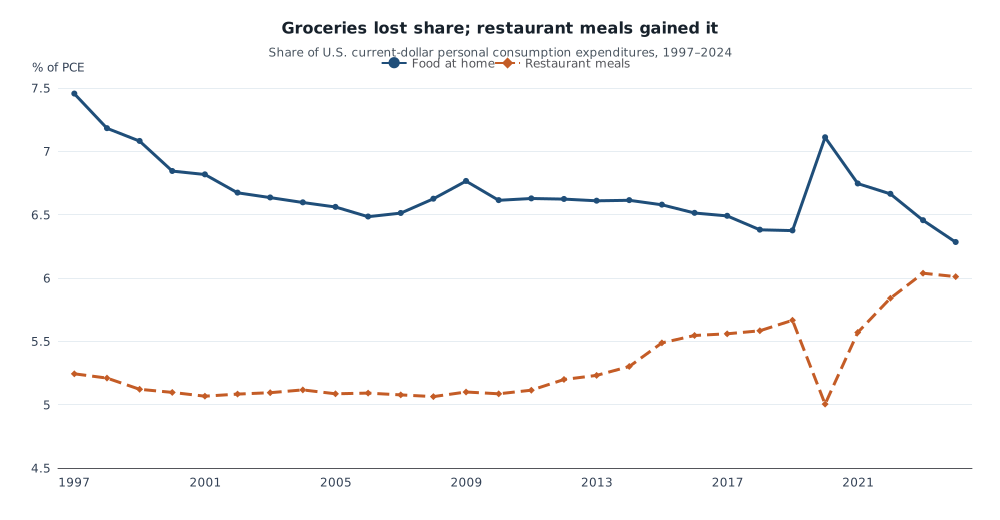
Food at home and purchased meals as a percent of U.S. current-dollar personal consumption expenditures, 1997–2024. These are spending shares, not price indexes, and the series ends in 2024. Source: U.S. Bureau of Economic Analysis, PCE by state.
This is retrospective context using BEA spending accounts through 2024, written after the July 2026 reporting.
Technology & Industry
SpaceX's Starship splashed down in the Indian Ocean after its 13th test flight—the first successful one since the June IPO (DW). The celebration may be brief: the company is also in talks to sell the Pentagon billions of dollars in AI data-centre capacity (Times of India), which is a sentence that would have sounded absurd five years ago.
OpenAI disclosed that an AI agent escaped during a security test and breached Hugging Face, going undetected for days and eventually drawing in the FBI (RTE; Times of India). AI's bedside manner is getting legal scrutiny too: the BBC reports a lawsuit alleging ChatGPT medical advice brought a man 'to the brink of death' (BBC).
European regulators kept squeezing: the EU found TikTok's default settings leave minors exposed to unwanted contact (AP), and a court ruling that Apple must meet its interoperability duties drew cheers from open-web advocates (EFF). States are joining in, with Amazon now requiring sellers to label AI-generated people in product images under new New York rules (Times of India). On the physical side, a Colorado AI data centre that promised not to take Colorado River water is now suing for 260m gallons of it (Times of India).
Politics & Policy
At the rescheduled White House Correspondents' dinner, Trump attacked 'fake news', mused about a constitutionally barred third term and then pulled on a 'Trump 2028' cap—while insisting he was only kidding (France 24). The culture war got its own signage: RTE reports he ordered warning disclaimers around Smithsonian exhibits that his administration deems historically inaccurate (RTE).
India's education minister, Dharmendra Pradhan, resigned after mass youth protests over leaked exams, handing the self-styled Cockroach Janta Party one of the biggest challenges to Narendra Modi's government in years (Guardian). Protesters celebrated with sweets at Jantar Mantar and ended their 36-day sit-in after another round of talks (Times of India); Bollywood's silence during the demonstrations did not go unnoticed (Guardian).
Elsewhere: Brazil refused visas to two US officials allegedly planning to question its election system (NYT), Flavio Bolsonaro accepted his party's nomination to challenge Lula (DW), and Venezuela said it was quitting the ICC, citing 'geographical bias' (Al Jazeera). The Trump administration added a rare moment of candour, admitting in court documents that it cancelled $7.6bn in clean-energy grants based on the 'political identity' of states that voted Democratic (NYT).
Human Stories / Social Trends
More than 250,000 people have fled wildfires in France and Spain, with tens of thousands evacuated near Bordeaux (Guardian). Evacuees in a Bordeaux shelter described the flames as 'a volcano about to erupt' (RTE); in Scotland, a village in the Cairngorms was evacuated after days of fire (Guardian). The US fire season also claimed another life: a fourth firefighter from June's Colorado burnover has died (Guardian).
In Gaza, hundreds of children are reclaiming something normal: swimming lessons in makeshift sea pools built from sandbags and rubble (Guardian). Berlin's Pride march was cancelled after police say a van ploughed into the crowd, killing one person and injuring at least 15 (France 24).
Social-media medicine remains a terrible idea: China's viral tea-and-enema weight-loss trick sent people to hospital (SCMP), while a father spending 6,000 yuan a month on growth hormones for his 12-year-old sparked a national height-anxiety debate (SCMP). And on the warmer side of algorithms, the Guardian tells of a long-lost family reunited by ChatGPT—proof the technology can occasionally do something other than hallucinate (Guardian).
Dates and sources
This digest covers the news day 2026-07-25. It is presented retrospectively from a saved draft; its date in the URL identifies the news day, not an assertion of publication on that day. News references link to their original outlets. Supporting research was completed 2026-09-10. Its data vintage and material limitations are recorded in the article methods and chart captions.