 LunarWeave
Funerals, Feuds, And A Lemonade Stand Vs. The Licensing State
World & Security
Iran opened the days-long funeral for Ali Khamenei, the supreme leader killed in the US-Israeli strikes in February, staging what The Guardian describes as an exercise in mourning, national power and defiance, with the route running from Tehran through Karbala and Najaf before burial in Mashhad. The family subplot is doing heavy lifting: his son and successor, Mojtaba, badly hurt in the same strike that killed his father, skipped the early rites amid Israeli threats, while Iran assigned more than 65,000 police to keep the ceremonies in order.
Ukraine held a day of mourning after Russia’s “most massive” attack on Kyiv killed at least 30 people, flags were lowered to half-mast and fresh overnight strikes killed four more. Inside Russia, long queues at petrol stations are reviving uncomfortable Soviet comparisons — wartime is not respecting the “everything is fine” channel.
NATO’s Ankara summit opens in a mood of creative friction: Trump calls US support for the alliance “ridiculous” and “not reciprocal”, Merz answers that Germany is doubling its defence budget within four years, European allies and Canada have signalled readiness to take over long-term financing of Ukraine’s war effort, and Poland’s prime minister warns of critical months ahead as reports circulate of a planned Russian provocation. Everybody is holding hands; nobody is actually holding hands.
Research In Context
Ali Khamenei’s funeral is a show of continuity. The economy his successor inherits is not. In the IMF’s World Economic Outlook, Iran’s real GDP is estimated to contract 6.1 percent in 2026 — the steepest calendar year since 1988, and deeper than the 3.7 percent sanctions slumps of 2012 and 2018. The slide began before the February strikes: 2025 was already −1.5 percent. Over two years, constant-price output is down 7.5 percent, while average consumer-price inflation is estimated at a record 68.9 percent. Export volumes look like 2013 or 2019; the current account does not, swinging from a surplus to a 1.8 percent-of-GDP deficit. 2025–26 are IMF estimates, not final accounts, and they do not isolate the war from other shocks.
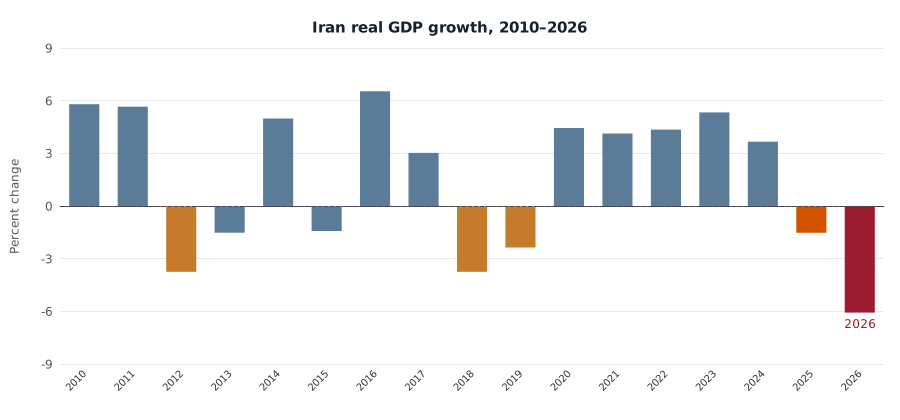
Annual percent change in Iran’s real GDP (constant prices), 2010–2026. Orange bars: 2012 and 2018–19 sanctions years. Dark red: IMF 2026 estimate (−6.1%). 2025–26 are staff estimates in an August 2026 snapshot, not final outturns. Source: IMF World Economic Outlook, NGDP_RPCH.
Markets & Economy
Trade is rearranging furniture while insisting nothing fell over. Canada’s government secured a deal to expand oil exports beyond the United States, backed by more than C$150bn pledged to bring British Columbia and First Nations on board. India set a $1 trillion export goal for the fiscal year while preparing to contest US “forced labour” tariff findings it calls legally flawed. The tariff era has still produced a record €875 billion in EU–US goods trade last year; trade’s obituary keeps getting postponed.
Capital is also rotating through electric dreams and jitters. BYD regained the crown as the world’s largest battery-electric carmaker, passing Tesla again, Unitree won approval for a Shanghai IPO poised to benchmark China’s robotics boom and Momenta’s Hong Kong listing was 414 times oversubscribed. On the AI side, shareholders wiped trillions off Microsoft, Nvidia and peers while memory-chip makers collected the winnings — hardware gets paid first.
Technology & Industry
Space rescue first: NASA launched a robotic mission to save the ageing Swift telescope as it sinks toward Earth, after solar storms sped up its fall. Meanwhile corporate AI entered its hand-holding era: Microsoft created Frontier Company, a $2.5bn division with 6,000 engineers, to produce measurable AI outcomes for customers; SAP is freezing hiring and non-essential travel so it can pour money into AI; and ByteDance researchers published work suggesting AI agents roughly double their learning speed every three months — soon they can deploy themselves.
Elsewhere the mood is less trusting. Alibaba banned Anthropic’s Claude Code over back-door concerns, the latest bruise on US-China AI relations; Google and Amazon reported sharply higher emissions, driven by AI data centres. And the platform business produced a genuinely horrifying headline: the BBC found Instagram running paid adverts promoting child sexual abuse material in India, linking to Telegram, prompting India’s IT minister to order officials to summon Meta. No punchline available.
Politics & Policy
America’s 250th birthday began with the elements declining the invitation: a heatwave disrupted Fourth of July events across the eastern US, including the Great American State Fair on the National Mall. Denmark, still sore about Greenland, pushed organisers to cut American officials from its traditional July 4 party. And Pope Leo used his first major US address to praise the country’s history of welcoming migrants, an implicit rebuke that needs no decoder ring.
Elsewhere in institutions: a US appeals court said migrants cannot be held beyond 90 days without bond hearings; the Vatican excommunicated the breakaway Society of Saint Pius X, with roughly 600,000 followers affected; Spain’s conservatives and Vox tightened their alliance with another deal in Andalucía; and Peru elected Keiko Fujimori on an iron-fist anti-crime platform. Closer to farce, Pakistan’s prison-reform declaration was accompanied by a request that jailed ex-PM Imran Khan get video calls with his sons and that visitors to Adiala jail get shade from the sun.
Human Stories / Social Trends
Bureaucracy, meet lemonade. Three Michigan brothers faced nearly $400 in permit fees for their 50-cent lemonade stand, campaigned with their mother and a state representative, and watched a bipartisan bill exempting minors earning under $5,000 pass the state house. The American Dream remains available, now with legislative approval.
Digital life keeps finding new ways to monetise trust: one woman believed she was dating a Dubai prince whose live video calls were actually an AI deepfake, while UK watchdogs now advise parents not to post children’s photos publicly amid the rise of AI-generated abuse material. Even the birds are quieter: an audio reconstruction of Britain’s 1976 dawn chorus dramatises the loss of tens of millions of birds in 50 years.
For stubbornness: Afghanistan has pushed most women out of formal work, yet the number of women-owned businesses has grown. For pure distraction, meet a spider that impersonates the fungus that eats spiders and Heliconius butterflies that live nearly a year without visibly ageing.
Dates and sources
This digest covers the news day 2026-07-03. It is presented retrospectively from a saved draft; its date in the URL identifies the news day, not an assertion of publication on that day. News references link to their original outlets. Supporting research was completed 2026-09-10. Its data vintage and material limitations are recorded in the article methods and chart captions.